
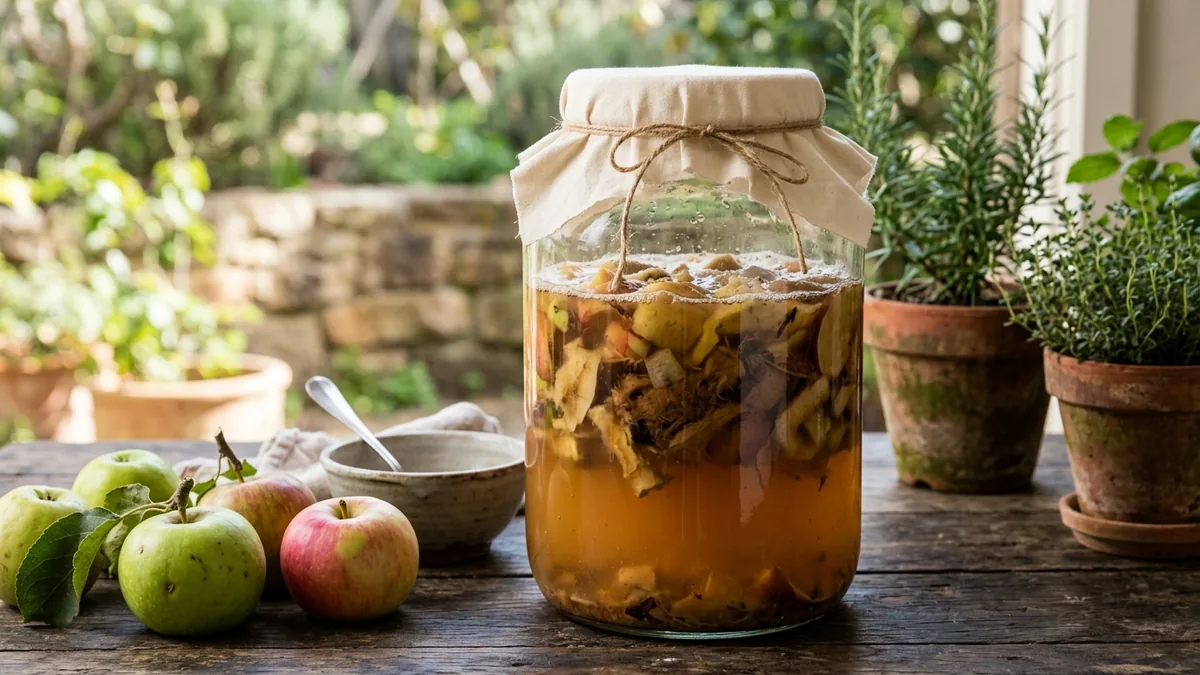
How to Make Apple Cider Vinegar at Home
Updated June 2026
From apple scraps or juice, the two fermentation stages, the mother, and how to keep it safe.
Apple cider vinegar is one of the easiest and most satisfying things you can make from the orchard or the fruit bowl. It turns peels and cores that would otherwise go to the compost into a useful pantry staple, and it costs almost nothing. A jar of scraps, a little sugar, water and time is all it takes.
Apple cider vinegar is simply apple liquid that has fermented twice. First yeast turns the natural sugars into alcohol, then a group of bacteria turns that alcohol into acetic acid, the sour compound that makes vinegar a vinegar. This page walks you through both routes, both stages, the famous mother of vinegar, how to tell it apart from mold, and how long the whole thing takes.
Scrap Vinegar Calculator
Making vinegar from apple scraps? Enter how many cups of water you are using and this works out roughly how much sugar to dissolve in it for stage one. The rule of thumb is about 1 tablespoon of sugar per cup of water.
So 4 cups of water needs about 4 tablespoons of sugar (roughly 50 grams). Loosely fill your jar about half to two thirds full with apple scraps, then pour the sweetened water over to cover them.
Two routes: scraps or juice
There are two starting points, and both end up in the same place.
From apple scraps
This is the thrifty method. Save the cores and peels from a baking session, or use whole apples roughly chopped. Pack them loosely into a clean wide-mouth glass jar until it is about half to two thirds full, then cover with sweetened water using the calculator above. The sugar feeds the yeast that does stage one, since the scraps alone do not carry enough juice. Weigh the scraps down so they stay under the liquid, cover with breathable cloth, and stir daily.
From hard cider or apple juice
If you already have apple juice or, better still, hard cider that has fermented to alcohol, you can skip toward stage two. Pure unfiltered apple juice with no preservatives will first ferment to a rough cider on its own, then sour into vinegar. Cider that is already alcoholic just needs acetic acid bacteria and air to turn. Avoid juice with added preservatives such as sodium benzoate or potassium sorbate, since those are designed to stop the very fermentation you want.
The two fermentation stages
Every batch of apple cider vinegar goes through two distinct stages. Understanding them makes the whole process much easier to read.
Stage one: sugar to alcohol
Wild or added yeast eats the sugars in the apple liquid and produces alcohol and carbon dioxide. This stage is mostly anaerobic and bubbly. Cover the jar with a breathable cloth and a rubber band, keep it at room temperature out of direct sun, and stir daily to keep the scraps wet and discourage surface growth. You will see bubbles, smell something fruity and slightly beery, and the mix will start to fizz. This usually takes 1 to 2 weeks for juice, or up to a few weeks for a scrap mix.
Stage two: alcohol to acetic acid
Now acetic acid bacteria, called acetobacter, take over. These bacteria need oxygen, so this stage must stay loosely covered with cloth, never sealed. They convert the alcohol into acetic acid, which is what makes vinegar sour. Once stage one settles, strain out the scraps, return the liquid to a clean jar, cover with cloth, and wait. This stage runs several weeks to a few months. A mother of vinegar often forms on the surface during this time.
The mother of vinegar
The mother of vinegar is the cloudy, gelatinous mat that forms on the surface of a fermenting batch. It is built from cellulose produced by the acetic acid bacteria, with the bacteria living in and on it. It is completely harmless and is a good sign that your vinegar is working.
A mother looks like a smooth, slightly slimy, flat film or a jelly-like disc. It can be pale, cream or slightly tan, and it may float on top or sink as it gets heavier. You can leave it in the jar, eat it, or lift it out with clean hands to start your next batch faster. Stored in a little vinegar at room temperature, a mother will keep for months.
The mother is often confused with mold, but they are very different, and telling them apart is the single most important safety skill here.
Mother vs mold: know the difference
This is the part to read twice. The mother is your friend. Mold means the batch is finished.
| What you see | Mother of vinegar (keep it) | Mold (discard the batch) |
|---|---|---|
| Texture | Smooth, flat, slightly slimy or jelly-like | Fuzzy, raised, hairy or powdery |
| Shape | An even film or disc across the surface, or a sunken blob | Round spots or patches, often growing upward |
| Color | Pale, cream, white or tan, even and translucent | Black, blue, green, pink, or fuzzy white spots |
| Smell | Clean, sharp vinegar smell | Musty, rotten, off, or like solvent |
| What to do | Leave it, or reuse it for the next batch | Throw the whole batch out, jar contents and all |
How long it takes
Home vinegar runs on its own clock, and temperature is the biggest dial. Warmer rooms speed it up, cooler rooms slow it right down.
- Stage one (sugar to alcohol): roughly 1 to 2 weeks for juice, up to about 3 weeks for a scrap mix.
- Stage two (alcohol to acetic acid): roughly 3 to 6 weeks and often longer, sometimes a couple of months.
- Whole process: commonly two to three months from scraps to finished vinegar.
Start tasting from about 3 to 4 weeks into stage two and keep tasting weekly. Stop when it is as sour as you like. The longer it sits, the sharper it gets.
How to know it is ready
Use your senses, in this order.
- Smell. Finished vinegar smells of sharp, clean vinegar. A nail-polish or acetone note means it needs more air and more time. A rotten or off smell means something has gone wrong.
- Taste. It should taste pleasantly sour with no harsh alcohol burn. If it still tastes boozy, stage two is not finished.
- pH (optional). Finished home vinegar usually sits around pH 2.5 to 3.5. If you have test strips, aim for under about 3.5. Commercial vinegar is standardized to around 5 percent acidity, but home vinegar varies and its acidity is not guaranteed.
When it tastes right, strain it, bottle it in clean glass, and store it sealed. It keeps for a long time. You can pasteurize it gently, around 160F (70C) for a few minutes, to stop further fermentation, though most home cooks simply leave it raw.
Staying safe
Apple cider vinegar is a forgiving ferment, and a few simple habits keep it that way.
- Use clean jars and utensils, and clean hands when handling the mother.
- Use glass or food-grade plastic for the vinegar, never reactive metal. Acetic acid corrodes aluminum, copper and bare cast iron, which can taint the vinegar and leach metal into it.
- Keep the scraps and the mother below the liquid line. Anything sitting dry above the surface can grow mold.
- Cover with a breathable cloth and a rubber band. This lets oxygen in for stage two while keeping fruit flies, dust and debris out.
- Keep the jar at room temperature and out of direct sun.
- Discard the whole batch at the first sign of fuzzy mold or a rotten smell.
Using your vinegar
In the kitchen
- Dressings. Whisk with good oil, a little mustard and honey for a bright salad dressing.
- Switchel. Mix a spoonful with water, honey or maple, and grated ginger for an old-fashioned thirst quencher.
- Marinades. The acid tenderizes and adds tang to meat and vegetable marinades.
- Deglazing. A splash lifts the browned bits from a pan and sharpens a sauce.
In the garden
- Acid-loving plants. Heavily diluted, a very weak vinegar solution is sometimes used as an occasional feed for acid-loving plants, but use it sparingly and with caution, since too much will harm soil and roots.
- Cleaning pots. Diluted vinegar helps remove mineral and salt crust from terracotta pots.
- Fruit-fly trap bait. A little vinegar in a covered cup with a few holes makes a simple fruit-fly trap.
Be responsible with vinegar in the garden. It is not a reliable weedkiller at household strength, and pouring it freely onto soil acidifies it and can damage plants and soil life. Always dilute heavily and aim it carefully.
Best time to make it
The natural season is fall, when apples are abundant and cheap. You can make vinegar any time of year, though. A warm room speeds fermentation along, while a cool room slows it down, so adjust your patience to the season. In a hot Southern summer you might be done in weeks, while a cool Northern winter can stretch it out for months.
Track your preserving loop
Log your apple harvest, your scraps and your vinegar batches in the Planting Season app, and close the loop from orchard to pantry to compost.
Open the App →Common questions
How long does it take to make apple cider vinegar?
The scrap method usually takes about 3 to 6 weeks for stage one, where sugar ferments to alcohol, then a further 3 to 6 weeks or more for stage two, where alcohol turns to acetic acid. All up that is roughly two to three months, though warm rooms speed it up and cool rooms slow it down. Start tasting from about 3 to 4 weeks into the second stage and stop when it is pleasantly sour.
Is the mother of vinegar safe?
Yes. The mother of vinegar is a harmless mat of cellulose and acetic acid bacteria that forms on the surface of fermenting vinegar. It looks like a cloudy, gelatinous, smooth disc or film, sometimes pale or slightly tan. It is a sign your ferment is working well, you can leave it in, and you can lift it out to start a new batch faster.
Why does my apple cider vinegar smell like nail polish?
A sharp solvent or nail-polish (acetone) smell usually means the ferment is mid-way between alcohol and vinegar, or that it lacks oxygen. Make sure the jar is covered with breathable cloth, not a sealed lid, give it a gentle stir to add air, keep it at room temperature, and give it more time. The smell normally settles into a clean, sharp vinegar aroma as stage two finishes.
Can I use homemade apple cider vinegar for canning or pickling?
Not unless you have tested its acidity. Safe water-bath canning and pickling rely on a guaranteed acidity of around 5 percent. Homemade apple cider vinegar varies in strength and is not standardized, so use commercial vinegar of known acidity for any canning where safety depends on the acid level. Enjoy your homemade vinegar in dressings, marinades and cooking instead.
Do I need a starter to make apple cider vinegar?
No. You can make it from scratch, since wild yeasts and acetic acid bacteria are present on apple skins and in the air. Adding a splash of raw, unpasteurized apple cider vinegar that contains the mother, or a piece of an existing mother, will speed things up and make a reliable result more likely, but it is not essential.
Can I reuse the mother of vinegar?
Yes. Lift the mother out with clean hands or a clean utensil and drop it into a new batch of cider or sweetened apple liquid to kick-start stage two. Stored in a jar of vinegar at room temperature, a mother will keep for months and can be used again and again.
Why is my apple cider vinegar not getting sour?
Stage two needs oxygen, warmth and time. If it stays flat and alcoholic, the most common causes are too little air (use a wide jar covered with cloth, not a lid), temperatures that are too cool, or simply not enough time. Give it a stir, move it somewhere warmer and out of direct sun, and wait. It often takes several weeks to a few months to turn fully sour.
Is the white film on my vinegar mold or the mother?
A smooth, flat, slightly slimy film or a gel-like disc on the surface is the mother of vinegar, which is harmless and good. Mold is different. Mold is fuzzy and raised, often in spots, and can be black, blue, green, pink or fuzzy white. If you see fuzzy raised growth or it smells rotten or of solvent, throw the whole batch out.
Source: university extension home food preservation guidance on vinegar making and fermentation safety.
Related guides
See what to plant this month
Pick your region for a month-by-month calendar tuned to your climate.
Find your region →