
How to Brew Kombucha and Water Kefir at Home
Updated June 2026
Cheap, fizzy, homemade ferments. SCOBY basics, first and second ferment, a batch calculator, and how to brew safely.
Brewing your own fizzy drinks is one of the most rewarding corners of the homestead. A jar of sweet tea, a culture, and a week or two on the counter turns a few cents of sugar into gallons of kombucha that would cost a small fortune at the store. Water kefir is even faster and gentler. Both fit neatly alongside the garden, the worm bin and the canning shelf, closing another loop in a self-reliant kitchen.
This guide covers both drinks from scratch. You will learn what a SCOBY is and where to get one, how to run the first and second ferments, what gear you need, and the small handful of safety rules that keep your brew clean and your bottles from over-pressurizing. Use the batch calculator to scale a recipe to any jar size, then taste your way to the flavor you like.
Kombucha Batch Calculator
Enter your finished batch size in liters and we will work out the tea, sugar and starter tea to begin. As a rough guide, 1 quart is about 0.95 L and 1 gallon is about 3.8 L.
Please enter a batch size greater than zero.
| Black or green tea | |
| White sugar | |
| Starter tea (mature kombucha) | |
| Batch volume | |
| SCOBY |
These are starting-point ratios, roughly 1 tea bag (about 5 g loose tea), 70 g sugar and 100 ml starter tea per liter. Adjust to taste over a few batches. You always use one SCOBY per brewing vessel, whatever the size.
Meet the SCOBY
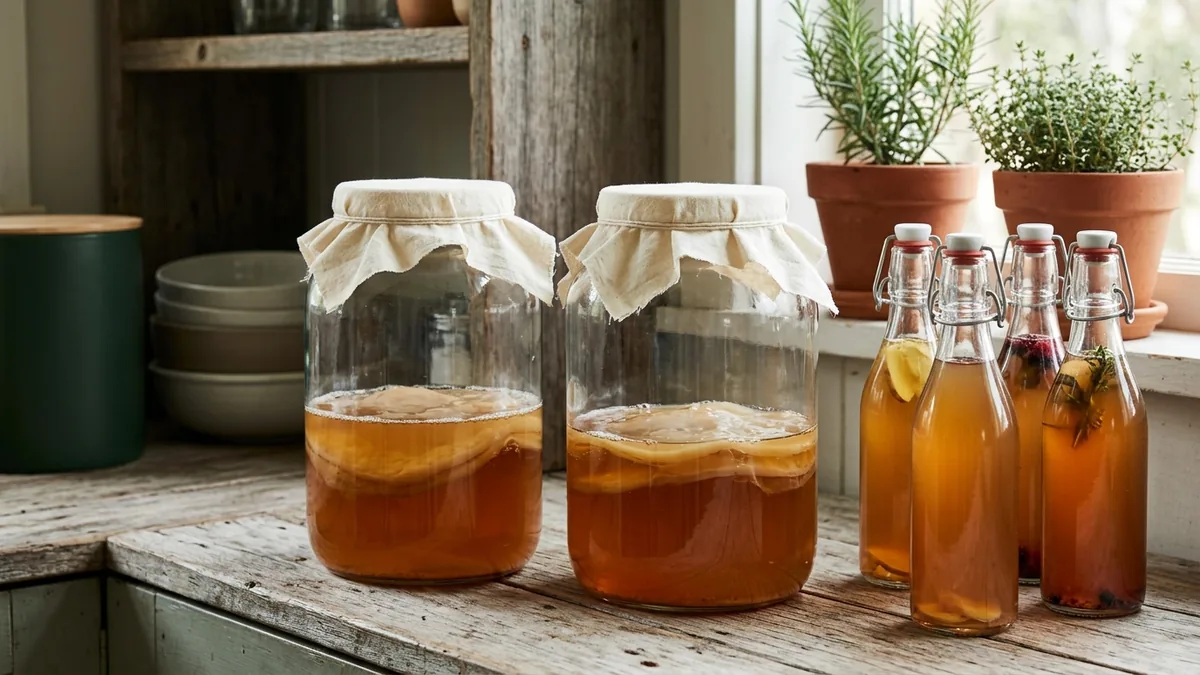
SCOBY stands for Symbiotic Culture Of Bacteria and Yeast. It is the living engine of kombucha. In the jar it looks like a pale, rubbery, pancake-shaped disc that floats on top of the tea. That disc is a cellulose pellicle the culture builds as it works, and it grows a fresh layer with every batch, so over time you build up spares to share.
The SCOBY almost always comes packed in a cup or two of mature, sharply acidic kombucha called starter tea, and that starter is just as important as the disc itself because it drops the acidity fast and protects the brew while it gets going. The easiest way to get one is from a friend who brews. You can also buy a SCOBY with starter from a fermenting supplier, or grow your own from a bottle of raw, unflavored, unpasteurized kombucha left in sweet tea for a couple of weeks until a new pellicle forms across the surface.
The First Ferment (1F)
The first ferment is where plain sweet tea becomes kombucha. The recipe is simple and the calculator above scales it to your jar.
- Brew sweet tea. Steep black or green tea, stir in the sugar until it dissolves, then let the tea cool to room temperature. Hot tea will kill the culture, so this step matters.
- Add the culture. Pour the cooled sweet tea into a clean glass jar, add the SCOBY and all of its starter tea.
- Cover and wait. Cover the jar with a tight-weave cloth held on with a rubber band, which keeps fruit flies and dust out while letting the brew breathe. Stand it somewhere out of direct sun at normal room temperature, roughly 64 to 79F (18 to 26C), for about 7 to 14 days.
As it ferments, the culture eats the sugar, the drink gets less sweet, and the acidity rises. Start tasting from about day 7 by dipping a clean straw past the SCOBY and drawing up a little brew. It is ready when it is pleasantly tart with just a touch of sweetness left. Leave it longer for a sharper, more vinegary brew.
The Second Ferment (2F) for Flavor and Fizz
The first ferment gives you kombucha, but the bubbles and flavor come from the second ferment. This is where it gets fun.
- Bottle the finished kombucha into strong, airtight bottles, leaving the SCOBY and about 100 ml of brew per liter behind to start your next batch.
- Add a little flavor to each bottle, such as a spoon of fruit, a splash of juice, or a few slices of fresh ginger. The small amount of sugar in the fruit is what feeds the carbonation.
- Seal the bottles and leave them at room temperature for 1 to 3 days. In a sealed bottle the culture keeps working and traps the carbon dioxide it makes, building real fizz.
- Refrigerate. Chilling slows the ferment right down and locks in the bubbles. Always open over a sink.
Timing and Taste
Kombucha is a moving target, and that is the appeal. Early in the first ferment it is sweet and mild. As the days pass it gets drier, sharper and more sour as the culture converts the sugar. Warmth speeds everything up, so a brew that takes 8 days in a warm room might take two weeks in a cool one. Taste often, trust your own palate, and write down how many days gave you the flavor you liked so you can repeat it.
Equipment You Need
- A brewing vessel. A wide-mouth glass jar (a half-gallon or gallon jar is ideal) or a food-grade plastic container. Glass is the classic choice and lets you watch the brew.
- A breathable cover. A tight-weave cloth or paper towel and a rubber band. Avoid loose-weave cloth that lets tiny flies through.
- Plastic or wooden utensils. Use these for stirring and lifting the SCOBY in preference to metal.
- Strong airtight bottles for the second ferment. Swing-top or flip-top bottles are made for carbonation and are the safest choice.
Brewing Safely and Responsibly
Home fermenting is very safe when you respect a few basics. The acidity of kombucha is itself a strong defense, because most spoilage organisms cannot survive in it, which is exactly why your starter tea matters so much.
- Clean all gear well. Wash everything in hot soapy water and rinse thoroughly. Avoid antibacterial cleaners that can leave a residue and harm the culture.
- Keep the brew acidic and covered. Always include enough starter tea so the brew acidifies quickly, and keep the cloth on to keep contaminants out.
- When in doubt, throw it out. A healthy culture is forgiving, but a bad batch is not worth the risk.
Signs you must discard the batch
What is normal and not mold
Plenty of harmless things look alarming the first time. The following are all normal: brown stringy bits or strands floating in the brew or hanging from the SCOBY, bubbles and foam, sediment at the bottom, and a new thin pale layer slowly forming across the top. These are signs of a healthy, working culture, not mold.
Fizz and bottle pressure
Who should be cautious
Home-brewed kombucha is unpasteurized, mildly acidic, and contains a small amount of caffeine and a trace of alcohol from fermentation. For most healthy people in moderate amounts it is fine, but people who are pregnant, immunocompromised or sensitive to acidity should be cautious and check with a health professional first. Brew it for enjoyment and gut-friendly fizz, and avoid making exaggerated health claims about it.
Water Kefir
Water kefir is the easy-going cousin of kombucha. Instead of a tea-based SCOBY disc, it uses water kefir grains, which are small, translucent, gel-like clusters that look a little like soft crystals. They are a different culture, they multiply as they work, and they ferment far faster than kombucha.
- Make sugar water. Dissolve about a quarter cup of sugar in 1 liter (about 1 quart) of water. You can add a small piece of dried fruit and a tiny pinch of a mineral source such as unsulfured molasses to feed the grains.
- Add the grains and ferment. Drop in the water kefir grains, cover loosely, and leave at room temperature for 24 to 48 hours.
- Strain and reserve. Strain out the grains using a plastic or nylon sieve rather than reactive metal, and set the grains aside to start your next batch.
- Optional second ferment. Bottle the strained liquid in sealed bottles with a little fruit or juice and leave 1 to 2 days at room temperature for fizz, then refrigerate.
Water kefir is faster and milder than kombucha, with little or no caffeine, and the grains keep growing so you can share them. The same rules apply: discard any batch that grows fuzzy mold or smells off, and treat sealed bottles with the same pressure caution as kombucha.
Kombucha vs Water Kefir at a Glance
| Feature | Kombucha | Water kefir |
|---|---|---|
| Base | Sweetened black or green tea | Sugar water (plus optional dried fruit) |
| Culture | SCOBY disc plus starter tea | Translucent gel-like grains |
| First ferment | About 7 to 14 days | About 24 to 48 hours |
| Second ferment (fizz) | 1 to 3 days, sealed | 1 to 2 days, sealed |
| Flavor | Tart, tangy, vinegary edge | Light, mild, lemonade-like |
| Caffeine | Some, from the tea | Little or none |
Season and Temperature
Temperature, not the calendar, sets the pace. Warm rooms ferment faster and cool rooms slower, so a brew that is ready in a week through a warm Southern summer can take two weeks or more in a chilly Northern winter. In the colder months find the warmest steady spot in the house, such as on top of the refrigerator or in a cabinet near the kitchen, and expect to wait a little longer. Whatever the season, taste to decide when it is done rather than counting days alone.
Track your ferments
Log your kombucha and water kefir batches in the Planting Season app alongside your garden and preserving, and keep your whole homestead routine in one place.
Open the App →Common questions
Is the white or brown stuff on my kombucha mold?
Usually not. Brown stringy strands, bubbles, sediment at the bottom, and a new pale jelly-like layer forming across the top are all normal signs of a healthy ferment. Mold is different. It is dry, fuzzy and raised, appears as spots of green, blue, black or white fluff sitting on top of the SCOBY, and looks like mold on bread. If you see fuzzy mold, discard the SCOBY and the whole batch and start again with fresh gear.
Where do I get a SCOBY?
The easiest way is from a friend who brews, because a healthy SCOBY grows a new layer every batch and brewers usually have spares. You can also buy a SCOBY with starter tea from a fermenting supplier, or grow your own from a bottle of raw, unflavored, unpasteurized kombucha left in sweet tea for a couple of weeks until a new pellicle forms.
How long does kombucha take to brew?
The first ferment usually takes about 7 to 14 days at normal room temperature. Warmer rooms ferment faster and cooler rooms slower. Start tasting from about day 7 with a clean straw and bottle it when it is pleasantly tart with just a little sweetness left. A second ferment for fizz takes another 1 to 3 days at room temperature.
Can kombucha bottles explode?
Yes, if they are over-fermented or made from weak bottles. The second ferment builds real carbonation in a sealed bottle. Use strong bottles rated for carbonation such as swing-top or flip-top bottles, do not leave them at room temperature too long, refrigerate to slow the build-up, burp them daily if you are unsure, and open them over a sink. Never use thin or cracked bottles.
Is home-brewed kombucha safe to drink?
For most healthy people, kombucha brewed with clean gear and a strong acidic culture is safe in moderate amounts. Keep everything clean, keep enough starter tea so the brew acidifies quickly, never use reactive metal, and discard any batch that grows fuzzy mold or smells rotten. Home brew is unpasteurized and acidic, so people who are pregnant, immunocompromised or sensitive to acidity should be cautious and check with a health professional.
Can I use metal with kombucha?
Avoid reactive metals such as aluminum, copper and cast iron, because the acid in kombucha can react with them and leach metal into your brew. Plastic and wood utensils are preferred. Food-grade stainless steel is fine for brief contact such as a quick stir or a strainer, but do not ferment or store kombucha in it long term, and never use decorative ceramics that may have a lead glaze.
What is water kefir?
Water kefir is a fizzy fermented drink made by feeding translucent, gel-like water kefir grains with sugar water. It is a different culture from a kombucha SCOBY. The grains ferment the sugar in about 24 to 48 hours, you strain them out and reuse them, and the drink is faster, milder and lighter than kombucha with little or no caffeine.
Why is my kombucha not fizzy?
Fizz mostly comes from the second ferment, not the first. Bottle the finished kombucha into airtight bottles with a little fruit or juice, seal them, and leave them at room temperature for 1 to 3 days so the culture produces carbon dioxide in the sealed bottle before refrigerating. Weak seals, too little sugar to feed on, or chilling too soon all reduce fizz.
Can I drink kombucha if I am pregnant?
Be cautious. Home-brewed kombucha is unpasteurized, mildly acidic, and contains a small amount of caffeine and a trace of alcohol from fermentation, so it is not recommended without medical advice during pregnancy. If you are pregnant, immunocompromised or unsure, talk to your doctor before drinking home-brewed ferments.
Source: university extension food preservation and fermentation guidance.
Related guides
See what to plant this month
Pick your region for a month-by-month calendar tuned to your climate.
Find your region →