Cabbage White and Cabbage Moth
Updated June 2026
Identify the caterpillars, understand the lifecycle, and protect your brassicas the organic way with netting, hand-picking and Dipel
If your cabbages, broccoli, kale and other brassicas turn to lace as they grow, the culprits are almost always caterpillars: the cabbage white butterfly and the cabbage moth. Both lay eggs on brassica leaves, and the caterpillars that hatch chew holes in the leaves and bore into the hearts and heads, where they hide and do their worst damage. The two insects are different but the way you deal with them is the same, and it is wonderfully simple. Stop the adults laying with a net, pick off any caterpillars that get through, and use a caterpillar-specific biological spray as a backstop. None of it harms bees.
This guide shows you how to tell the caterpillars apart, how the lifecycle turns a few butterflies into a leaf-stripping crew, the damage they do, and a clear organic control ladder. The interactive tool below builds you a plan depending on whether you want to prevent the caterpillars from ever arriving, deal with them organically once they are here, or step up to Dipel when hand-picking is not enough. Every step is chosen to leave bees and beneficial insects unharmed.
Build Your Caterpillar Control Plan
Pick the approach that fits where you are. The tool lays out the recommended steps for cabbage white and cabbage moth specifically, ordered from the gentlest and most bee-safe to the strongest. Exclusion does most of the work, so start there whenever you can.
Choose an approach above to see your recommended steps.
How to Identify Them
Two adults, two caterpillars, one set of solutions. Here is how to tell them apart and what to look for on the plant.
Cabbage white butterfly
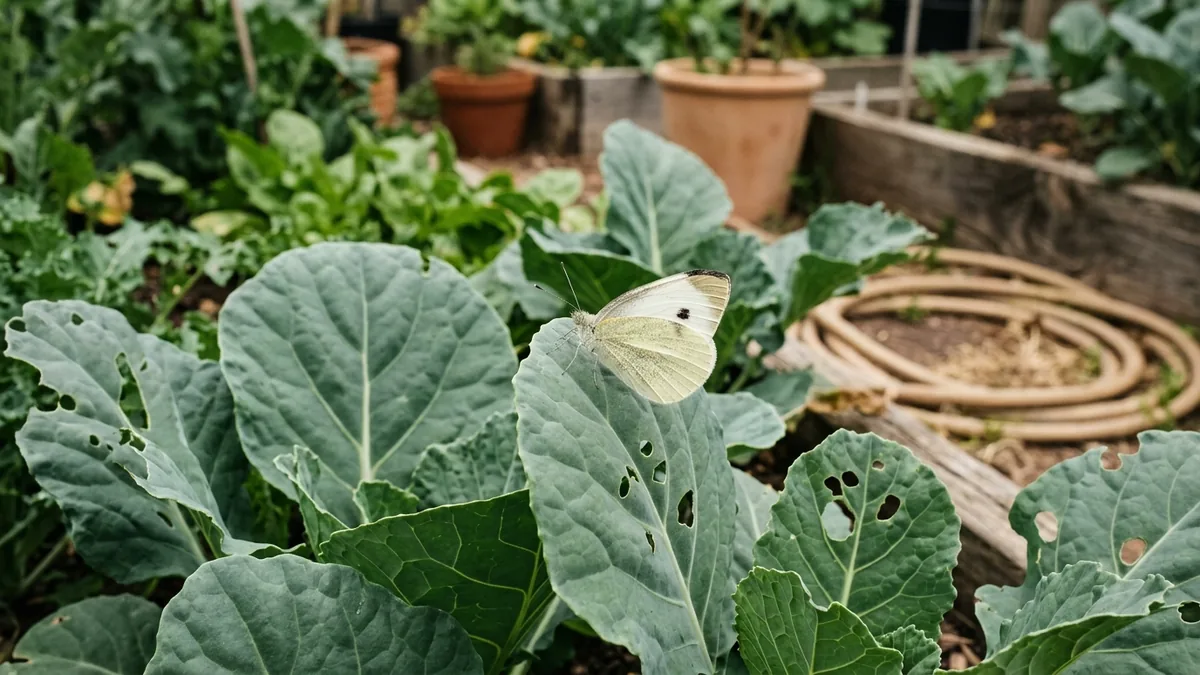
A white butterfly with one or two black spots on each wing, fluttering over the patch on warm sunny days. Its caterpillar is a plump, velvety green grub up to about 30 millimeters long, often resting stretched along a leaf vein where it is hard to spot.
Cabbage moth (diamondback moth)
A small, slender gray-brown moth, most active at dusk. Its caterpillar is smaller and thinner, pale green and tapered at both ends. Disturb it and it wriggles backwards fast or drops on a fine silk thread, which is a giveaway.
The eggs
Cabbage white lays yellowish, rocket-shaped eggs singly or in small clusters on leaf undersides. Cabbage moth lays tiny pale eggs scattered on the leaves. Squashing eggs is the cheapest control of all.
Signs on the plant
Ragged holes and chewed leaf edges, green caterpillars that blend in, dark green droppings (frass) on leaves and in the heart, and damage burrowing into the center of cabbages or the curds of broccoli and cauliflower.
The Lifecycle, and Why They Keep Coming
The cycle is the same in shape for both insects and it turns over fast in warm weather. Adults emerge and fly, feeding on nectar and doing no damage themselves. The females lay eggs on brassica leaves. Within about a week the eggs hatch into tiny caterpillars that feed and grow, getting larger and hungrier as they go, and it is this growing stage that wrecks the plant. The full-grown caterpillar then pupates, often on or near the plant, and a new adult emerges to start again.
In warm conditions the whole cycle can complete in a few weeks, so several overlapping generations build up across the season. This is why you cannot just clear the caterpillars once and relax: more adults keep arriving to lay more eggs as long as the weather is warm. It is also why exclusion is so powerful, because a net that keeps the adults off your plants breaks the cycle before a single egg is laid. Activity is heaviest from spring through fall, and in subtropical and tropical regions the insects can stay active much of the year.
The Damage They Do
- Holed and skeletonized leaves. Caterpillars chew ragged holes and can strip a young plant to the veins.
- Ruined hearts and heads. The worst damage is hidden, as caterpillars bore into the center of cabbages and the curds of broccoli and cauliflower, leaving frass and tunnels that make the crop unpleasant to eat.
- Stunted seedlings. Heavy feeding on young transplants can set them back badly or kill them.
- Frass contamination. Droppings packed into leaf folds and heads are hard to wash out and reduce the harvest you can actually use.
The Organic Control Ladder
Work from the top down. Exclusion comes first because it prevents the problem entirely, and the lower rungs deal with anything that slips through, all without harming bees.
- Exclusion netting. The most effective method by far. Cover brassicas from planting with fine insect net or veggie mesh over a frame, sealed at the edges so the adults cannot get under to lay. No eggs, no caterpillars.
- Inspect and hand-pick. Check every two to three days, turning leaves and parting the heart. Squash egg clusters and pick off caterpillars. For a few plants this alone can keep you on top.
- Encourage natural enemies. Predatory and parasitic wasps, predatory bugs and birds all take caterpillars. Grow nectar flowers such as alyssum and dill nearby and avoid sprays that would kill these helpers.
- Dipel (Bt), as the step up. If caterpillars get past netting and hand-picking, spray Dipel, a biological caterpillar spray based on Bacillus thuringiensis. It only affects caterpillars that eat the treated leaves and is harmless to bees, beneficials, pets and people. Cover the leaves including the undersides and reapply after rain.
- Companion and decoy extras. Strongly scented herbs and butterfly decoys can help a little as part of the mix, but treat them as extras, not your main defense.
What not to do
Do not reach for a broad-spectrum insecticide. Products that kill anything that moves also kill bees, ladybugs, lacewings and the parasitic wasps that attack these very caterpillars. You lose your free helpers and the caterpillars come back, so you spray again and again. Dipel does the job without any of that harm.
Do not spray flowers bees are visiting. Even though Dipel is bee-safe, good practice is to direct any spray at the foliage the caterpillars eat, not at open blooms, and to spray in the cool of the evening.
Do not rely on companion planting alone. Scented herbs and decoys can help around the edges but they will not protect a crop on their own. Net first.
Do not skip the heart. Spraying or picking the outer leaves while ignoring the growing center leaves the worst damage untouched. Always check and treat the heart.
Preventing Cabbage White and Cabbage Moth
- Net from day one. Cover brassicas with insect-exclusion mesh as soon as you plant, well sealed at the edges, and keep it on through the warm season.
- Inspect regularly. Even under netting, check every few days for eggs and any caterpillars that found a gap.
- Clear old brassicas. Remove finished and tatty brassica plants that act as a caterpillar reservoir, and rotate crops.
- Feed for predators. Keep nectar flowers nearby for the parasitic wasps and other beneficials that hunt caterpillars.
- Time your plantings. Where you can, grow brassicas through the cooler months when the adults are least active in your region.
- Strong, steady growth. Healthy, well-grown plants shrug off light damage far better than stressed ones.
Plants They Attack
These pests specialize in the cabbage family (the brassicas), so the target list is the brassica bed.
- Heading brassicas: cabbage, broccoli, cauliflower and Brussels sprouts, where caterpillars in the heart do the most damage.
- Leafy brassicas: kale, bok choy and other Asian greens, arugula and mustard greens.
- Root brassicas: turnip, rutabaga and radish tops.
- Other brassicas: kohlrabi, collards and broccolini.
When They Are Serious
Act promptly rather than waiting if you are growing heading brassicas, because caterpillars that reach the heart of a cabbage or the curd of a broccoli or cauliflower ruin the part you eat and are nearly impossible to remove once they are deep inside, so netting from planting is the real answer there. Seedlings and young transplants are also vulnerable, since a few caterpillars can strip a small plant fast, so protect them. A heavy, repeated infestation through a warm season with several overlapping generations is your cue to combine netting with a Dipel program, reapplying after rain to keep new caterpillars in check. If you are growing brassicas commercially or at scale, watch especially for diamondback moth, which is known to develop resistance to chemical sprays, another strong reason to lean on exclusion, biological control and Dipel rather than broad-spectrum insecticides.
Know when the butterflies arrive
The Planting Season app includes a Pest Calendar that flags when cabbage white, cabbage moth and other pests are most active in your region, so you can have the netting on before the first eggs are laid. Plan your brassica beds, log the damage, and stay ahead of the caterpillars.
Open the App →Frequently Asked Questions
What is the difference between cabbage white and cabbage moth?
They are two different insects whose caterpillars both eat brassicas. The cabbage white is a white butterfly with black wing spots that flies by day, and its caterpillar is a velvety green grub up to about 30 millimeters long that often rests along leaf veins. The cabbage moth, or diamondback moth, is a small gray-brown moth that flies at dusk, and its caterpillar is smaller and thinner, pale green, and wriggles backwards fast and may drop on a silk thread when disturbed. The control methods are the same for both.
How do I stop cabbage moth and cabbage white naturally?
The single most effective organic method is exclusion. A fine insect net or veggie mesh over a frame, sealed at the edges, stops the adults laying eggs on your plants in the first place, so there are no caterpillars to fight. Combine that with checking under leaves and hand-picking any caterpillars and yellow egg clusters you find, encouraging predatory wasps and birds, and using Dipel (a caterpillar-specific biological spray) only if the caterpillars still get through. Avoid broad-spectrum sprays, which harm bees and beneficial insects.
What is Dipel and is it safe?
Dipel is a brand of biological caterpillar spray based on Bacillus thuringiensis, a naturally occurring soil bacterium often shortened to Bt. It only affects caterpillars that eat the treated leaves, and it is not toxic to bees, ladybugs, lacewings, people or pets when used as directed. The caterpillars stop feeding within a day and die over the next two or three days. Spray the leaves the caterpillars are eating, including the undersides, reapply after rain, and follow the label. It is the organic gardener's go-to when netting and hand-picking are not enough.
Why are there holes in my cabbage and broccoli leaves?
Ragged holes and chewed edges on brassica leaves are almost always caterpillars, usually cabbage white or cabbage moth. Look on the undersides of leaves and down in the growing heart for green grubs that blend in with the leaf, along with their dark green droppings (frass). Cabbage white caterpillars are plump and velvety green, while cabbage moth caterpillars are smaller and wriggle backwards. Both can be controlled organically with netting, hand-picking and Dipel.
Do white cabbage butterflies harm the garden?
The adult butterflies and moths do no damage themselves, as they feed on nectar. The harm is done by their caterpillars, which hatch from the eggs the adults lay on your brassicas and then eat the leaves and bore into the hearts. So while seeing the white butterflies fluttering over your patch is a warning sign that egg-laying is happening, the thing to control is the caterpillar stage, ideally by stopping the adults from laying at all with a net.
Does companion planting keep cabbage moth away?
Companion planting can help a little but it is not a reliable stand-alone control. Strongly scented herbs such as dill, thyme, sage and nasturtium may confuse the adults or attract beneficial insects, and some gardeners use white butterfly-shaped decoys to suggest the patch is already taken, with mixed results. Treat these as useful extras alongside the methods that really work: exclusion netting, regular hand-picking, and Dipel when needed. Do not rely on companions alone to protect a precious crop.
How often should I check my brassicas for caterpillars?
Check every two to three days during the warm growing season when the butterflies and moths are active. Eggs hatch quickly and small caterpillars do little visible damage at first, then grow fast and ruin a plant. Turn leaves over to look at the undersides, inspect the growing tip and heart where caterpillars hide, and remove eggs and grubs as you find them. Frequent checking means you catch problems while a quick hand-pick still solves them.
Will cabbage moth caterpillars kill my plants?
They rarely kill an established plant outright, but they can ruin the harvest and badly set back seedlings. Caterpillars chewing the heart of a cabbage or the head of a broccoli or cauliflower can make it unmarketable and unpleasant to eat, and heavy feeding on a young transplant can stunt or kill it. The damage is worst on heading brassicas where the caterpillars hide deep inside, which is exactly why exclusion netting from planting is so valuable.
When are cabbage white and cabbage moth worst in the US?
They are most active in the warm months, broadly spring through fall, and the cabbage white is busiest on warm, sunny days. In much of the US the spring and fall brassica seasons overlap with peak butterfly and moth activity. In cold-winter regions the pests die back over winter, while in the warm South they can be active for much of the year. Net from planting whenever the adults are flying.
See also: How to Grow Cabbage, How to Grow Broccoli and the Pest & Disease Guide