
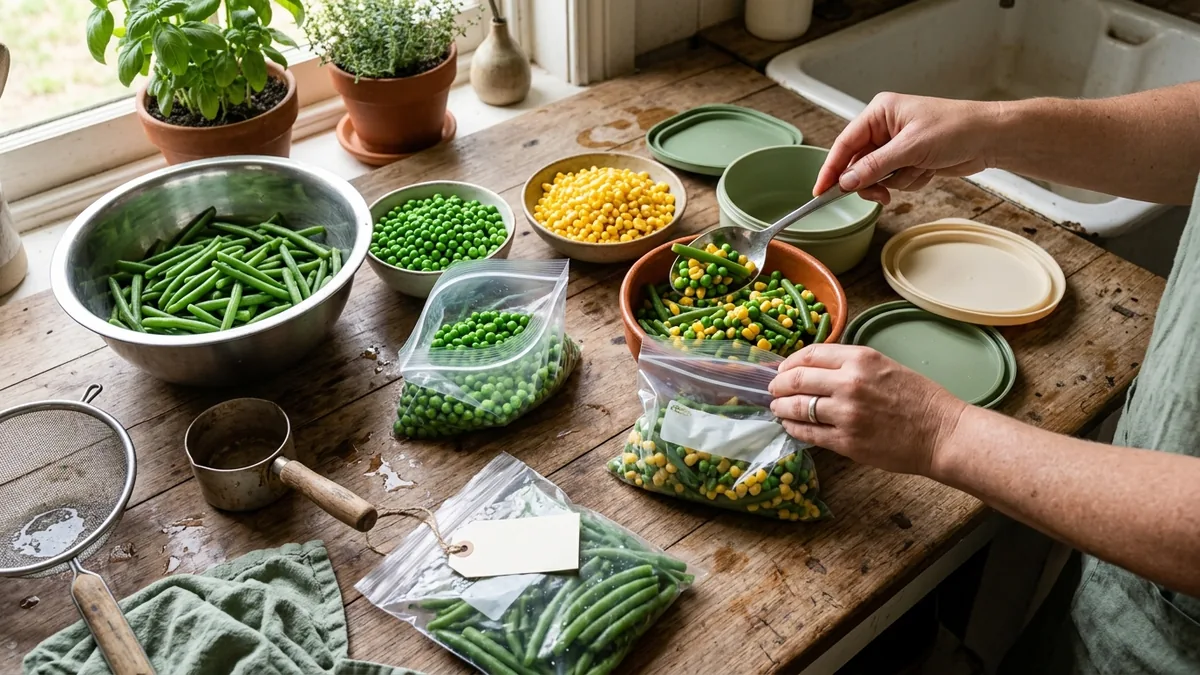
Freezing the Harvest
Updated June 2026
How to freeze garden vegetables, fruit and herbs so they taste as good in winter as the day you picked them.
Freezing is the easiest way to keep a garden glut. There is no special equipment, no boiling-water bath and no risk of getting your acid levels wrong the way there is with canning. You blanch, you bag, you freeze, and a tray of summer beans or a bag of sweet corn is waiting for you months later. For most home gardeners it is the first preserving method worth learning, and often the only one you need.
Done well, freezing also keeps nutrients better than almost any other method. The cold halts the slow loss of vitamins that happens to fresh produce sitting in the crisper, and a quick blanch locks in color and goodness before it can fade. The trick is knowing which crops freeze beautifully, which ones turn to mush, and the few simple steps that make the difference. This page starts with a lookup tool that gives you the right blanch time for any vegetable in one click.
Blanching time lookup
Pick a vegetable to see whether it needs blanching, and for how long. Blanch in rapidly boiling water for the time shown, then chill in ice water for the same time and drain well. Some crops freeze raw with no blanching, and a few are best cooked first.
How to use it: blanch times start counting once the water returns to a rolling boil after you drop the veg in (for leafy greens, count from the moment they go in). Chill for the same number of minutes in ice water to stop the cooking, then drain and pat dry before freezing.
What freezes well, and what does not
The single thing that decides how a vegetable freezes is how much water it holds. Freezing turns that water into ice crystals, and the crystals puncture the cell walls. Low-moisture and cooked foods come through fine. High-moisture raw foods collapse into a soggy mess once thawed.
Freezes well
- Beans, peas and lima beans: blanched, they keep color and snap.
- Sweet corn: on the cob or as kernels, one of the best freezer crops.
- Broccoli, cauliflower and Brussels sprouts: blanched florets freeze cleanly.
- Berries: tray-freeze raw and they stay loose and bright.
- Bell peppers and chilies: freeze raw, no blanching needed.
- Cooked greens: spinach, Swiss chard and kale, blanched and squeezed.
- Herbs: chopped into oil or water and frozen in cubes.
- Tomatoes for cooking: freeze raw and use in sauces and stews.
- Stewed or pureed fruit: apples, stone fruit and rhubarb cooked down first.
Freezes poorly
- Salad greens and lettuce: almost pure water, they turn to slime.
- Raw cucumber and radish: high water content, they go limp and watery.
- Celery for raw use: loses its crunch (fine for soups and stocks).
- Whole raw potatoes: turn grainy and watery (cooked or par-cooked fries freeze well).
- Raw tomatoes for slicing: the cells rupture and they go soft, so only freeze them for cooking.
Why blanching matters
Picked vegetables are still alive. Natural enzymes inside them keep working, slowly breaking down color, flavor, texture and vitamins. Freezing slows this right down but does not stop it, so unblanched veg keeps quietly degrading in the freezer and can taste flat, look dull and turn tough within a month or two.
Blanching is a short, sharp burst of heat that deactivates those enzymes before you freeze. A few minutes in boiling water is enough to switch them off while keeping the vegetable crisp and barely cooked. The result holds its bright color and fresh flavor for many months. This is why a quick blanch is worth the effort for most crops, and why some foods that are eaten raw or always cooked can skip it.
How to blanch and chill
- Bring a large pot of water to a rolling boil. Use plenty of water so it returns to the boil quickly after the veg goes in.
- Prepare an ice-water bath in a big bowl or the sink alongside the pot.
- Drop the prepared vegetables into the boiling water in small batches so the temperature does not crash.
- Start timing when the water returns to a rolling boil. For leafy greens, which cook almost instantly, count from the moment they go in.
- When the time is up, lift the veg straight into the ice water and chill for the same number of minutes. This stops the cooking dead, so they stay crisp.
- Drain thoroughly and pat dry. Excess water turns into ice in the bag and causes clumping and freezer burn.
Tray freezing vs packing straight into bags
How you freeze decides whether you can pour out a handful later or have to chip at a solid brick.
- Tray (open) freezing: spread the drained, dry veg or fruit in a single layer on a lined sheet pan and freeze until solid, then tip into a bag. The pieces freeze separately so they stay loose, and you can pour out exactly what you need. This is the method for berries, beans, peas, corn kernels and florets.
- Packing straight into bags: faster, and fine for anything you will use all at once, such as a portion of blanched greens or a batch of sauce. The downside is everything freezes into one clump.
Packing and removing air
Air is the enemy in the freezer. It dries food out and causes freezer burn. Get as much of it out as you can.
- Squeeze or straw method: with a freezer bag, press out the air by hand, or seal it almost shut and suck the last air out through a straw before closing.
- Vacuum sealer: the best result if you freeze a lot, pulling out nearly all the air for the longest storage life.
- Leave headspace for liquids: sauces, soups and purees expand as they freeze, so leave about an inch at the top of rigid containers.
- Freeze flat: lay filled bags flat to freeze. They freeze faster, stack like books and thaw quickly.
Labeling
Everything looks the same once it is frozen. Write the contents and the date on every bag and container with a permanent marker before it goes in. Use the oldest stock first so nothing lingers past its best. A few minutes labeling now saves a freezer full of mystery bags later.
How long frozen produce keeps
Frozen food stays safe to eat indefinitely while it is solid, but quality slowly fades. These are the windows for best flavor and texture at 0F (minus 18C).
| Food | Best within |
|---|---|
| Blanched vegetables (most) | 8 to 12 months |
| Sweet corn, peas, beans | 8 to 12 months |
| Berries and tray-frozen fruit | 8 to 12 months |
| Stewed or pureed fruit | 8 to 12 months |
| Tomatoes (whole or chopped, for cooking) | 6 to 12 months |
| Cooked sauces and tomato puree | 6 to 12 months |
| Herbs frozen in oil or water | 3 to 6 months |
How to use frozen produce
- Most vegetables: cook straight from frozen. Tip them into boiling water, a hot pan or the steamer without thawing. Thawing first lets the cells collapse and the veg goes mushy.
- Leafy greens: thaw, then squeeze out the water before adding to a dish, or stir frozen straight into soups and curries.
- Berries: thaw for eating fresh, or use them frozen in baking, smoothies and stewing where a little softness does not matter.
- Herbs: drop the frozen cubes straight into the pot. No thawing needed.
- Tomatoes: run a frozen tomato under warm water and the skin slips off, then drop it into the sauce.
Blanch-time reference table
This table complements the lookup tool above. Water-blanch for the time shown, then chill in ice water for the same number of minutes.
| Vegetable | Blanch time | Notes |
|---|---|---|
| Asparagus | 2 to 4 min | 2 min thin spears, 4 min thick |
| Green beans / snap beans | 3 min | Trim the ends first |
| Lima beans | 3 min | Shell before blanching |
| Broccoli (florets) | 3 min | Cut into even florets |
| Brussels sprouts | 3 to 5 min | By size, small to large |
| Cabbage (wedges or shredded) | 1.5 to 3 min | Shredded 1.5 min, wedges 3 min |
| Carrots (sliced) | 2 min | Whole small carrots 5 min |
| Cauliflower (florets) | 3 min | Cut into even florets |
| Corn (on the cob) | 7 to 11 min | By size; kernels off the cob 4 min |
| Spinach / Swiss chard / kale | 2 min | Count from when they go in |
| Peas (shelled) | 1.5 min | Snow and sugar snap peas 2 to 3 min |
| Bell pepper | No blanch | Freezes raw, sliced or diced |
| Zucchini (sliced) | 1 min | Or grate raw and freeze for baking |
| Chilies | No blanch | Freeze raw, whole or chopped |
| Tomatoes | No blanch | Freeze raw whole; skins slip off after |
| Onions (chopped) | No blanch | Freeze raw for cooking |
| Herbs (basil, parsley) | No blanch | Chop into oil or water, freeze in cubes |
| Berries | No blanch | Tray-freeze raw |
| Pumpkin / winter squash | Cook first | Roast or steam and mash before freezing |
| Mushrooms | Cook first | Saute before freezing |
Freeze at the peak
The best time to freeze is right at the glut, when a crop is in full swing and you cannot eat it fast enough. Across most of the US that is the summer harvest of beans, sweet corn, zucchini, tomatoes and berries pouring in faster than the kitchen can keep up. Freeze produce within hours of picking for the best result, while it is at its sweetest and freshest. A chest freezer earns its keep at harvest time, turning a week of gluts into a year of dinners.
Track your harvest and preserving
Log what you pick and what you put away in the Planting Season app, so you know exactly what is in the freezer and what to grow more of next season.
Open the App →Common questions
Do I have to blanch vegetables before freezing?
Most vegetables keep far better if you blanch them first. Blanching deactivates the enzymes that keep breaking down color, flavor, texture and nutrients even at freezer temperatures. A few foods do not need it, including bell peppers, onions, chilies, tomatoes for cooking, berries and herbs, which all freeze raw. If you skip blanching on veg that needs it, expect duller color, off flavors and a softer result within a month or two.
Can I freeze tomatoes whole?
Yes. Wash and dry whole ripe tomatoes, then freeze them raw on a tray and bag them once solid. The skins slip off easily under warm water once frozen. They turn soft when thawed, so use them only for cooking, in sauces, soups and stews, not for slicing into a salad.
Why did my frozen vegetables go mushy?
Freezing forms ice crystals that rupture the cell walls, and the more water a vegetable holds, the worse the damage. High-water foods such as lettuce, cucumber, radish and raw tomatoes for slicing go limp and watery once thawed. Cooking from frozen rather than thawing first keeps most veg firmer, because thawing lets the cells collapse before they hit the heat.
How long does frozen vegetables last?
Most blanched vegetables keep their quality for 8 to 12 months at 0F (minus 18C). Fruit and tray-frozen berries last 8 to 12 months, cooked sauces and tomato purees 6 to 12 months, and herbs frozen in oil 3 to 6 months. Food stays safe to eat indefinitely while frozen solid, but flavor and texture slowly decline, so label everything and use the oldest first.
Can I refreeze thawed vegetables?
As a rule, do not refreeze produce that has fully thawed and warmed up, because quality drops sharply and any bacteria present can multiply. If food still has ice crystals and is cold throughout, it is safe to refreeze, though it will be softer. The better habit is to freeze in meal-size portions so you only thaw what you need.
Do I thaw frozen vegetables before cooking?
No, for most vegetables. Tip them straight from the freezer into boiling water, a hot pan or the steamer. Thawing first lets the cells collapse and the veg turns mushy. The exceptions are leafy greens, which you thaw and squeeze dry, and berries, which you thaw for eating fresh or use frozen in baking.
What are the best containers for freezing?
Heavy-duty freezer bags and rigid freezer-safe containers both work. Bags are best for most veg because you can press out the air and freeze them flat to save space and speed freezing. Rigid containers suit liquids, sauces and soft fruit. Leave headspace for anything with liquid, as it expands as it freezes.
How do I stop freezer burn?
Freezer burn is drying caused by air reaching the food. Remove as much air as you can by pressing it out of bags or using a vacuum sealer, seal tightly, and avoid part-full containers with a lot of trapped air. Keep the freezer at 0F (minus 18C) or colder and use food within its best window. Burnt patches are safe to eat but dry and tasteless, so trim them off.
Source: USDA Complete Guide to Home Canning and Freezing; National Center for Home Food Preservation freezing guidance.
See also: Preserving the Harvest → and How to Preserve Tomatoes →
Related guides
See what to plant this month
Pick your region for a month-by-month calendar tuned to your climate.
Find your region →