
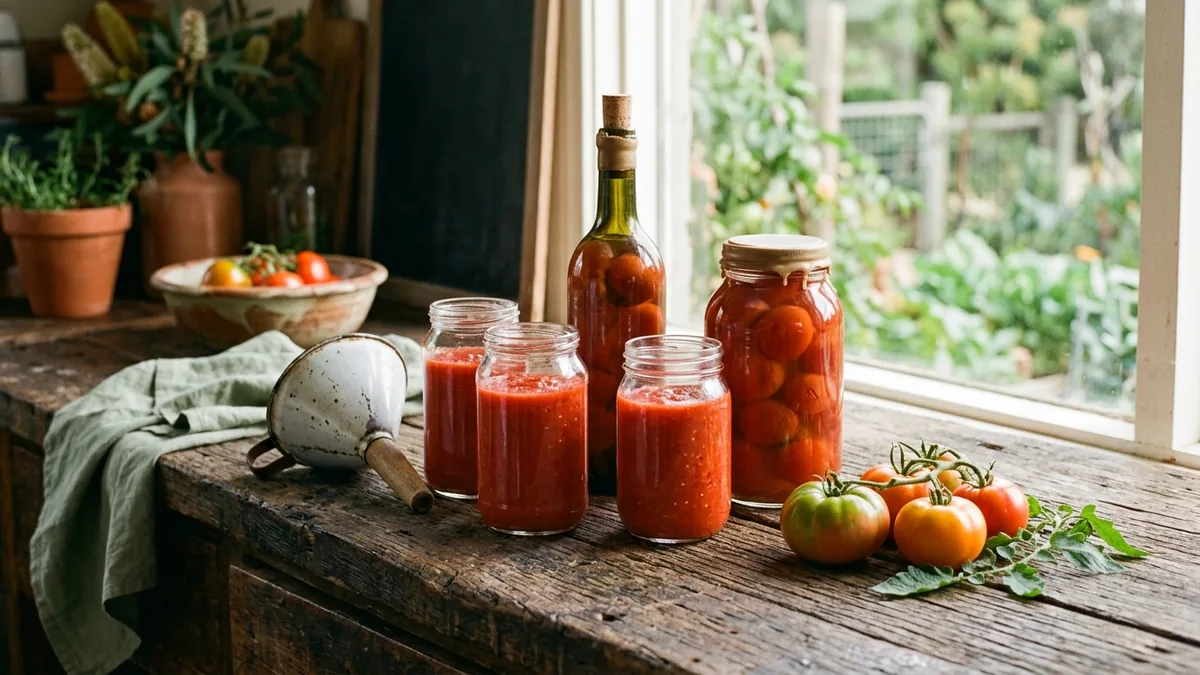
How to Make Passata and Bottle Tomatoes
Updated June 2026
Turn a late-summer glut into shelves of smooth tomato passata, the safe way, with the one rule that matters most: tomatoes always need added acid.
When the tomatoes come in all at once, canning is the oldest answer in the book. A morning at the stove turns flats of soft, ripe fruit into rows of jars you can pull down in the middle of winter for pasta, soup and braises that taste like August. Passata, the smooth sieved puree that Italian families make by the gallon, is the easiest place to start because it captures the flavor of peak-season tomatoes with almost nothing added.
There is one piece of food safety you must get right, and it is not optional. Tomatoes sit on the borderline between high-acid and low-acid foods. Some modern varieties, and very ripe fruit, can drift into the low-acid range where the bacteria that cause botulism can survive a boiling-water process. The fix is simple and reliable: add a measured amount of acid to every jar. The USDA and the National Center for Home Food Preservation publish the exact amounts. Do that, follow a tested process time, and canned tomatoes are one of the safest things you can put up at home. Skip it and you should freeze them instead.
Passata Yield Calculator
Work out roughly how much passata your tomatoes will make, how many jars of your chosen size that fills, and the exact acid dose each jar needs. Enter the weight of fresh, ripe tomatoes you have on hand.
Equipment you will need
You do not need a fancy setup, but a few things make the day go smoothly and safely.
- A big stockpot for cooking the tomatoes down.
- A food mill or a fine sieve. This is what separates passata from chunky sauce. A mill is far faster if you do this every year. An immersion blender plus a sieve also works.
- Clean canning jars with new, undamaged lids. Mason jars with fresh two-piece lids and rings. Reuse jars and rings, but always use new flat lids, never reuse a once-popped lid.
- A boiling-water canner. Any deep pot with a rack on the bottom and a lid works, as long as the jars sit on the rack and can be covered by at least an inch of water. A purpose-made water-bath canner does the same job.
- Jar lifter, a funnel, a ladle, a bubble remover and a clean cloth. Bottled lemon juice or citric acid, and salt.
The acid-safety rule (read this first)
Tomatoes are borderline-acid, so to can them safely in a water bath you must add acid to every jar. This lowers the pH into the safe range and is not negotiable.
Per pint (16 oz) jar: add 1 tablespoon of bottled lemon juice OR 1/4 teaspoon of citric acid.
Per quart (32 oz) jar: add 2 tablespoons of bottled lemon juice OR 1/2 teaspoon of citric acid.
Use bottled lemon juice, not fresh: bottled juice has a standardized, reliable acidity, while fresh lemons vary too much to trust for safety. Add the acid straight to the jar before you fill it. Salt is for flavor only and does nothing for safety, so it is optional. These amounts come from the USDA and the National Center for Home Food Preservation. If you would rather not add acid, freeze the tomatoes instead.
The passata method, step by step
- Wash and sort. Use ripe, sound fruit. Discard anything moldy, badly bruised or showing soft rot. Wash well under running water.
- Core and roughly chop. Cut out the hard stem core and quarter the tomatoes. Peeling is optional because the mill removes skins later, but blanching for peeling first (30 to 60 seconds in boiling water, then into ice water so the skins slip off) gives a slightly cleaner color and flavor if you have time.
- Cook them down. Tip the tomatoes into the stockpot and bring to a brisk simmer, stirring, until they collapse and soften, around 15 to 20 minutes. Heating them fast helps keep the color bright and reduces watery separation later.
- Mill or sieve. Pass the hot, soft tomatoes through the food mill or push them through a fine sieve. The skins and seeds stay behind and you are left with smooth passata. Return it to the pot.
- Season and reduce (optional). Bring the passata back to a simmer. If you like it thicker, let it reduce until it coats a spoon. Keep it hot, near a simmer, right up until you fill the jars.
- Acidify and salt the jars. Into each clean, hot jar put the measured acid (see the box above) and, if you like, up to 1/2 teaspoon of salt per pint for flavor.
- Fill, leaving headspace. Ladle the hot passata into the jars through a funnel, leaving about 1/2 inch of headspace at the top. Slide a bubble remover down the side to release trapped air, then wipe the rims spotlessly clean.
- Lid and process. Center fresh lids and screw on the rings to fingertip tight. Process in a boiling-water canner (see the next section), following a current tested time for your jar size and altitude. Lift the jars out and let them cool undisturbed.
- Check the seals. After 12 to 24 hours, press the center of each lid. A sealed lid is firm and does not flex. Remove the rings, label, date and store.
Water-bath vs pressure canning
Both methods make jars shelf-stable, but they do different jobs. A water bath holds jars at the temperature of boiling water, which is safe for high-acid and acidified foods like properly acidified tomatoes. A pressure canner reaches a higher temperature and is required for low-acid foods such as plain green beans, corn or any tomato product that has not been acidified.
Boiling-water canner
Any deep pot with a rack and a lid. Jars sit on the rack, covered by at least an inch of water, brought to a rolling boil and held for the tested time. Perfect for acidified tomatoes and high-acid fruit.
Pressure canner
Required for low-acid foods. If you ever can plain tomatoes without added acid, a pressure canner is the only safe route. For acidified passata, a water bath is enough.
Whichever you use, the rule is the same: follow a current, tested recipe for the exact processing time. Times change with jar size, altitude and method, so use the charts from the USDA or the National Center for Home Food Preservation rather than guessing. The table below shows how the variables fit together, not invented times.
| Jar size | Acid dose | Headspace | Processing time |
|---|---|---|---|
| Half-pint (8 oz) | 1.5 tsp bottled lemon juice or a pinch under 1/4 tsp citric acid | ~1/2 inch | Follow a current USDA or National Center for Home Food Preservation chart. Time rises with jar size and altitude. |
| Pint (16 oz) | 1 tbsp bottled lemon juice or 1/4 tsp citric acid | ~1/2 inch | |
| Quart (32 oz) | 2 tbsp bottled lemon juice or 1/2 tsp citric acid | ~1/2 inch |
Storage and shelf life
Once the jars have sealed and cooled, wipe them down, label them with the contents and date, and store them somewhere cool, dark and dry. A cupboard away from the stove and out of sunlight is ideal because heat and light dull the color and flavor over time.
- Best quality lasts about 12 months. Sealed, acidified passata stays safe well beyond that if the seal holds, but color and flavor are at their best in the first year, so eat last season's before this season's.
- After opening, refrigerate and use within a few days, just like a store-bought jar. Tip what you do not use into a covered container and keep it cold.
- Check before you use. A sealed lid, clear liquid and a fresh smell mean it is good. A bulging or unsealed lid, spurting liquid, fizzing, an off smell or any mold means throw the whole jar out.
When to bottle: season and region
Across most of the United States the tomato glut lands in late summer, roughly August into early fall, with warmer southern regions running earlier and longer. That is the window to buy a flat cheap at the farmers market or pick your own beds clean in one go. Canning a glut in late summer means homegrown passata right through the cold months when fresh tomatoes are expensive and flavorless. The how to grow tomatoes guide covers getting that glut in the first place.
Track your harvest and never waste a glut
Planting Season logs what you pick, reminds you when a crop is peaking, and shows how much you have put up. Plan beds, track to harvest and turn the surplus into a full pantry.
Open the AppTroubleshooting
Watery layer or separation
A thin, watery layer settling under thicker pulp is normal and safe. It happens when enzymes break down pectin before the tomatoes are fully cooked. Reduce it by working quickly and heating the tomatoes fast at the start, or by cooking the passata down further before canning. Just shake the jar before use.
Jars did not seal
If a lid has not sealed within 24 hours, do not store it on the shelf. Refrigerate that jar and use it within a few days, or reprocess it with a fresh lid within 24 hours. Common causes are a rim that was not wiped clean, a reused or damaged lid, too little headspace, or jars cooled in a draft.
A sealed jar later unseals
A jar that pops its seal weeks later has usually spoiled, often from a nick on the rim or a poor seal that slowly failed. Discard the contents. Do not taste it.
Floating fruit or siphoning
Passata is smooth so floating is rarely an issue, but if you canned whole or crushed tomatoes, fruit floating to the top is cosmetic. Siphoning, where liquid is forced out during processing and lowers the level in the jar, comes from a too-fast temperature change or overfilled jars. Let the canner cool a few minutes before lifting jars, and keep to the right headspace.
Mold
Any mold means discard the entire jar. Do not scrape it off, do not taste the contents, and do not feed it to animals. Mold on a preserve is a sign the seal failed and the contents are no longer safe.
Frequently asked questions
Do I really need to add acid to canned tomatoes?
Yes. Tomatoes sit right on the borderline between high-acid and low-acid foods, and some varieties tip into the unsafe range. The USDA and the National Center for Home Food Preservation direct you to acidify every jar. Add 2 tablespoons of bottled lemon juice or 1/2 teaspoon of citric acid per quart, or 1 tablespoon of lemon juice or 1/4 teaspoon of citric acid per pint.
Can I use fresh lemon juice instead of bottled?
No. Fresh lemon juice varies in acidity from fruit to fruit, so it cannot be relied on for safety. Use bottled lemon juice, which has a standardized acidity, or use citric acid measured by the spoon.
What is the difference between passata and tomato sauce?
Passata is tomatoes cooked and passed through a sieve or food mill to remove skins and seeds, leaving a smooth, pourable puree. It is unseasoned beyond a little salt and the safety acid, which makes it a flexible base for pasta sauce, soups and stews.
How long does canned passata keep?
A properly sealed, acidified jar keeps for about 12 months in a cool, dark cupboard for best quality. Once opened, refrigerate it and use within a few days.
Why did my passata separate into layers?
A watery layer under thicker pulp is normal and harmless, caused by enzymes breaking down pectin before cooking. Heat the tomatoes fast, or cook the passata down further before canning, and shake the jar before use.
My jar did not seal. What do I do?
If a lid has not sealed within 24 hours, refrigerate that jar and use it within a few days, or reprocess it with a fresh lid within 24 hours. Never store an unsealed jar at room temperature.
Can I just water-bath plain tomatoes with no added acid?
No. Plain tomatoes without added acid are not safe for water-bath canning because they can fall into the low-acid range where dangerous bacteria can grow. Always add the measured acid, or freeze the tomatoes instead.
What if I see mold in a jar?
Discard the entire jar. Do not taste it and do not try to scrape the mold off. Mold, a bulging lid, spurting liquid or an off smell all mean the contents are unsafe.
Acid amounts and the high-acid vs low-acid distinction follow guidance from the USDA and the National Center for Home Food Preservation. Always use a current, tested recipe for exact processing times.