
Apple Tree Varieties: A US List by Chill Hours, Zone and Disease Resistance
Updated November 2026
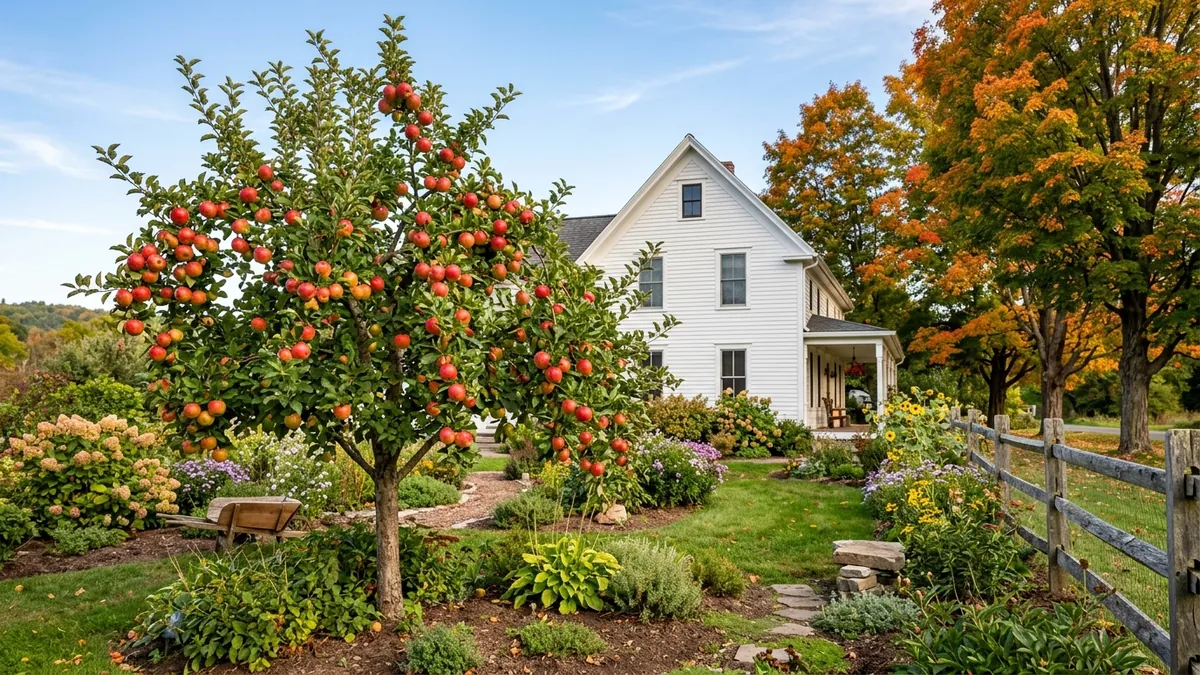
Popular US-sold apples sorted by chill, zone, pollination and disease resistance
Apple tree varieties differ most in three ways: how much winter chill they need, how well they stand up to scab, cedar apple rust and fire blight, and which other apples they need beside them for pollination. For a US garden the first question is chill, because an apple that wants 800 hours of cold will leaf out and flower weakly in a mild-winter yard. This guide sorts popular US-sold apples by chill, lists disease ratings from a university table, explains pollination and rootstock, and says which varieties suit which region.
In cold and moderate climates (zones 4 to 7), grow disease-resistant varieties such as Liberty, Enterprise and Freedom, plus eating apples such as Honeycrisp, Gala and Fuji. In warm climates, choose low-chill apples such as Anna, Dorsett Golden, Pink Lady and Granny Smith. In every region, plant two compatible varieties for pollination.
How to read an apple variety list
A variety listing should tell you four things: the chill hours, the zone range, the pollination needs and the ripening time. The numbers below come from the Dave Wilson Nursery apple list, which is sold to home growers across the US, and from a Penn State Extension table for disease ratings. Chill figures are working numbers rather than laboratory values, and the nursery itself notes that some varieties have proven productive with much less chilling than listed, so check with your county extension office. Our chill hours tool shows what your location collects, and the USDA zones guide explains zone numbers. For a general walk-through of planting, spacing and pruning, see how to grow apple trees and the apple plant page.
Popular US apple varieties by chill and zone
The table is ordered from the lowest chill to the highest, so you can start at the top if you garden in a warm climate. Where the nursery did not give a value, the cell says so rather than guessing.
| Variety | Chill hours (nursery list) | Zones where listed | Pollination | Harvest |
|---|---|---|---|---|
| Dorsett Golden | 100 | 5 to 10 | Self-fruitful | Early season (central California) |
| Einshemer | 100 | Not listed | Self-fruitful; good pollenizer for Anna | Early summer (late June, central California) |
| Anna | 200 | 5 to 10 | Self-fruitful, or with Dorsett Golden or Einshemer | Not listed |
| Lady Williams | 200 to 300 | 4 to 10 | Needs a mid-to-late bloomer such as Fuji or Granny Smith | Fall into winter |
| Beverly Hills | 300 | 5 to 10 | Self-fruitful | Summer |
| Pink Lady | 300 to 400 | 6 to 9 | Self-fruitful in many western climates; a pollenizer is recommended | Late October (central California) |
| Granny Smith | 400 | 6 to 9 | Self-fruitful; long bloom makes it a good pollenizer | Late |
| Gala | Under 500 | 4 to 10 | Self-fruitful; good pollenizer | 2 to 3 weeks before Red Delicious |
| Fuji | Under 500 | 4 to 9 | Self-fruitful; excellent pollenizer | Mid-September |
| Arkansas Black Spur | 500 to 600 | 5 to 9 | Partly self-fruitful | Late season |
| Golden Delicious | 700 | 5 to 10 | Self-fruitful; pollenizer for Red Delicious | Midseason |
| Liberty | 800 | 4 to 8 | Self-fruitful; interfruitful with Red Delicious, Empire and McIntosh | Early fall |
| McIntosh | 900 | 4 to 7 | Partly self-fruitful; or Red Delicious or Gala | Early |
| Honeycrisp | Not listed | 3 to 9 | Gala, Granny Smith, Empire, McIntosh or Red Delicious | Mid-August (central California) |
Popular varieties not in the table are still easy to find. Golden Delicious sits at 700 hours on the same list, and Cortland at 800 hours for zones 4 to 6. Zestar!, developed at the University of Minnesota, is an early-season apple bred for cold climates; check the seller's tag for its chill and zone figures, since we did not read a figure for it.
Low-chill apples for the South and Southern California
Warm-winter gardeners have more choice than they expect. Dorsett Golden and Einshemer are listed at about 100 chill hours, Anna at 200, and Lady Williams, Beverly Hills and Pink Lady between 200 and 400. Pettingill is listed at about 100 to 300 and for zones 6 to 11, which is among the widest ranges on the list. Anna and Dorsett Golden are a classic pairing, and the nursery notes Anna is self-fruitful but sets well with Dorsett Golden or Einshemer nearby.
Low-chill varieties flower early, so a late frost can take the blossoms. Our data gives Jan to Feb for planting an apple in the Gulf South, Jan to Feb in Texas and Jan to Feb in Southern California, all in the cool dormant months. More warm-climate fruit is in our low-chill fruit guide.
Disease resistance: scab, cedar apple rust and fire blight
Apple scab is a fungal disease that spots leaves and fruit in wet springs. Cedar apple rust needs both an apple and a juniper such as eastern red cedar to complete its life cycle, so it is worst where junipers grow nearby. Fire blight is the bacterial disease that blackens blossoms and shoots in warm, wet weather. Choosing a resistant variety is the lowest-effort control.
Penn State Extension publishes a table of scab-resistant apple varieties (Table 4.1, updated July 2026) that also rates each for three other problems on a scale of resistant, moderate and susceptible. All of the apples below are scab resistant according to the title of that table.
| Variety | Cedar apple rust | Powdery mildew | Fire blight |
|---|---|---|---|
| Liberty | Resistant | Resistant | Resistant |
| Freedom | Resistant | Resistant | Resistant to moderate |
| Enterprise | Resistant | Moderate | Resistant |
| Sundance | Resistant | Moderate | Resistant |
| Redfree | Resistant | Resistant to moderate | Resistant to moderate |
| Pristine | Moderate | Resistant | Moderate |
| Goldrush (Gold Rush) | Susceptible | Resistant | Moderate |
| WineCrisp | Susceptible | Moderate | Resistant |
| Crimson Crisp | Moderate | Moderate | Susceptible |
| Jonafree | Susceptible | Resistant | Moderate |
Liberty is the standout in that table, with a resistant rating on all three of the other problems, and the nursery list also describes it as resisting scab, rust, mildew and fire blight. Freedom and Enterprise are close behind. Pristine is an early apple that is moderate on rust and fire blight, so it is a weaker choice where junipers are common. Goldrush, a late-season keeper, is rated susceptible to cedar apple rust in that table. Ratings differ between regions and publishers, so treat any single table as a starting point. The Dave Wilson list also describes Dolgo crabapple, Hudson's Golden Gem and Spartan as resisting several diseases, including fire blight, and describes Wealthy as having some resistance to scab, fire blight and cedar apple rust. Where blight is the main worry, our fruit tree troubleshooting guide covers the related blossom and flowering problems. If sprays are needed, use a registered product, used to the label.
Pollination, crabapples and triploids
Apples need pollen from a different variety that blooms at the same time, even when a listing calls a variety self-fruitful, because a partner usually means a heavier crop. Gala, Fuji, Granny Smith and Golden Delicious are listed by the nursery as good pollenizers, and Fuji is described as excellent. Honeycrisp is listed as pollinated by Gala, Granny Smith, Empire, McIntosh or Red Delicious.
Crabapples make useful partners in small yards. The nursery describes Dolgo crabapple (500 chill hours) as self-fruitful and a recommended pollenizer for many commercial apples, with resistance to scab, rust, mildew and fire blight. Transcendent crabapple (700 to 800 chill hours) is self-fruitful and ripens in late summer. One crabapple in a neighbor's yard within roughly 50 feet (15 m) can serve as the partner for several apple trees.
Triploid varieties have sterile pollen, so they cannot pollinate other apples and need two different compatible varieties nearby so that all three set fruit. Jonagold, Mutsu and Gravenstein are common triploids. The nursery lists Jonagold with Fuji, Gala, Granny Smith or Red Delicious as partners, but not Golden Delicious, and lists Mutsu and Gravenstein as needing a pollenizer.
Rootstocks and tree size in general terms
The variety decides the fruit and the rootstock decides the tree. Dwarf rootstocks give a small tree that fruits young and usually needs a stake or trellis for support. Semi-dwarf rootstocks give a medium tree that is stronger and tougher. Standard rootstocks make a large, long-lived tree that takes the most space and the longest to fruit. Our planting data uses about 13 feet (4 m) of spacing for an apple and about four years from planting to a good crop, with a mature tree giving roughly 45 to 90 pounds (20 to 40 kg). For small yards and containers, see our dwarf fruit trees guide. Columnar apples such as Northpole and Scarlet Sentinel are listed by the nursery for 2 foot (60 cm) spacing or containers, and they need a partner like any other apple.
Which apples suit which US region
Northeast and New England. Cold winters give plenty of chill, and wet springs make scab and rust a concern. Liberty, Enterprise and Freedom are sensible picks, along with McIntosh and Cortland. The planting window in our data is Apr to May.
Midwest and Upper Midwest. Cold-hardy varieties matter. The nursery lists Honeycrisp for zones 3 to 9, Cortland for zones 4 to 6 and Wealthy for zones 2 to 8. Our data gives Mar to May for planting in the Midwest and Great Lakes. Look at Zestar! and Honeycrisp for eating, and Liberty for low-spray growing.
Mid-Atlantic and Mid-South. A middle band of chill suits Gala, Fuji, Golden Delicious and Arkansas Black Spur. Humid summers mean rust and blight resistance pays off, and the data gives Feb to Mar and Nov for the Mid-Atlantic.
Pacific Northwest and California. Dry summers reduce disease pressure, and almost any variety can work. The data gives Feb to Mar and Nov for the Pacific Northwest and Nov to Feb for Northern California and the Central Valley. In the Southern California and desert areas, look back at the low-chill group above.
Mountain West. Late frosts are the risk, so later-blooming varieties help. Our data gives Apr to May for planting. Check the frost dates tool before choosing a bloom time.
Questions
What are the best apple tree varieties to grow at home?
It depends on your climate. In cold and moderate regions, Liberty, Enterprise, Freedom, Honeycrisp, Gala and Fuji are popular and widely sold. In mild-winter regions, choose low-chill apples such as Anna, Dorsett Golden, Pink Lady or Granny Smith.
Which apple trees need the fewest chill hours?
The Dave Wilson Nursery list gives Dorsett Golden and Einshemer about 100 hours, Anna 200, Lady Williams 200 to 300 and Beverly Hills 300. Pink Lady is listed at 300 to 400 and Granny Smith at 400. Check your local extension office, since chill figures vary by source.
Which apple varieties resist scab, rust and fire blight?
Penn State Extension rates Liberty resistant to cedar apple rust, powdery mildew and fire blight, and rates Enterprise resistant to rust and fire blight. Freedom is rated resistant on rust and mildew and resistant to moderate on fire blight. All the apples in that table are scab resistant.
Do I need two apple trees?
Usually yes for a good crop. Plant two compatible varieties that bloom at the same time within about 50 feet (15 m), or use a neighbor's apple or a crabapple. Triploids such as Jonagold need two other varieties nearby.
Can a crabapple pollinate an apple tree?
Yes, if the bloom times overlap. The nursery describes Dolgo crabapple as a recommended pollenizer for many commercial apples, and it is listed as resistant to scab, rust, mildew and fire blight.
How big will my apple tree get?
The rootstock decides it. Dwarf rootstocks give small trees that fruit young and need support, semi-dwarf trees are medium, and standard trees are large. Our planting data uses about 13 feet (4 m) of spacing and four years to a good crop.
Sources
- Penn State Extension, Home Orchards Table 4.1: Scab-resistant Apple Varieties
- Dave Wilson Nursery, apple varieties (chill hours, zones, pollination, disease notes)
- USDA Plant Hardiness Zone Map
Plant profile
The apple profile has sowing times for your region, companion plants and common pests.