
Updated November 2026
How to Grow Mushrooms at Home: Kits, Straw Buckets and Shiitake Logs
Oyster mushrooms from a kit or a straw bucket, and shiitake on logs, with the conditions each one needs and what can go wrong.
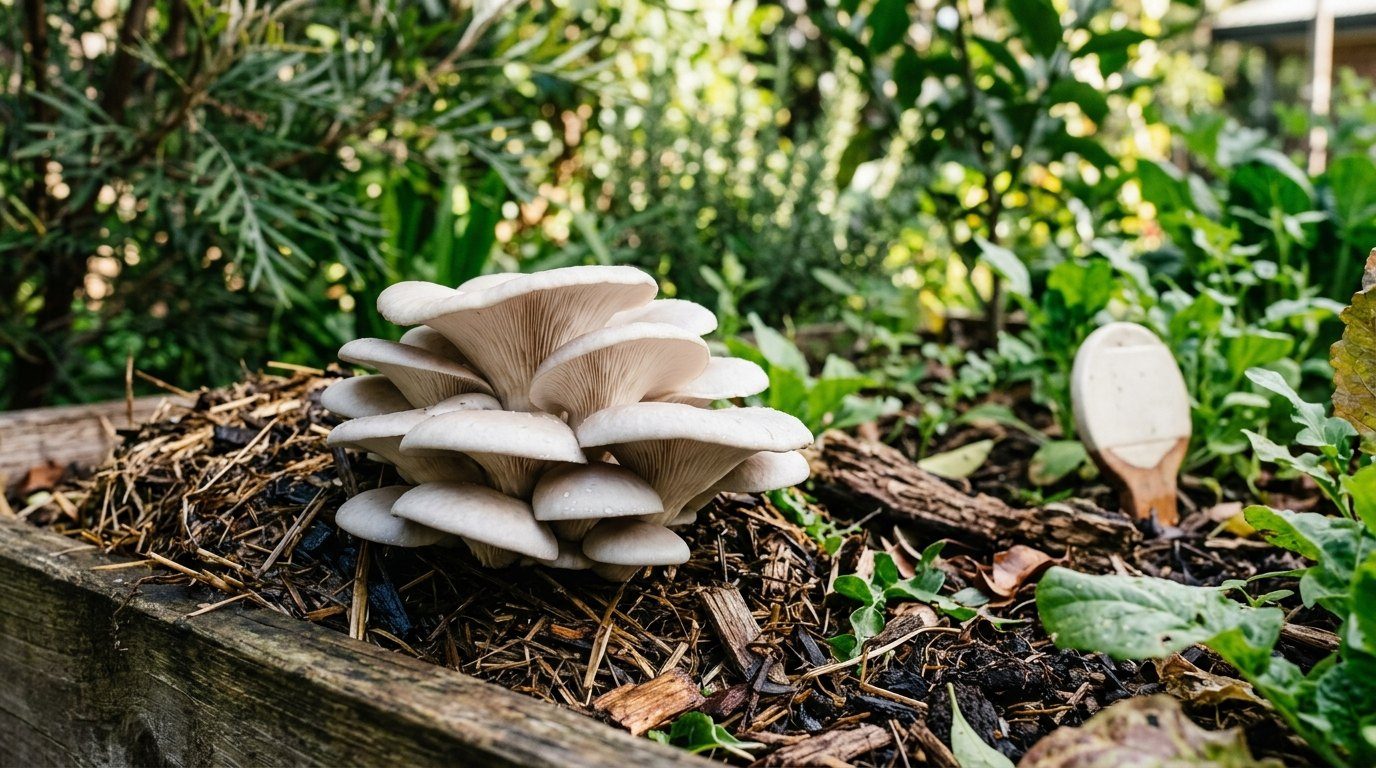
Mushrooms are not plants. They are the fruiting bodies of a fungus that feeds on dead organic material, so they need no garden bed and no sunlight. That makes them suited to a basement, a closet, a garage or a shaded corner where nothing else will grow. The easiest start is an oyster mushroom kit, and the cheapest way to scale up is a bucket of pasteurized straw.
Which method should you start with?
| Method | Time to first harvest | Effort | Best for |
|---|---|---|---|
| Ready-made kit | About 3 weeks from opening to first harvest, following the maker's instructions | Very little | A first attempt |
| Straw in a bucket | About 4 to 6 weeks from spawning to first harvest | Moderate | Oyster mushrooms in larger amounts |
| Shiitake on logs | Usually a year or two after inoculating, with the best fruiting 2 to 3 years in | Low, but slow | Patient growers with an outdoor shaded spot |
The shiitake timing comes from North Carolina Cooperative Extension, which reports it typically takes a year or two after inoculating freshly cut white oak logs to see the first flush. Our plant data lists oyster mushroom as a crop for any month in every US region, with about 21 days to harvest from a kit, because the crop grows in a controlled indoor space or a shaded spot rather than a seasonal garden bed.
How mushrooms grow
The main organism is the mycelium, a network of white threads that grows through the material it feeds on, called the substrate. Growing has two phases, and most failures come from not changing conditions between them.
- Colonization. The mycelium grows through the substrate. This needs warmth of about 68 to 77°F (20 to 25°C), darkness and little airflow, and takes 2 to 4 weeks.
- Fruiting. Mushrooms emerge from the colonized substrate. This needs cooler air of about 59 to 72°F (15 to 22°C), humidity of 80 to 95%, fresh air and indirect light, and each flush takes 7 to 14 days.
Method 1: a ready-made kit
A kit is a block of substrate that is already colonized, so someone else has done the hard part. Follow the maker's instructions, which usually run like this.
- Open the bag or box where the maker says, usually by cutting a slit or an X.
- Stand it somewhere with indirect light and good airflow, such as a kitchen counter or a laundry.
- Mist the cut area two or three times a day to keep the humidity high without soaking the block.
- Tiny pins appear in 5 to 10 days. Keep misting the air around them and keep air moving.
- Pick the cluster when the caps have opened but before the edges curl upward.
Most kits give two to four flushes over six to eight weeks. Between flushes, soak the block in water for a few hours, then resume misting.
Method 2: oyster mushrooms on straw in a bucket
You need a 5 gallon bucket with a lid, a drill, enough wheat straw to fill it and grain or sawdust oyster spawn from a mushroom spawn supplier. Follow the supplier's rate for the amount of spawn. Oyster mushrooms are aggressive colonizers, so this method suits them but not shiitake or lion's mane.
- Drill the holes. Make 5/8 inch holes in a diamond pattern, 6 to 8 inches apart around the sides, which is where the mushrooms will fruit.
- Pasteurize the straw. Cornell University's Small Farms Program describes hot pasteurization: keep the straw at 140 to 160°F (60 to 71°C) for at least two hours. The simplest way is to heat the water and straw to 180°F (82°C), turn off the heat and put a lid on so it cools slowly. Drain it and spread it on a clean surface, and use it once it drops below 100°F (38°C).
- Layer. Pack straw and spawn in alternating layers, press down firmly and finish with straw.
- Colonize. Put the lid on and keep the bucket warm and dark for 2 to 3 weeks, until white threads show at the holes.
- Fruit. Move it to a shaded, humid spot with fresh air and mist the holes. Mushrooms appear within 7 to 14 days.
Wear gloves when you handle the straw, and keep the equipment you use for the straw separate from the kitchen.
Method 3: shiitake on logs
Log growing takes the longest and then needs very little attention. North Carolina Cooperative Extension reports that a log fruits for as many years as its diameter in inches, so a 5 inch log can keep producing for about five years. Use freshly cut hardwood, and oak is the species the extension guidance describes. Drill holes for the spawn, push in plug or sawdust spawn and seal the holes with wax. Stack the logs in shade with good airflow and keep the bark moist in dry weather. Our shiitake guide covers varieties and care.
Forcing a flush
Wait at least a year after inoculation, and six weeks after a natural flush. Then soak the log in water for 24 hours, and no more than 48. North Carolina Cooperative Extension says pins form about 3 days later and the mushrooms are ready to pick about 12 days after soaking, when the gills are visible under the cap and the cap edge is slightly curled. Rest the log for 8 weeks afterwards and force it no more than three times a year.
Where to grow them
Indoors gives you the most control. A basement, closet or laundry with indirect light works, and a simple fruiting chamber is a large plastic tub with holes in the sides and damp perlite on the bottom. The challenges are keeping humidity up in dry heated air and moving fresh air through, because mushrooms give off carbon dioxide. Outdoors suits buckets, logs and straw beds in full shade out of the wind, and spring and fall bring the best fruiting temperatures. Summer heat in the South and Southwest is too hot and dry for most species, except pink and golden oysters.
Fruiting conditions
| Condition | What most oyster mushrooms want |
|---|---|
| Humidity | 80 to 95%. Mist the air around the mushrooms rather than spraying the caps once they form. |
| Fresh air | Plenty. Long thin stems with small caps mean there is too much carbon dioxide, so open the tent or add a small fan on a timer. |
| Temperature | Gray oysters fruit across 50 to 75°F (10 to 24°C). Pink oysters prefer warmer air, 64 to 86°F (18 to 30°C). King oysters and shiitake prefer 54 to 64°F (12 to 18°C). |
| Light | Indirect light only. Direct sun dries the mushrooms out. |
Species temperatures vary by strain, so the label on your kit or spawn comes first.
Common mistakes
- Too little humidity. Pins form and then dry out and shrivel. Mist more often or make a humidity tent from a bag with holes.
- Too little fresh air. Long, spindly stems with tiny caps are the sign. Balance humidity with ventilation.
- Contamination. Green, black or orange mold on the substrate means another fungus got in first. A contaminated batch cannot be saved, so put it in the compost, wash your hands and start fresh.
- Wrong substrate. Oysters grow on almost anything, but shiitake needs hardwood.
- Giving up after one flush. Most substrates give two to four flushes, so soak the block between flushes and try again.
Storing what you pick
The US Food and Drug Administration lists mushrooms among the perishable produce to keep in a refrigerator at 40°F (4°C) or below. Our freezing guide covers keeping a larger harvest.
Common questions
What is the easiest mushroom to grow at home?
Oyster mushrooms. They colonize fast, tolerate imperfect conditions and fruit on cheap substrates such as straw, and a ready-made kit takes about three weeks to the first harvest in our plant data.
Can I grow mushrooms indoors?
Yes. A basement, closet or laundry with indirect light, good airflow and humidity of 80 to 95% works for oyster mushrooms and for ready-made kits.
How do you grow mushrooms in a bucket?
Drill holes in a 5 gallon bucket, pasteurize straw, layer it with spawn, keep it warm and dark for 2 to 3 weeks, then move it to a shaded, humid spot to fruit.
How long do shiitake logs take to fruit?
North Carolina Cooperative Extension says a year or two after inoculating freshly cut oak logs, with the best fruiting two to three years in.
Do you cover foraging for wild mushrooms?
No. We do not cover wild mushroom foraging or identification, and we never recommend eating a mushroom picked in the wild.
Sources we checked (November 2026): Cornell University Small Farms Program, Four Methods of Commercial Cultivation (hot pasteurization of straw); North Carolina Cooperative Extension, Henderson County Center, Forcing Shiitake Mushroom Logs to Fruit; US Food and Drug Administration, Selecting and Serving Produce Safely.