
How to Make Jam, Jelly and Marmalade
Updated June 2026
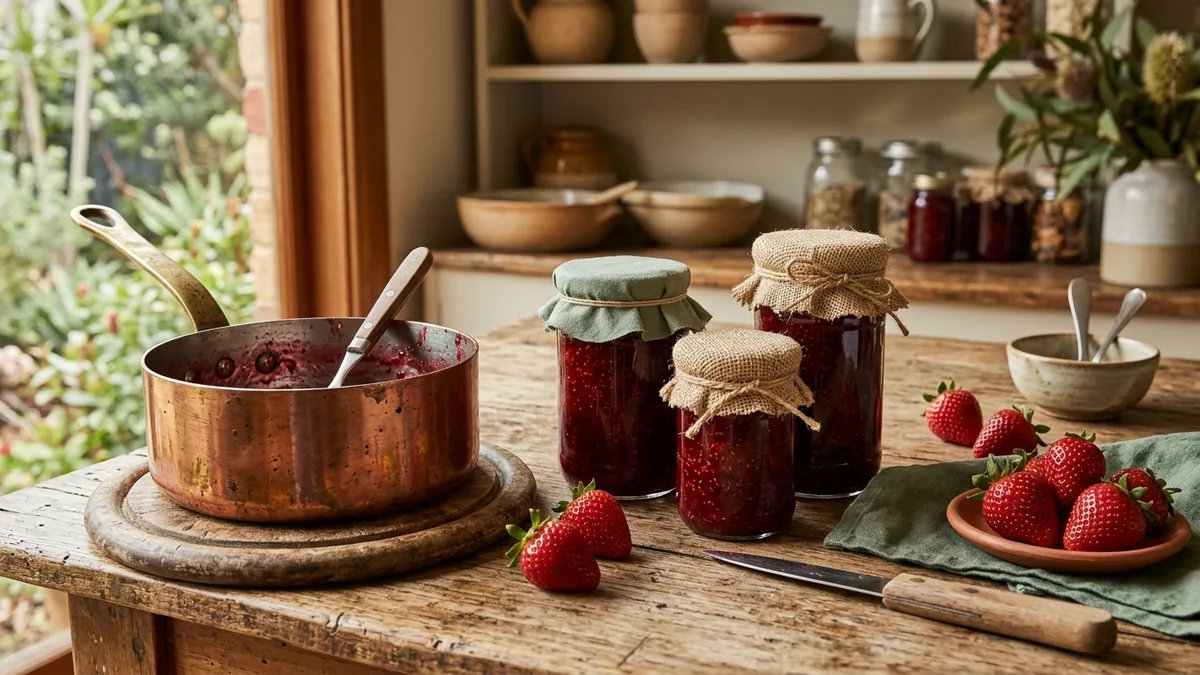
Turn a fruit glut into a year of jars, and use the batch calculator below to work out your sugar, lemon and how many jars to have ready.
A heavy crop never arrives politely. The fruit all ripens in the same two weeks, the strawberries come faster than anyone can eat them, and the citrus tree drops more than the kitchen can use. Jam, jelly and marmalade are how generations of growers turned that flood into something that lasts. A pot of sugar and fruit becomes a shelf of jars that carries the taste of the season into the rest of the year.
This guide covers how a jam actually sets, how to test for the setting point, which fruit needs help, and how to can your jars safely. The calculator below does the math for you. Enter your fruit weight, choose a sugar ratio, and it works out the sugar, a rough lemon-juice amount, the finished yield and how many jars to wash before you start.
Jam Batch Calculator
1000 g of fruit is about 2.2 lb. These are estimates. Real yield varies with how juicy the fruit is and how long you boil it, so keep a spare clean jar handy.
How a Set Happens: Pectin, Acid and Sugar
A good set is a three-legged stool. Knock out any leg and the jam stays runny. The three legs are pectin, acid and sugar, and they each do a different job.
Pectin is the natural gelling fiber found in fruit, concentrated in the skins, cores and seeds. When pectin is heated with sugar and acid it forms a mesh that traps the liquid and holds the jam together. Some fruit is loaded with it, some has almost none.
Acid lowers the pH so the pectin molecules stop repelling each other and start to bond. This is why so many recipes call for lemon juice. The acid is not there for flavor alone, it is what lets the pectin do its work. Low-acid fruit such as pears or sweet cherries usually needs a squeeze of lemon to set.
Sugar pulls water away from the pectin so the network can form, and it is the main preservative. Plenty of dissolved sugar makes a hostile place for the molds and yeasts that spoil food. This is the honest trade-off in low-sugar jam: less sugar gives a fresher, less sweet flavor, but a weaker set and a shorter shelf life. Full-sugar jam sets firmly and keeps for around a year, while a low-sugar batch usually needs pectin to set and is best kept in the refrigerator or freezer.
Testing for the Setting Point
Jam will not thicken properly in the pan. It thickens as it cools, so you need a way to judge the set while it is still boiling. There are three reliable methods, and many cooks use two together.
The temperature method
Jam sets at about 220 degrees F (104 to 105 degrees C) at sea level. A candy thermometer or a probe makes this the easiest check. At higher altitude water boils cooler, so the setting point drops by roughly 2 degrees F for every 1,000 feet above sea level. If you live up high, aim a couple of degrees lower and confirm with the plate test.
The wrinkle or plate test
Put two or three small plates in the freezer before you start. When you think the jam is close, take the pan off the heat, spoon a little jam onto a cold plate and leave it for thirty seconds. Push it gently with a fingertip. If the surface wrinkles and the jam holds its shape rather than flooding back, it has reached setting point. If it stays loose, boil for a few more minutes and test again.
The flake or sheet test
Dip a cold metal spoon into the jam, lift it and let the jam run off the side. Early on it drips in single drops. At setting point the last of it slides off in a sheet, with two drops merging and hanging off the edge in a flake. It takes a little practice but is handy when you have no thermometer.
Pectin and Acid by Fruit
Knowing where your fruit sits saves a failed batch. High-pectin, high-acid fruit sets on its own. Low-pectin or low-acid fruit needs a hand, usually from lemon juice or added pectin. Commercial liquid or powder pectin comes with its own instructions and is the most reliable option for low-pectin fruit.
| Fruit | Pectin | Acid | What to add |
|---|---|---|---|
| Cooking apples | High | High | Nothing, often used to help other fruit set |
| Citrus with peel (marmalade) | High | High | Nothing |
| Quince | High | High | Nothing |
| Crabapple | High | High | Nothing |
| Cranberry | High | High | Nothing |
| Currants (red and black) | High | High | Nothing |
| Gooseberry | High | High | Nothing |
| Plums (most) | High | Medium to high | Usually nothing |
| Blackberry | Medium | Medium | A little lemon helps |
| Raspberry | Medium | Medium | A little lemon helps |
| Apricot | Medium | Medium | A little lemon helps |
| Strawberry | Low | Medium | Add lemon juice or pectin |
| Cherry | Low | Low | Add lemon juice plus pectin |
| Rhubarb | Low | High | Add pectin |
| Pear | Low | Low | Add lemon juice and pectin |
| Peach | Low | Low | Add lemon juice and pectin |
| Fig | Low | Low | Add lemon juice and pectin |
| Elderberry | Low | Low | Add lemon juice, often paired with apple |
Low-Sugar Jam: The Caveats
Lower-sugar jam is popular, and it can be lovely, but it is worth being clear-eyed about it. Sugar is a preservative, so less sugar means less keeping. A low-sugar batch has a shorter shelf life and is much more prone to mold once opened.
The safe approach is to treat low-sugar jam as a refrigerator or freezer product, or to use a recipe that has been written and tested for reduced sugar, set with a low-sugar or no-sugar-needed pectin, and processed in a water-bath canner for shelf-stable jars. Do not simply halve the sugar in a standard recipe and store the jars in the pantry. For reduced-sugar canning, follow a tested recipe from USDA or the National Center for Home Food Preservation, and label your jars with the date so you use them in good time.
Water-Bath Canning for Shelf-Stable Storage
To keep jars in the pantry rather than the refrigerator, you want a proper seal. Ladle the hot jam into hot, freshly sterilized jars, leaving the headspace your recipe specifies, wipe the rims clean, then fit the lids and bands. A boiling-water bath, where the filled jars sit covered by simmering water for a set time, drives out air and gives a reliable seal.
For shelf-stable jam stored at room temperature, the tested authority in the US is USDA and the National Center for Home Food Preservation (NCHFP). They publish the correct processing times by jar size and altitude, and you should follow those rather than guessing. Processing time increases with altitude, so use the chart that matches where you live.
Marmalade
Marmalade is citrus jam where the shredded peel does double duty. The peel and pith are where the pectin lives, so a peel-rich marmalade sets readily, and the peel also carries the gentle bitterness that defines it. The peel needs a long, slow simmer to soften before the sugar goes in, because sugar added too early sets the peel tough. Seville oranges are the classic choice for their high pectin and proper bitter edge, but sweeter oranges, lemons, limes, grapefruit and mandarins all make good marmalade. A splash of bourbon or whiskey or a vanilla bean is an optional flourish once the set is reached.
Troubleshooting
| Problem | Likely cause | Fix |
|---|---|---|
| Too runny | Not enough pectin, acid or sugar, or undercooked | Re-boil with a squeeze of lemon or added pectin, and cook to setting point |
| Too stiff or rubbery | Overcooked or too much pectin | Gently warm with a little water to loosen, and cook for less time next batch |
| Crystallizing | Too much sugar, sugar not fully dissolved before boiling, or overcooked | Stir in a little lemon juice or corn syrup, and dissolve sugar fully before the rolling boil |
| Mold on top | Poor seal or contamination | Discard the whole jar, and improve sterilizing and sealing next time |
When to Make Jam
The best jam follows the harvest, so tie your jam-making to the local gluts. In Florida, citrus peaks in winter, which makes December to March the prime marmalade season for oranges, grapefruit and mandarins. Strawberries run from late winter into spring and make a classic, easy first batch. Blueberries come in spring, and mangoes and other tropical fruit pile up in summer. Plan a winter weekend for marmalade and a spring one for strawberries and blueberries, and you will have a balanced shelf by the end of the year.
Plan your preserving year in the app
Log your harvests, track which fruit is coming in, and plan what to grow so the gluts arrive when you want to make jam. The app turns a busy fruit season into a calm preserving plan.
Open the App →Plan Your Preserving Garden in the App
If you want a steady supply of jam fruit, the app helps you grow for it on purpose. Add strawberries, blueberries, mangoes and a citrus tree to your beds, log each harvest as it comes in, and the planner shows you when each crop will be ready so you can line up jars and sugar before the rush. It is the difference between scrambling on a hot Saturday and working through a glut at your own pace.
Frequently Asked Questions
Why didn't my jam set?
A soft set usually means one of pectin, acid or sugar was short, or the jam was not cooked to the setting point. Low-pectin fruit needs added lemon juice or pectin. Cook until the mix reaches about 220 degrees F at sea level, or passes the wrinkle test on a chilled plate. If it is still runny once cold, you can re-boil it with a squeeze of lemon or a little added pectin.
How much sugar do I need for jam?
A traditional full-sugar jam uses roughly equal weights of sugar and fruit, so 2 pounds of fruit takes about 2 pounds (about 4.5 cups) of sugar. You can drop to 3:4 or even 1:2 for a fresher, less sweet result, but sugar is a preservative, so lower-sugar jams keep less well and usually need pectin to set. Use the batch calculator above to work out the exact sugar weight for your fruit.
Can I make jam with less sugar?
Yes. Use a commercial low-sugar or no-sugar-needed pectin and follow a recipe written for reduced sugar. Expect a shorter shelf life. Store low-sugar jam in the refrigerator or freezer, or follow a tested low-sugar recipe and water-bath canning process from USDA or the National Center for Home Food Preservation for shelf-stable jars.
Do I need to add pectin?
It depends on the fruit. High-pectin fruit like apples, citrus, quince, currants and most plums set well on their own. Low-pectin fruit like strawberries, cherries, pears and figs benefit from added lemon juice or commercial liquid or powder pectin.
What is the difference between jam, jelly and marmalade?
Jam is made from crushed or chopped whole fruit cooked with sugar. Jelly is made from strained fruit juice only, so it is clear with no fruit pieces. Marmalade is a citrus preserve that includes shredded peel, which gives it pectin and a gentle bitterness.
How long does homemade jam last?
A full-sugar jam that has been water-bath canned and sealed well keeps for about a year in a cool, dark pantry, and several weeks in the refrigerator once opened. Lower-sugar jams keep for a shorter time and are best refrigerated or frozen. Always discard any jar that shows mold or an off smell.
Do I have to water-bath can jam?
For shelf-stable jars stored at room temperature, USDA and the National Center for Home Food Preservation recommend a boiling-water bath. It gives a reliable seal and reduces spoilage risk. If you skip canning, treat the jam as a refrigerator or freezer product. Follow USDA or NCHFP for the right processing time for your jar size and altitude.
See also: our preserving guide hub and the Preserving the Harvest section.