
Yam vs Sweet Potato: Are Sweet Potatoes the Same as Yams?
Updated November 2026
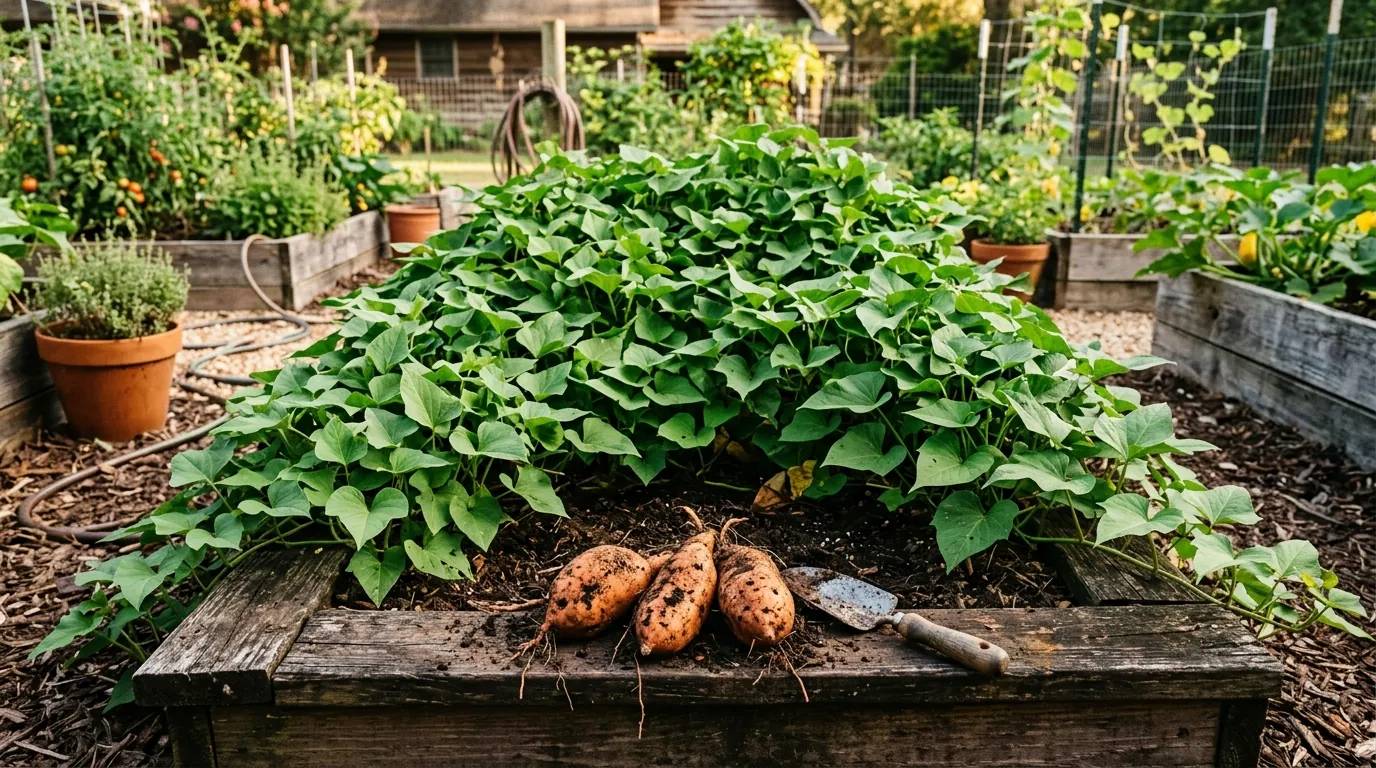
What a true yam is, why the grocery store calls sweet potatoes yams, and which one belongs in your garden.
No, sweet potatoes and yams are not the same plant. A sweet potato (Ipomoea batatas) is a trailing vine in the morning glory family. A true yam belongs to the genus Dioscorea, a separate group of climbing vines that is not closely related to sweet potatoes at all. The orange, soft-fleshed roots sold as "yams" in most American grocery stores are sweet potatoes with a traditional label.
Short answer: if you bought it in an ordinary US supermarket, it is almost certainly a sweet potato, even when the sign says yam. If you want to grow one in your own garden, sweet potatoes are the realistic choice almost everywhere in the country, and you grow them from rooted cuttings called slips.
What a true yam is
True yams are tropical climbing vines in the genus Dioscorea, which has hundreds of species. University of Illinois Extension describes them as monocots in the family Dioscoreaceae, the same broad plant group as grasses, lilies and palms. Sweet potatoes are dicots, which is a different branch of the plant family tree altogether.
Yams are native to Africa and Asia, and Africa grows the large majority of the world's crop. The tubers can be large, with rough, bark-like or hairy skin that is brown or nearly black, and the flesh is usually white, cream or sometimes purple. The texture is starchy and dry, closer to a potato than to the soft, sugary flesh of a baked sweet potato.
Yams are a staple food in parts of West Africa, the Caribbean and the Pacific. In the United States you will mostly find them in Caribbean, African and Latin American grocery stores, sometimes sold in chunks cut from a much larger tuber. A standard supermarket produce aisle rarely stocks them.
What a sweet potato is
The sweet potato is a root crop native to Central and South America. It is a trailing vine in the morning glory family, Convolvulaceae, and you can see the family resemblance in the funnel-shaped flowers it sometimes produces in warm summers. It is also not related to the white potato, which is a nightshade like tomatoes and peppers.
The edible part is the thickened storage root. Skin color runs from pale tan to rose, copper and deep purple, and flesh color runs from white and yellow through orange to purple. Growers separate the types into firm, drier varieties and soft, moist ones that turn syrupy when cooked. Nearly every sweet potato in an American store, whatever its skin or flesh color, is one species.
Why US stores call orange sweet potatoes yams
The confusion has a long history. According to University of Illinois Extension, which cites the Library of Congress, firm sweet potato varieties were grown in the United States before the soft ones. When soft, moist varieties came into commercial production, growers needed a way to tell the two types apart. Enslaved Africans in the South had already begun calling the soft roots "yams" because they resembled the African yams they knew, and the word stuck as a sales term.
Today the label is mostly a marketing habit. Extension sources, including University of Illinois Extension and North Dakota State University Extension, summarize the USDA position this way: when the word "yam" is used for a sweet potato, the product must also be labeled "sweet potato." That is why a bin of orange roots might carry a sign saying "yams" with the words "sweet potatoes" in smaller print. Both signs describe the same plant. We could not find the regulation text itself, so check the USDA sweet potato grade standards if you need the exact wording.
| Feature | Sweet potato | True yam |
|---|---|---|
| Botanical name | Ipomoea batatas | Dioscorea species |
| Plant family | Morning glory (Convolvulaceae), a dicot | Dioscoreaceae, a monocot |
| Origin | Central and South America | Africa and Asia |
| Skin | Thin and smooth, tan, rose, copper or purple | Thick, rough and bark-like, brown to black |
| Flesh | Orange, yellow, white or purple; moist and sweet | White, cream or purple; starchy and dry |
| Where it grows | Warm summers across most of the US, from slips | Frost-free tropics only; far South and Hawaii at best |
| Propagation | Slips grown from a sprouted root | Tuber pieces or, in some species, aerial bulbils |
| Sold in US stores as | Sweet potato, and often "yam" | Yam, mostly in specialty and international stores |
How to tell them apart at the store
Check the label first. If it says sweet potato anywhere, even beside the word yam, it is a sweet potato. Look next at the skin. A thin, smooth skin that you could peel with a fingernail points to a sweet potato. A thick, rough, almost bark-like skin on a very large tuber points to a true yam. Finally, check where you are shopping. A true yam is far more likely to come from a Caribbean or African market than from the produce aisle of a chain supermarket.
Which one can you grow?
For almost every American gardener the answer is the sweet potato. It is a tender, warm-season crop that wants warm soil and a long stretch without frost. Our data lists about 120 days from planting to harvest, so the plants need a full warm season. If you have a short summer, grow it in a raised bed or large container, where the soil warms sooner, and cover the bed with black plastic before planting.
You do not plant sweet potato seeds. You plant slips, which are rooted sprouts that grow from a sweet potato kept warm and moist. Our sweet potato slips guide covers how to grow your own and how to buy them, and the complete sweet potato growing guide covers spacing, soil, vine management and harvest. The sweet potato plant page has the full planting calendar.
When to plant sweet potatoes in your region
Slips go out after frost danger has passed and the soil is warm, and the right months depend on where you live. These are the planting months in our data for several regions, and you can find the dates for your own area on the frost dates page.
- Gulf South: Apr to Jun. See the Gulf South planting calendar.
- Mid-Atlantic: May to Jun. See the Mid-Atlantic planting calendar.
- Midwest and Great Lakes: May to Jun. See the Midwest planting calendar.
- South Florida: Feb to Oct. See the South Florida planting calendar.
- Hawaii: Jan to Dec. See the Hawaii planting calendar.
Our data shows no planting window for the Pacific Northwest or Alaska, where summers are usually too cool for a reliable crop outdoors.
Sweet potato varieties sold in the US
Most home gardeners buy slips of a few well-known varieties. Beauregard is a reliable standard. Clemson Cooperative Extension describes it as having light rose skin and deep orange, very sweet flesh, and lists a harvest time of roughly 90 to 100 days. Johnny's Selected Seeds lists Beauregard slips on its sweet potato page, and notes that its slips are certified, meaning inspected for disease and insect pests. Covington is the dominant commercial variety in the Southeast according to a University of Georgia extension trial, with rose skin and dark orange flesh. Georgia Jet is an earlier type, listed by Fedco Seeds at about 90 days with deep red skin and deep orange flesh, which makes it a common pick for gardeners in cooler states. Availability changes from year to year, so check each seller's current list before you plan around a variety.
Can you grow a true yam in the US?
Only in a very small part of the country. True yams need long, hot, frost-free conditions, so outdoor culture is realistic mainly in South Florida, Hawaii and the warmest parts of the Gulf coast, and even there the crop takes most of a year. Seed tubers are hard to find from ordinary garden sellers, and most yams in the US are imported. If you garden in the rest of the country, a true yam would need a heated greenhouse and a great deal of space, and the sweet potato will give you a far better result for the effort.
A warning about air potato in Florida
Florida gardeners should know about one yam relative in particular. Air potato (Dioscorea bulbifera) is a climbing vine that produces aerial tubers called bulbils, and it is a serious invasive plant. UF/IFAS Extension reports that it forms dense cover that smothers native vegetation, that it grows across the state from the Panhandle to the Florida Keys, and that it is on the Florida Noxious Weed List, which means that plants on that list may not be introduced, possessed, moved or released without a permit. Please do not plant it, trade its bulbils or move them from one place to another. If you find it, UF/IFAS Extension describes how to deal with it and how biological control beetles are being released against it, and your county Extension office is the right place to ask for help.
Using this page to decide
If your question was whether you can swap one for the other in a recipe, the answer is that a sweet potato is a different root with a sweeter, moister texture, and a true yam is much starchier. If your question was what to put in the garden this spring, buy slips of a sweet potato variety suited to your region, plant them once the soil is warm, and give them the full season they need. You can also read how to grow tomatoes in the same warm bed, since both crops like the same heat.
Questions
Are sweet potatoes the same as yams?
No. Sweet potatoes (Ipomoea batatas) are in the morning glory family and come from the Americas. True yams are Dioscorea species, a separate tropical plant group from Africa and Asia. Most of the orange roots labeled yams in US stores are sweet potatoes.
Why does my grocery store sell sweet potatoes as yams?
It is a long-standing naming habit used to separate the soft, moist sweet potato types from the firmer ones. Extension sources summarize the USDA rule as requiring that anything labeled yam also carries the words sweet potato.
Can you eat yams and sweet potatoes the same way?
Both are cooked before eating, but they are not interchangeable in texture. Sweet potatoes are moist and sweet when baked, while true yams are starchy and dry, closer to a potato.
Can I grow yams in my US garden?
Only in the frost-free far South and Hawaii, and the crop takes most of a year. For most gardeners, sweet potatoes grown from slips are the practical choice.
Is air potato a yam I should grow?
No. Air potato (Dioscorea bulbifera) is a prohibited invasive in Florida according to UF/IFAS Extension. Do not plant it or move its bulbils.
When should I plant sweet potato slips?
After frost danger has passed and the soil has warmed. The months depend on your region, so check the sweet potato plant page and your regional planting calendar.
Sources
- University of Illinois Extension: What's the difference between sweet potatoes and yams?
- NDSU Extension: Prairie Fare column on sweet potatoes (labeling note)
- UF/IFAS: Invasive plants in natural areas, air potato (Dioscorea bulbifera)
- Clemson Cooperative Extension: Sweet potato
- Johnny's Selected Seeds: Beauregard sweet potato slips
- Fedco Seeds: Sweet potato slips
Plant profile
The sweet potato profile has sowing times for your region, companion plants and common pests.