
Mealybugs: identify, prevent, control
Updated October 2026
Year round outdoors in Florida, South Texas, Southern California and Hawaii, and in summer and in greenhouses and indoors elsewhere.
Mealybugs are soft, oval sap-feeding insects coated in white wax, closely related to scale insects. They hide in leaf joints, under bark, in fruit clusters and on roots, so colonies are often large before you notice them. Their honeydew and the sooty mold that follows spoil grapes and soursop fruit, and heavy feeding stunts pineapple, hibiscus and aloe.
Family Pseudococcidae, including Planococcus citri, Pseudococcus longispinus and Maconellicoccus hirsutus

How to identify it
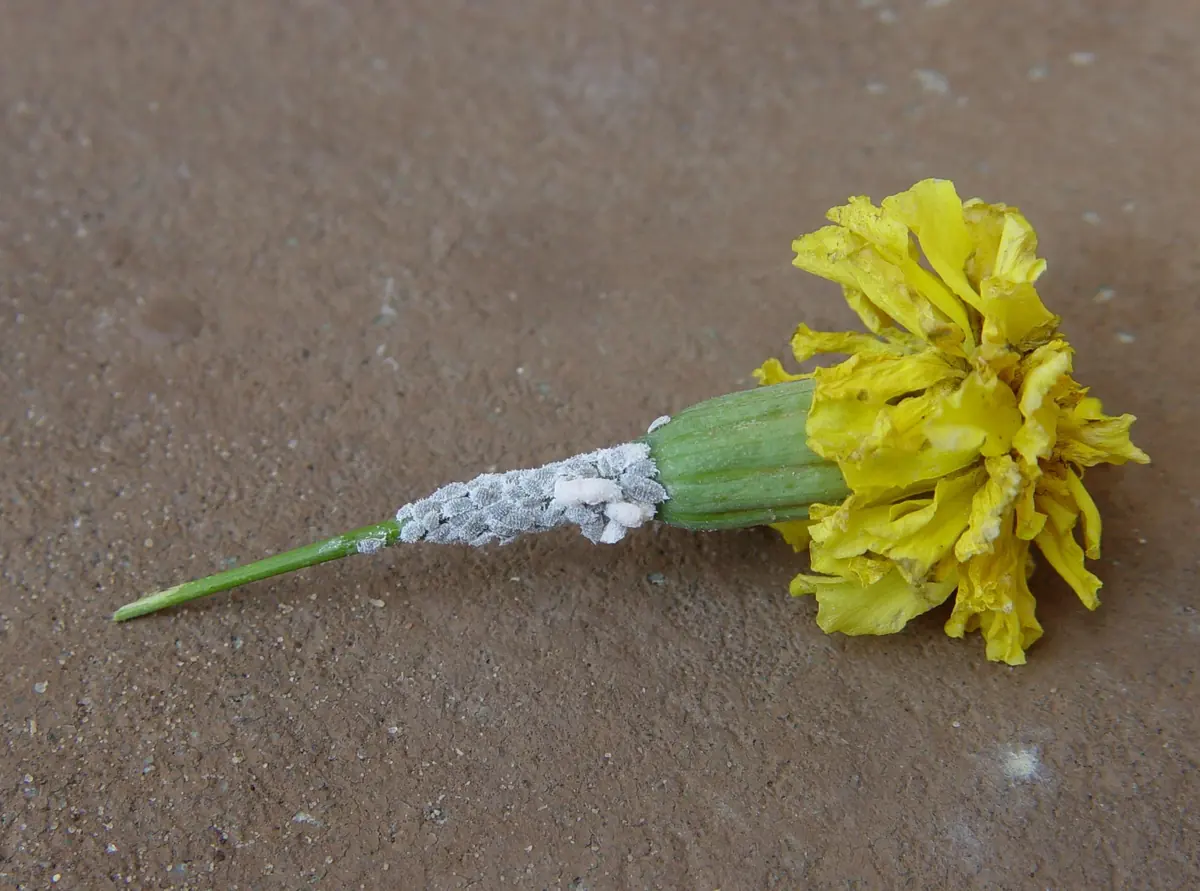
- You usually notice white, cottony tufts in leaf axils, at the base of fruit, or under loose bark, often with ants nearby.
- Look closely and you will see oval insects 1/10 to 1/5 inch long, dusted with white wax and fringed with short or long waxy filaments.
- Fluffy white egg sacs, each holding a hundred or more eggs, sit on stems, bark, and fruit clusters or near the soil line.
- Leaves and fruit below a colony become sticky with honeydew and then black with sooty mold.
- On pineapple, plants that turn red or yellow and wilt may have mealybugs on the roots and lower leaf bases, and pineapple mealybugs are linked to mealybug wilt disease.
- On hibiscus in Florida, crinkled, bunched new shoots with pink-bodied mealybugs under the wax suggest pink hibiscus mealybug.
What it is often confused with
Scale insects
Scales sit fixed under a smooth or hard cover, while mealybugs can still walk slowly and are covered in loose white wax. Cottony cushion scale has a large fluted white egg sac, so look at the body itself.
Aphids
Woolly aphids also carry white wax, but they are pear-shaped and have two short tubes on the rear. Mealybugs are oval and segmented with waxy filaments around the edge.
Whiteflies
Whitefly adults are winged and fly when disturbed, and their nymphs are flat scale-like ovals. Mealybug adult females never fly.
When and where it is worst
Mealybugs breed all year outdoors in Florida, the Gulf Coast, South Texas, Southern California and Hawaii, which is why custard apple, soursop, dragon fruit and pineapple growers see them most. Grape mealybug and vine mealybug are pests of grapevines in California and other grape regions from spring into harvest.
In the Northeast, Midwest, Mountain West and Pacific Northwest they are mostly a problem on potted plants, aloe vera and hibiscus brought indoors for winter, and in greenhouses. Warm, still conditions, ants, and sprays that kill their predators all help them build up.
Plants it attacks
These plants in our library list it as a problem to watch for.
How to prevent it
- Check new plants, cuttings and pineapple tops carefully and keep them apart from your other plants for a couple of weeks.
- Keep ants away from infested plants with sticky trunk bands and ant baits, because ants protect mealybugs from predators.
- Avoid heavy nitrogen feeding, which produces the soft growth mealybugs prefer.
- Strip loose bark from old grape trunks in winter to expose overwintering mealybugs to predators.
- Encourage the mealybug destroyer lady beetle and parasitic wasps by limiting broad-spectrum sprays.
Organic control, step by step
- Wipe or prune off small colonies and egg sacs and bag them.
- On potted plants and aloe, dab individual mealybugs with a cotton swab dipped in rubbing alcohol diluted to 70 percent or less, after testing a leaf for damage.
- Leave the mealybug destroyer alone; its larvae look like large, fluffy mealybugs but move quickly and eat mealybug eggs and young.
- Spray insecticidal soap, neem oil or a horticultural oil thoroughly into leaf joints and fruit clusters, and repeat every one to two weeks while young crawlers are active.
- For grapes, gardeners in warm regions can buy and release mealybug destroyers or parasitic wasps once mealybugs are numerous.
Conventional control
- Pyrethrins or malathion can be used on edible crops whose label lists mealybugs, but they mostly hit exposed young stages and kill predators too.
- Systemic imidacloprid or dinotefuran is labelled for mealybugs on ornamentals such as hibiscus in many states; keep it off plants in bloom, and remember California restricts unlicensed outdoor use on shrubs and trees.
- Read the label, check that the crop is listed, and keep to the pre-harvest interval.
Frequently asked questions
What is the white fluff on my plant?
If the fluff hides small oval insects that move when prodded, it is mealybugs and their egg sacs. If you find a fast-moving white larva about 1/2 inch long, it is probably the mealybug destroyer, a beneficial lady beetle larva that you should leave alone.
Can mealybugs live in the soil?
Yes. Root mealybugs feed on roots and the base of plants, especially in pots, and plants slowly yellow and stall. Slide the plant out of its pot and look for white waxy patches on the root ball.
Should I throw out an infested houseplant?
A light infestation can be cleaned up with alcohol swabs and soap sprays over several weeks. A small plant that is heavily infested, especially with root mealybugs, is often easier to replace than to treat.
Related problems
Sources: UC IPM, Mealybugs (Pest Notes); UF/IFAS Extension, Natural Products for Managing Garden Pests in Florida. Identification and control follow these sources. Always read and follow the product label.