Aphids: identify, prevent, control
Updated October 2026
Worst in the cool, lush growth of spring and fall across most of the country, and through the mild winter in Florida, Texas, the Southwest and California.
Aphids are small, soft-bodied insects that suck sap from tender shoots, buds and the undersides of leaves. A few on a healthy plant do little harm, but colonies multiply quickly, coat plants in sticky honeydew and can spread viruses to peppers, squash, cucumbers, lettuce and potatoes. Most outbreaks collapse on their own once lady beetles, lacewings and parasitic wasps catch up.
Family Aphididae, including Aphis gossypii, Myzus persicae and Brevicoryne brassicae
How to identify it
- You usually notice curled, puckered or yellowing new leaves first, or a shiny, sticky film on the leaves below a colony.
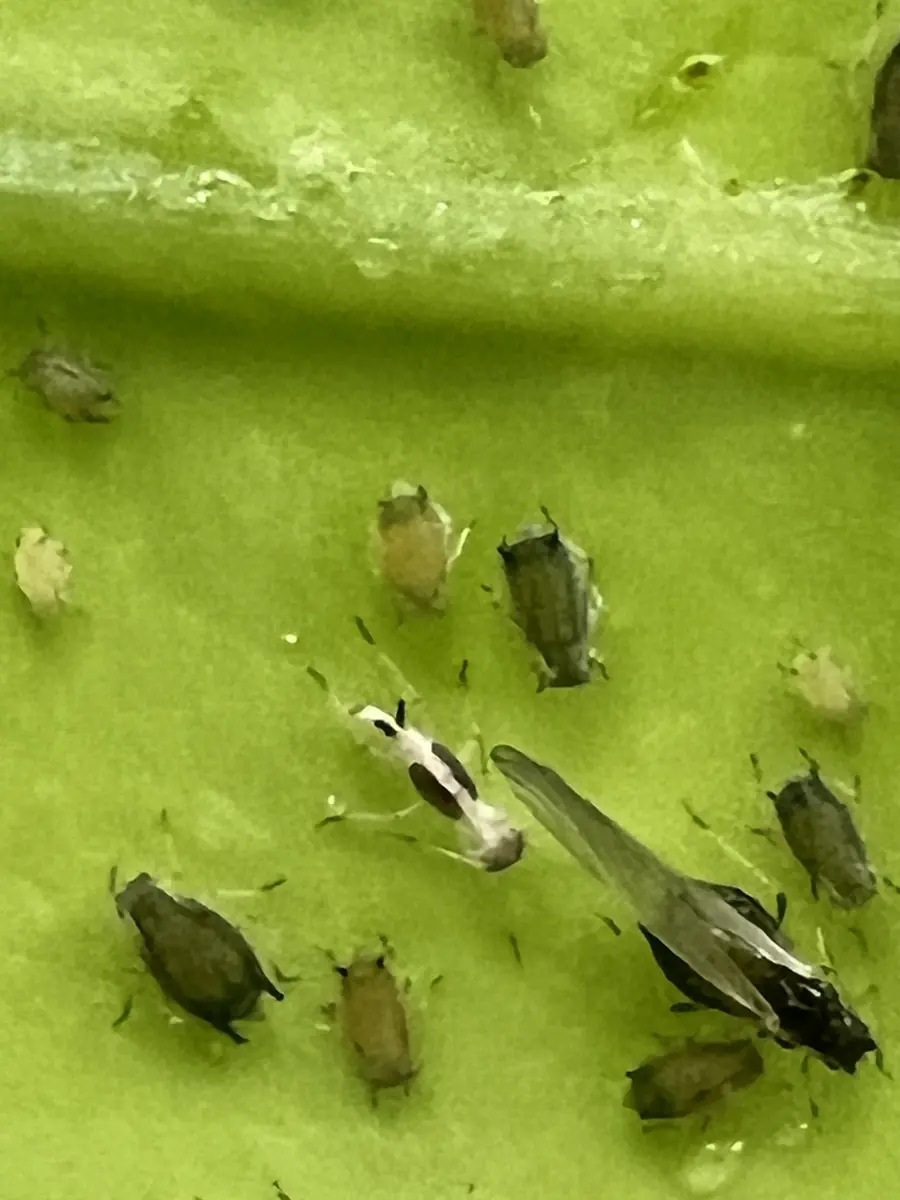
- Turn the leaf over and look for clusters of pear-shaped insects about 1/16 to 1/8 inch long that may be green, yellow, pink, gray, or black.
- Look for two short tubes, called cornicles, pointing backward from the rear of the body, which no other garden insect has.
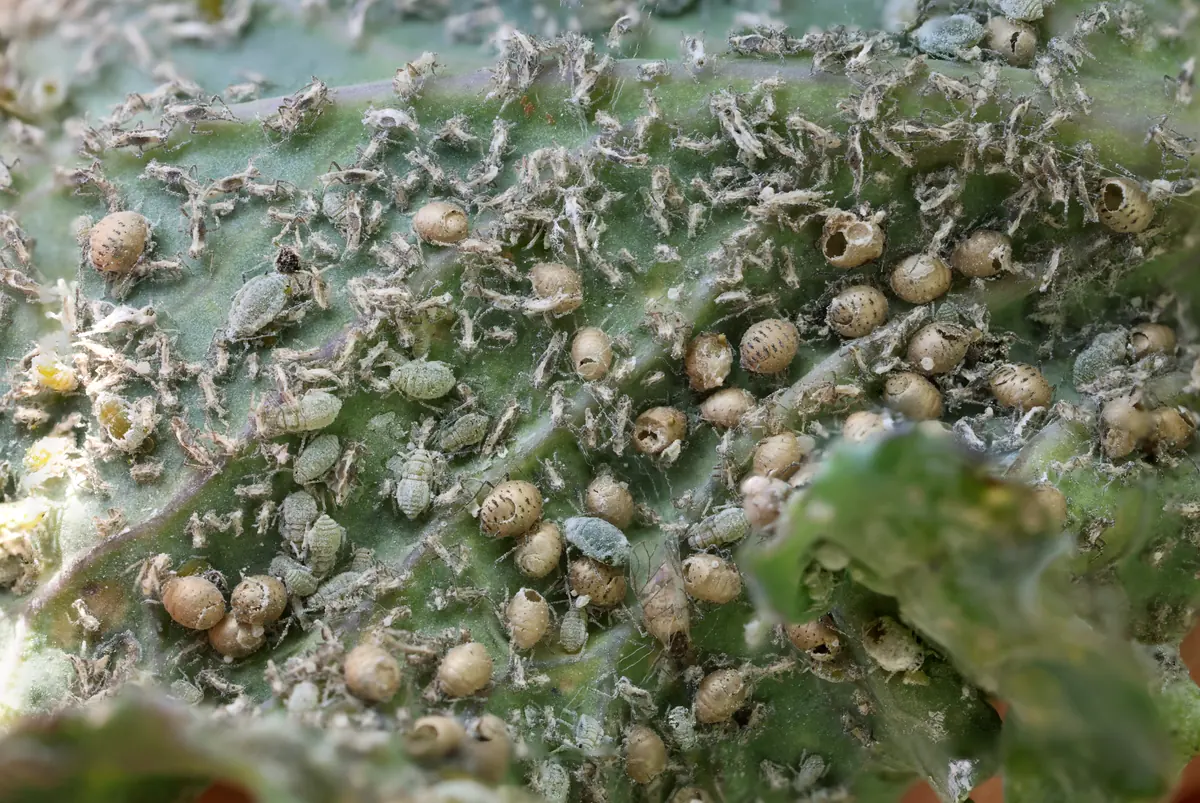
- Check for white cast skins scattered around the colony and for winged adults, which appear when colonies get crowded.
- Watch for ants running up and down the stems, because ants farm aphids for their honeydew and guard them from predators.
- Black sooty mold growing on the honeydew is a sign the colony has been feeding for a while.

What it is often confused with
Whiteflies
Whiteflies also gather under leaves and make honeydew, but the adults are tiny white moth-like insects that fly up in a cloud when you brush the plant. Aphids mostly stay put and have no white wings.
Mealybugs
Mealybugs are covered in white, cottony wax and have no cornicles. Woolly aphids also carry wax, so check for the cornicles and the pear shape under the fluff.
Spider mites
Spider mites cause fine pale stippling and silk webbing rather than curled leaves and honeydew. They are far smaller than aphids and you need a hand lens to see their eight legs.
When and where it is worst
Aphids are found in every region. In the Northeast, Midwest, Great Plains, Mountain West and Pacific Northwest they build up in spring on fresh growth and again as nights cool in fall. In Florida, the Gulf Coast, Texas, the Southwest deserts and coastal California they are often worst from late fall through spring, when brassicas, lettuce, peas and herbs are growing fast.
Mild weather, soft growth pushed by too much nitrogen fertilizer, and the absence of predators all favor them. Hot summer weather and heavy rain knock populations back, and natural enemies usually bring a colony under control within a few weeks if you leave them to work.
Plants it attacks
These plants in our library list it as a problem to watch for.
How to prevent it
- Check the undersides of leaves and new shoots once or twice a week so you catch the first small colonies.
- Go easy on nitrogen fertilizer and use slow-release forms, because soft, lush growth makes aphids breed faster.
- Grow flowers such as sweet alyssum, dill, cosmos and zinnias nearby to feed the lady beetles, lacewings, hover flies and parasitic wasps that eat aphids.
- Cover young brassicas, lettuce and squash with lightweight row cover at planting and remove it from squash when flowering starts.
- Keep ants off fruit trees and shrubs with a sticky barrier band on the trunk so predators can reach the aphids.
- Avoid broad-spectrum sprays that kill beneficial insects, since that usually brings aphids back worse.
Organic control, step by step
- Squash small colonies with your fingers or prune off the worst-infested shoot tips and bag them.
- Knock aphids off sturdy plants with a firm spray of water from the hose every few days; most cannot climb back.
- Look for bronze, puffed-up aphid mummies and lady beetle or lacewing larvae before you spray, and hold off if they are already present in numbers.
- Spray insecticidal soap, neem oil or a horticultural oil, wetting the undersides of the leaves where the aphids sit, and repeat after five to seven days if needed.
- Spray in the cool of the morning or evening and test a few leaves first on sensitive plants such as ferns, sweet peas and some herbs, since soaps and oils can scorch in heat above about 90°F.
- Use pyrethrins only as a last organic option, because they also kill the natural enemies that keep aphids in check.
Conventional control
- Malathion is labelled for aphids on many home vegetables and fruit, but it is hard on bees and predators, so use it only on serious infestations and never on open flowers.
- Pyrethrins combined with piperonyl butoxide give quick knockdown on many vegetables and herbs, with a short pre-harvest interval on most labels.
- Systemic imidacloprid soil drenches are sold for ornamentals in many states, but they should never go on plants in bloom, and in California unlicensed outdoor use on trees, shrubs, flowers and lawns ended on January 1, 2025.
- Read the label, check that the crop is listed, and keep to the pre-harvest interval.
Frequently asked questions
Do aphids go away on their own?
Often they do. Lady beetles, lacewing larvae, hover fly larvae and tiny parasitic wasps usually find a colony within a couple of weeks, and hot weather slows aphid breeding. If the plant is healthy and the damage is light, a hose spray and some patience are often all you need.
What are the tan, swollen aphids that do not move?
Those are aphid mummies, the hardened skins of aphids that have been parasitized by a tiny wasp. A small round hole means the new wasp has already emerged. Mummies are a good sign, so avoid spraying that plant.
Is dish soap safe to spray on aphids?
Household dish soaps and detergents are not made for plants and can burn leaves. A registered insecticidal soap is formulated to kill soft insects with less risk to the plant, and its label tells you which crops tolerate it.
Why do I see ants on plants with aphids?
Ants feed on the sugary honeydew aphids excrete and protect them from predators in return. Controlling the ants with trunk barriers or ant baits often lets natural enemies clean up the aphids.
Related problems
Sources: UC IPM, Aphids (Pest Notes); University of Minnesota Extension, Aphids in home yards and gardens; California Department of Pesticide Regulation, Neonicotinoid pesticides for non-agricultural outdoor use. Identification and control follow these sources. Always read and follow the product label.