Scale insects: identify, prevent, control
Updated October 2026
Present year round, with crawlers hatching mainly in late spring and summer in most regions and almost all year in Florida, South Texas and Southern California.
Scale insects are sap feeders that settle on a plant, lose their legs and hide under a waxy or hard cover, so they rarely look like insects at all. Light infestations are common and harmless, but heavy ones yellow leaves, kill twigs, mark fruit and coat citrus, mango and bay in honeydew and black sooty mold. They are hard to kill once covered, so timing sprays to the mobile crawler stage matters.
Superfamily Coccoidea, armored scales (Diaspididae) and soft scales (Coccidae)

How to identify it
- You often notice sticky leaves, black sooty mold or a stream of ants on a citrus, mango or bay tree before you see the scale itself.
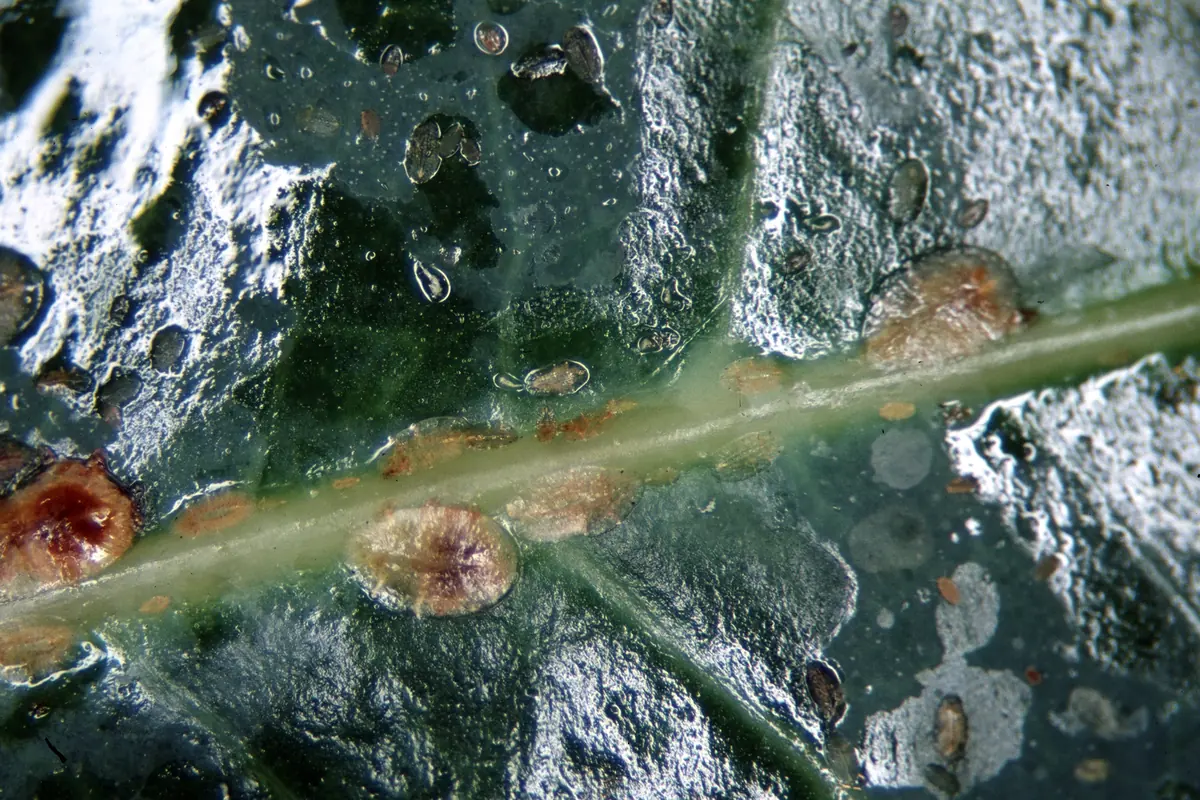
- Look along twigs, leaf midribs and fruit for flat or domed bumps from 1/16 to 1/4 inch across, in brown, black, gray, white or orange.
- Soft scales, such as brown soft scale and black scale, are rounded, fairly large and produce honeydew.
- Armored scales, such as purple scale, California red scale and San Jose scale, are small, flat and hard, make no honeydew and leave the insect behind when you lift the cover with a fingernail.
- Wrap clear double-sided tape around a twig in spring and check it weekly; tiny yellow or orange specks stuck to it are crawlers on the move.
- Heavy infestations show as yellowing leaves, dieback of twigs and, on fruit trees, spotted or pitted fruit.

What it is often confused with
Mealybugs
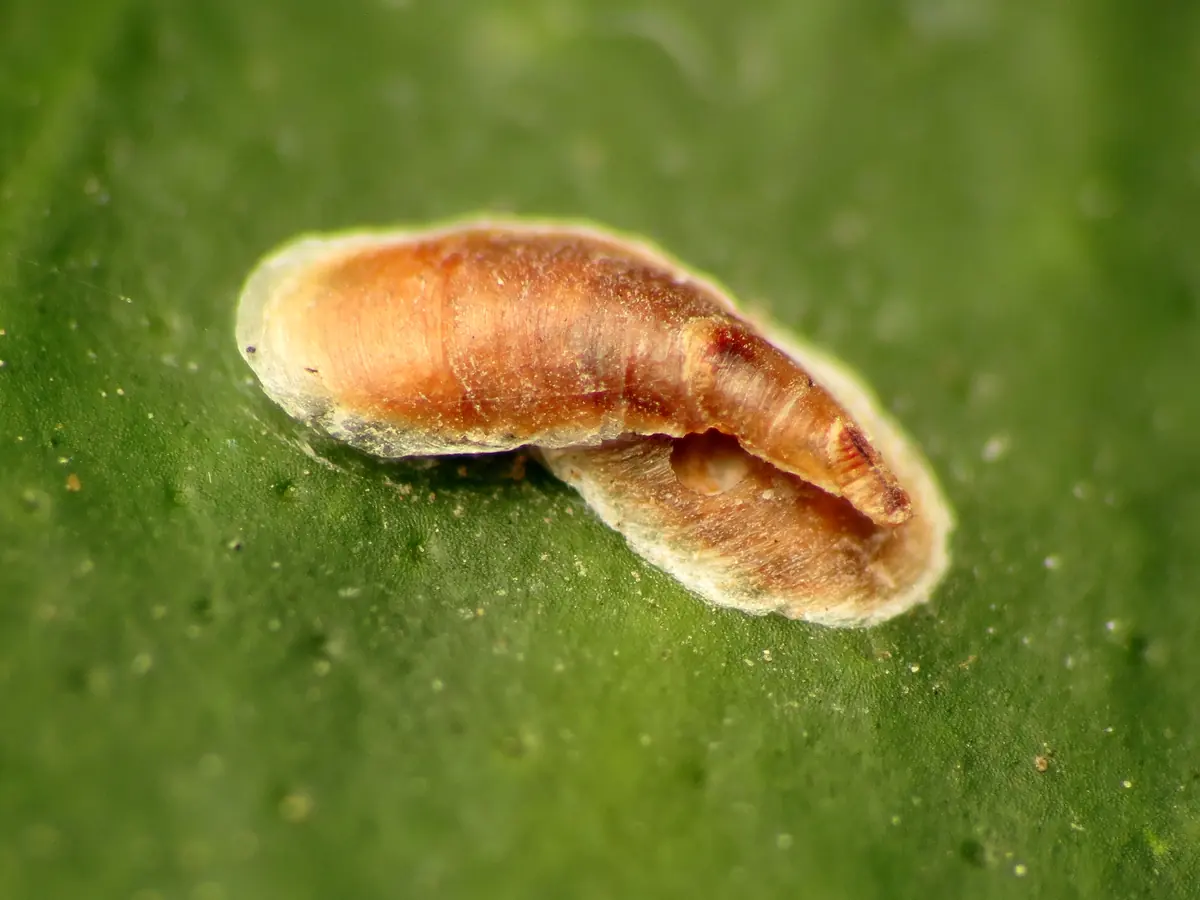
Mealybugs are covered in white, mealy wax and can still crawl slowly. Scales are fixed in place under a smooth cover, although cottony cushion scale carries a fluted white egg sac that can look like a mealybug.
Whiteflies
Whitefly nymphs are flat, oval and scale-like on leaf undersides, but adults fly up as white specks when disturbed. Scales never produce winged adults that you would notice on the plant.
When and where it is worst
Scale is a year-round problem on citrus, mango, sapodilla and white sapote in Florida, the Rio Grande Valley, coastal Texas, Southern California and the low deserts of Arizona. Crawlers can hatch through most of the year there, with peaks in spring and early summer. On peaches, nectarines, apples, pears, kiwifruit and blueberries in the Northeast, Southeast, Midwest and Pacific Northwest, scales overwinter on the bark and crawlers emerge from late spring into summer.
Dusty trees, drought stress, ants guarding the colonies, and sprays that kill parasitic wasps all let scale build up. Indoor and greenhouse plants such as aloe vera and curry leaf can carry scale in any month.
Plants it attacks
These plants in our library list it as a problem to watch for.
How to prevent it
- Inspect new plants, especially citrus and potted tropicals, and do not bring home anything with bumps or sticky leaves.
- Keep trees watered through dry spells and avoid heavy nitrogen feeding, which favors soft scale.
- Band trunks with a sticky barrier and use ant baits so ants cannot protect the scale from parasitic wasps and lady beetles.
- Hose dust off leaves along driveways and paths, because dust interferes with natural enemies.
- Prune out heavily encrusted twigs and branches during routine pruning and bag them.
- Avoid broad-spectrum insecticides that kill the small wasps that keep most scale under control.
Organic control, step by step
- Scrape or rub off small numbers of scale with a soft brush or your fingernail, or prune out the worst twigs.
- Spray horticultural oil on deciduous fruit trees such as peach, apple and pear during winter dormancy to smother overwintering scale.
- In spring and summer, use the tape method to find when crawlers peak, then spray horticultural oil or insecticidal soap just after the peak, when most crawlers have settled.
- On citrus, mango and other evergreen fruit, use a summer-rate horticultural oil and cover twigs and both sides of the leaves thoroughly.
- Avoid oil sprays above about 90°F or on drought-stressed trees, and leave at least a few weeks between oil and sulfur sprays.
Conventional control
- Malathion or pyrethrins can be used against crawlers on fruit trees whose label lists them, timed to the crawler peak, but they will not reach adults under their covers.
- Systemic imidacloprid or dinotefuran soil treatments help against soft scales on ornamentals and some fruit trees in many states; apply after bloom, and note that in California unlicensed outdoor use on trees, shrubs and lawns ended on January 1, 2025.
- Read the label, check that the crop is listed, and keep to the pre-harvest interval.
Frequently asked questions
Are the bumps on my citrus tree alive?
Flip a few covers with a fingernail or knife tip. A plump, moist insect underneath means it is alive, while a dry, empty shell or one with a tiny round exit hole means it is dead or has been parasitized. Old dead scale can stay stuck to bark for months.
When is the best time to spray for scale?
Spray when crawlers are hatching and moving, which you can see as tiny specks on double-sided tape wrapped around a twig. For deciduous fruit trees, a dormant oil in winter is also effective because the bark is bare and easy to cover.
How do I get rid of the black sooty mold?
Sooty mold grows on the honeydew, so it fades once you control the scale and the ants. Rain and hosing will slowly wash it off, and a dilute insecticidal soap spray can help loosen it.
Related problems
Sources: UC IPM, Scales (Pest Notes); UF/IFAS Extension, Natural Products for Managing Garden Pests in Florida; California Department of Pesticide Regulation, Neonicotinoid pesticides for non-agricultural outdoor use. Identification and control follow these sources. Always read and follow the product label.