
Types of Cabbage and Cabbage Varieties: Which to Grow
Updated November 2026
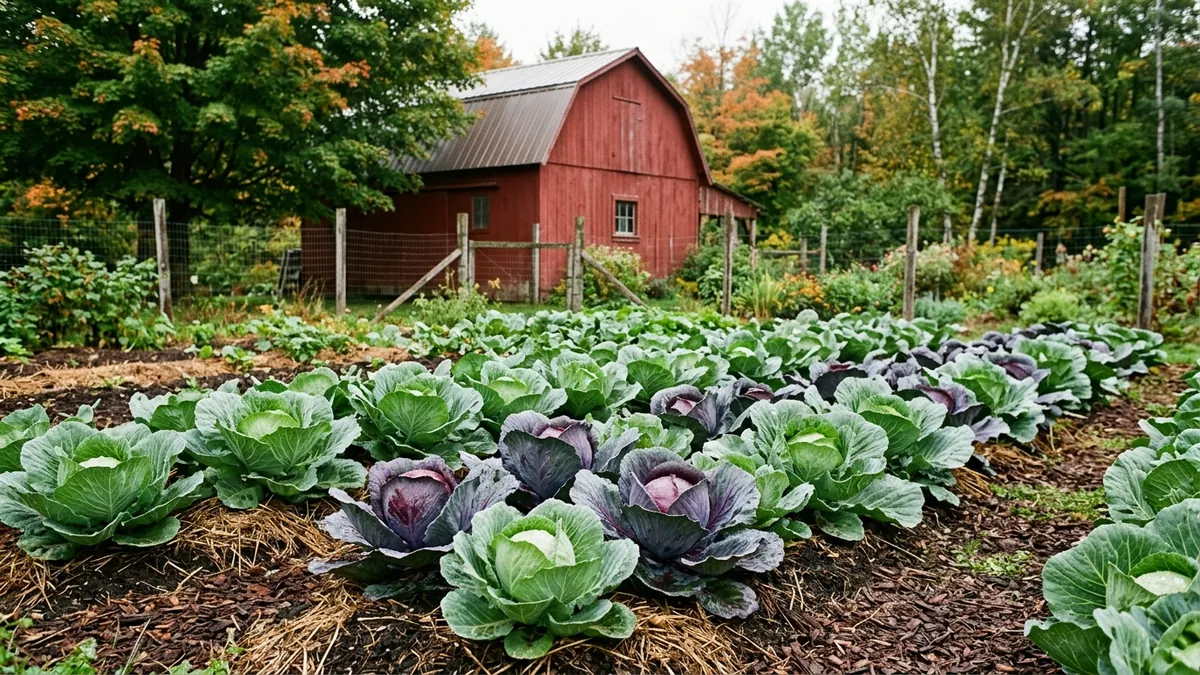
Green, red, savoy, napa, bok choy and flat types, with timing, size and use.
The main types of cabbage are green, red, savoy, napa (Chinese cabbage), bok choy and flat or drumhead types, and within each type you can choose early, midseason or late storage varieties. Early varieties such as Early Jersey Wakefield make small heads in about 60 to 75 days, midseason types take roughly 75 to 90 days from transplanting, and late storage types such as Danish Ballhead need more than 100 days. Which you grow depends on whether you want a spring crop, a fall crop or heads to keep into winter.
Short answer: for fast, small heads grow an early green or pointed type, for coleslaw and storage grow a late green or red, for ruffled leaves choose savoy, and for stir-fries and quick fall crops grow napa or bok choy. Most of the country does best with a fall crop, because heads mature in cool weather and are less likely to bolt.
The main types of cabbage
Green cabbage
Green cabbage is the standard round or pointed head, and it covers the widest range of varieties. Early types are quick and compact. University of California Master Gardener notes list Early Jersey Wakefield at 60 to 75 days, and one seed catalog describes its pointed heads as about 2 to 3 pounds and not suited to storage. Johnny's Selected Seeds sorts its green cabbages into fresh-market and storage groups; its storage-class entries include Storage No. 4 (a cold-tolerant type) and the late-maturing organic Buscaro. Danish Ballhead is the old heirloom storage cabbage, listed by UC at 120 to 125 days. Tendersweet is described by Johnny's as slow-splitting, which helps if you cannot harvest on the day a head is ready.
Red cabbage
Red cabbage, sometimes called purple cabbage, has dense heads that hold well. Red Acre is a classic open-pollinated variety, listed at 74 to 90 days. Johnny's sells Ruby Perfection as a fall storage red, and Red Power as a pointed mini. Red types are usually a little slower than early greens and are used raw in slaws, pickled or cooked.
Savoy cabbage
Savoy has crinkled, ruffled leaves and a looser head. Savoy King is a midseason hybrid that UC lists at a wide 70 to 125 day range, which shows how much the figure moves with planting date and weather. Johnny's lists Samantha as a small, pointed savoy. Savoy leaves cook tenderly and are popular for rolls and wraps.
Pointed or conical cabbage
Pointed heads, including Early Jersey Wakefield, Caraflex and Red Power, are smaller and often quicker. Johnny's describes Caraflex as a pointed mini with very uniform heads. They fit small beds and succession plantings.
Flat or drumhead cabbage
Flat Dutch or drumhead cabbages form wide, flat-topped heads and are traditionally late, large and sold for storage or kraut. Check the packet of any flat variety you buy for its maturity and head weight, because catalogs differ.
Napa cabbage
Napa, also sold as Chinese cabbage or wombok, makes an elongated, frilly, mild head. It prefers cool weather and bolts if it is stressed by long days or heat. Planting Season data lists about 75 days to harvest. Timing and varieties are in the napa cabbage guide and on the napa cabbage plant page.
Bok choy
Bok choy (also pak choi) does not form a head. It makes upright, thick-stemmed rosettes, and it is one of the fastest brassicas: the data lists about 50 days. It suits spring and fall sowings and fits a quick stir-fry crop. See the bok choy plant page for timing in your region.
Cabbage types compared
Days to maturity depend on the source, and some seed companies count from transplanting while others count from seeding or emergence. Treat these as a planning guide and read your own packet.
| Type | Example | Days to maturity | Head size | Best season | Best use |
|---|---|---|---|---|---|
| Green, early pointed | Early Jersey Wakefield | 60 to 75 (UC); about 63 from emergence (seed catalog) | 2 to 3 lb | Spring, or early fall | Fresh eating, not storage |
| Green, storage | Danish Ballhead | 120 to 125 (UC) | Dense, medium to large | Fall, for winter storage | Slaw, kraut, keeping |
| Red | Red Acre | 74 to 90 | Medium, dense | Spring or fall | Slaw, pickling, cooking |
| Savoy | Savoy King | Wide range, 70 to 125 (UC) | Medium, looser | Fall | Cooking, rolls |
| Pointed mini | Caraflex | See seller | Small, uniform | Spring or fall | Small beds, fresh |
| Flat or drumhead | Late Flat Dutch types | Check packet | Large, flat top | Fall | Kraut, storage |
| Napa | Wombok types | About 75 (our data) | Tall, frilly | Fall; spring where cool | Stir-fry, kimchi, slaw |
| Bok choy | Pak choi types | About 50 (our data) | Loose rosette | Spring and fall | Stir-fry, quick cooking |
Johnny's lists black rot resistance for its Botran variety. Other disease resistance claims were not stated on the pages we read, so check packets if clubroot or black rot is a problem in your soil.
Spring versus fall cabbage by region
Cabbage is a cool-season crop that grows best with mild days and handles light frost. In the live data it is a spring and fall crop nearly everywhere, and a winter crop in the Deep South. Here is the planting timing in several regions.
- Northeast: Mar to May and Jul to Sep.
- Midwest and Great Lakes: Apr to May and Jul to Sep.
- Pacific Northwest: Feb to Apr and Jul to Sep.
- Mid-Atlantic: Feb to Apr and Jul to Oct.
- Texas: Jan to Feb and Aug to Sep.
- Gulf South: Sep to Feb.
- Alaska: May to Jul.
Napa follows a similar pattern but is more choosy. Its listed months are Mar to May and Jul to Sep in the Northeast, Apr to May and Jul to Sep in the Midwest and Aug to Oct in Texas. Use the frost dates page to anchor your timing, since spring transplants can go out a few weeks before your last frost and fall heads need time to size up before hard cold.
In the North, choose early types for spring, because they finish before summer heat, and late storage types for a summer sowing that matures in fall. In the South, the main crop is planted in fall and grown through mild winter, and spring plantings must finish before heat arrives. For your own dates, see the frost dates page and the cabbage plant page.
Bolting and splitting
Bolting means a cabbage sends up a flower stalk instead of finishing its head. It is usually triggered by a stretch of cold after young plants have grown large, followed by warm weather, or by heat and stress. Avoid it by timing transplants so they do not sit through a long cold spell, by choosing varieties sold as bolt-resistant, and by keeping plants evenly watered.
Splitting happens when a mature, dense head takes up a rush of water, often after a dry spell followed by rain. Harvest on time, give steady moisture and pick slow-splitting varieties such as Tendersweet. For a head that is nearly ready and facing heavy rain, a half-turn twist of the plant breaks some roots and slows water uptake.
Cabbage worms, loopers and other pests
Cabbage worms and cabbage loopers are caterpillars that chew holes in leaves and bore into heads. Look under leaves for pale yellow eggs and small green caterpillars, and check heads before harvest. Lightweight floating row cover, set over young plants and sealed at the edges, keeps the adult moths and butterflies off. Hand-picking works on small plantings. If you spray, use a registered product, used to the label. The cabbage white and cabbage moth guide and the cabbage worms page cover identification and control, and the flea beetle and clubroot pages cover two other common problems.
Rotate cabbage with non-brassica crops for at least a few years, because clubroot and black rot persist in soil. Full growing detail is in how to grow cabbage.
How to choose a cabbage type
- Decide when you want to harvest: spring, fall or winter storage.
- Match the days to maturity to the cool weather you have left, counting from transplanting.
- Choose small, early or pointed types for small beds and quick meals, and dense late types for slaw, kraut and storage.
- Add slow-splitting types if you cannot harvest promptly.
- Plan row cover from planting day if cabbage worms are common where you live.
Questions
What are the main types of cabbage?
The main types are green, red, savoy, napa (Chinese cabbage), bok choy and flat or drumhead cabbage. Within green and red cabbage, varieties are grouped as early, midseason or late storage.
How many days does cabbage take to mature?
It depends on the variety and on whether days are counted from seeding or transplanting. Early Jersey Wakefield is listed at 60 to 75 days, midseason types at about 75 to 90 days from transplanting, and Danish Ballhead at 120 to 125 days.
Which cabbage is best for storage?
Late, dense varieties store best. Danish Ballhead is a traditional storage heirloom, and Johnny's Selected Seeds lists storage-class types such as Storage No. 4 and Ruby Perfection. Early pointed types such as Early Jersey Wakefield are not meant for storage.
Should I plant cabbage in spring or fall?
Both work in most regions. Spring crops need early varieties that finish before heat, while fall crops mature in cool weather and are less likely to bolt. In the Deep South the main crop is a fall and winter one.
Why did my cabbage head split?
Splitting usually follows a dry spell and then heavy watering or rain on a mature head. Harvest promptly, keep soil moisture even and consider slow-splitting varieties such as Tendersweet.
Is napa cabbage the same as green cabbage?
No. Napa is a Chinese cabbage with an elongated, frilly head and a milder taste. It is faster than most green cabbages and more sensitive to heat and bolting.
Sources
- University of California Master Gardeners, Cabbage
- Johnny's Selected Seeds, Cabbage
- Fedco Seeds, Early Jersey Wakefield cabbage
Plant profile
The cabbage profile has sowing times for your region, companion plants and common pests.