Flea beetles: identify, prevent, control
Updated October 2026
Worst in spring when seedlings first come up, from April to June in most of the country and in late winter and fall in the South.
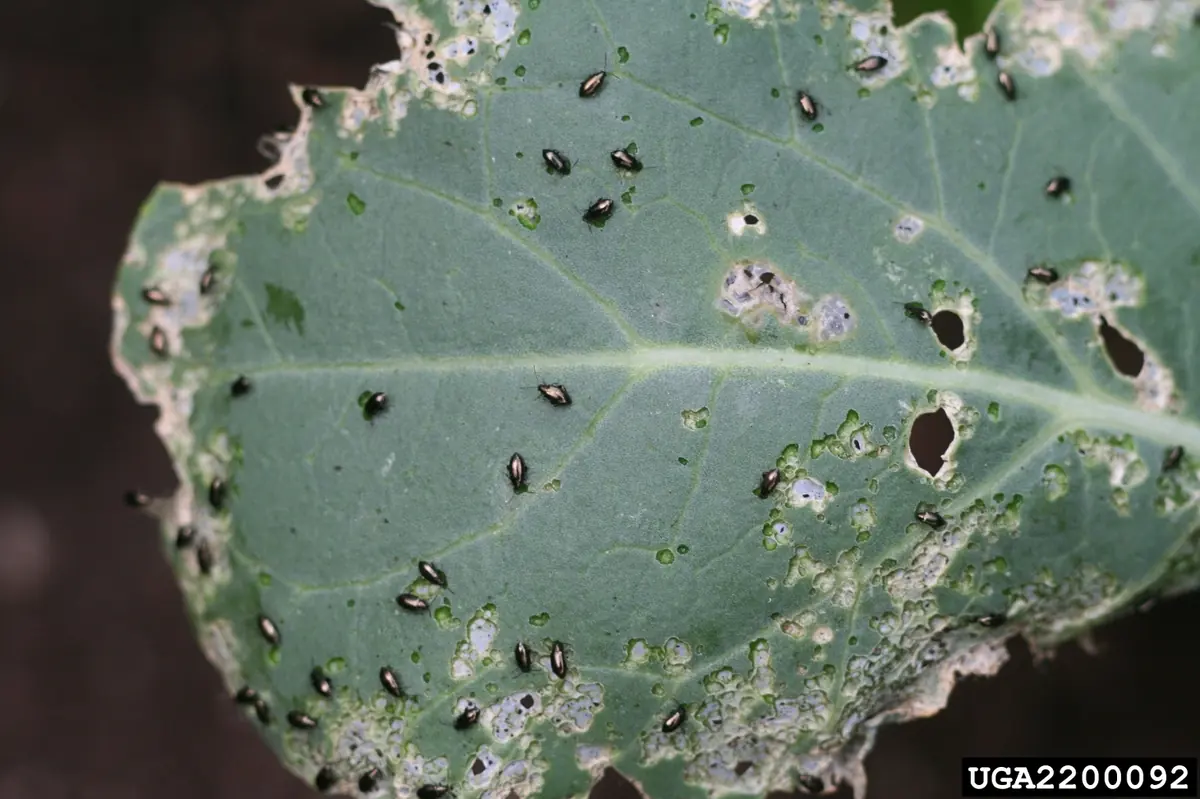
Flea beetles are tiny beetles that jump like fleas when you disturb them and chew small round holes in leaves. On radish, arugula, turnip, mustard greens, tatsoi and other members of the cabbage family the two main culprits are the crucifer flea beetle and the striped flea beetle. Older plants shrug off the damage, but heavy feeding can stunt or kill seedlings within days.
Phyllotreta cruciferae, Phyllotreta striolata
.jpg)
How to identify it
- The first thing you notice is a peppering of tiny round holes and shallow pits, usually less than 1/8 inch across, on seed leaves and young true leaves.
- When you brush the plants, specks jump off in all directions and land a short distance away.
- A close look shows shiny beetles 1/16 to 1/8 inch long with thick hind legs; the crucifer flea beetle is shiny black or blue black, and the striped flea beetle is black with a wavy yellow stripe down each wing cover.
- Badly hit seedlings look lacy, wilt in the afternoon sun and may stop growing or die.
- On radish and turnip roots you may also find small surface scars from the white larvae, which feed in the soil, though this is usually minor.
What it is often confused with
Cabbage worms
Caterpillars make larger, ragged holes and leave green droppings, and you can find the caterpillars on the leaves. Flea beetle holes are small, round and numerous, and the culprits jump.
Leaf spot
Some leaf spot diseases leave round spots that drop out and look like holes, but the spots start as colored lesions with a darker edge before the tissue falls away.
When and where it is worst
Flea beetles occur across the United States. The adults spend the winter in leaf litter, hedgerows and the edges of woods, and they become active on the first warm days of spring, which is why early sowings of radish and arugula get hit hardest. There are usually one or two generations a year in the North.
In the Midwest, Northeast and Great Plains the worst feeding comes from April to early June. In the South, Texas and California they also attack fall and winter greens. Mustard greens, turnips and arugula, which have little protective wax on their leaves, tend to suffer more than cabbage or collards. By midsummer plants with four or five true leaves usually outgrow the damage.
Plants it attacks
These plants in our library list it as a problem to watch for.
How to prevent it
- Cover seed rows of radish, arugula, mustard and turnip with floating row cover the day you sow, and bury the edges so beetles cannot crawl underneath.
- Rotate brassicas to a different bed each year, because covering a bed where beetles spent the winter can trap them inside with your seedlings.
- Sow a little later in spring when the soil is warmer, so seedlings grow quickly through the most vulnerable stage.
- Keep wild mustard, shepherd's purse and other weedy relatives out of and around the garden.
- Clear away old crop debris at the end of the season so fewer beetles find shelter for the winter.
- Use yellow sticky cards near seedlings so you know when beetles are active.
Organic control, step by step
- Keep seedlings well watered and fed so they grow out of the damage fast, which is often all you need once plants have several true leaves.
- Sow a strip of radish or mustard a week or two before your main crop as a trap crop, then pull it out or treat it once beetles gather there.
- Spray spinosad on seedlings if numbers are high, covering both sides of the leaves.
- Use pyrethrins, which kill beetles on contact but break down within a day, so you may need to repeat after a few days.
- Dust or spray kaolin clay on young plants to make them less attractive, and reapply after rain.
Conventional control
- Treat seedlings when you count more than about five beetles per plant, which is the threshold University of Minnesota Extension suggests.
- Carbaryl, permethrin, bifenthrin, cyfluthrin and lambda cyhalothrin are sold in home garden products labeled for flea beetles on many leafy and root crops, but check that radish, arugula or the green you are growing is on the label.
- There is usually no need to spray in summer, because beetle numbers fall and the plants are big enough to cope.
- Read the label every time, check that the crop you are treating is listed, and keep to the pre-harvest interval before you pick.
Frequently asked questions
Do flea beetle holes ruin the crop?
On older plants the holes are mostly cosmetic and the leaves are safe to eat. The real danger is to seedlings, where heavy feeding can kill the plant before it has enough leaf to recover.
Why are my arugula and radishes hit so much harder than my cabbage?
Arugula, radish, mustard and turnip greens are among the flea beetles' favorite foods, and their leaves have less wax than cabbage and collards. They are also usually sown early in spring, right when hungry overwintered beetles emerge.
Are the flea beetles on my eggplant the same ones?
No. Eggplant, potato and tomato are attacked by different flea beetles, such as the potato flea beetle, that do not feed on the cabbage family. The damage and the controls are much the same.
When can I take the row cover off?
For radish, arugula and other leafy brassicas you can leave it on until harvest because they do not need pollinating. If you are letting plants flower for seed, remove the cover at flowering.
Related problems
Sources: University of Minnesota Extension, Flea beetles; Clemson Cooperative Extension HGIC, Cabbage, broccoli and other cole crop insect pests. Identification and control follow these sources. Always read and follow the product label.