Cabbage worms: identify, prevent, control
Updated October 2026
Worst from late spring to fall across the country, and through the cool season in the South, Florida and the Southwest deserts.
Cabbage worms is the everyday name for three caterpillars that eat cole crops: the imported cabbageworm, the cabbage looper and the diamondback moth. All three chew ragged holes in leaves and can bore into heads of cabbage, broccoli and cauliflower, leaving green droppings behind. Seedlings and young transplants suffer most, while older plants can lose a fair amount of leaf without much loss of harvest.
Pieris rapae, Trichoplusia ni, Plutella xylostella

How to identify it
- You usually notice white butterflies with one or two black spots on each forewing fluttering over your brassicas on sunny days, which are the adults of the imported cabbageworm.
- Small holes appear in the leaves next, then larger ragged holes between the main veins as the caterpillars grow.
- Dark green pellets of frass collect at the base of leaves and down inside cabbage heads and broccoli crowns.
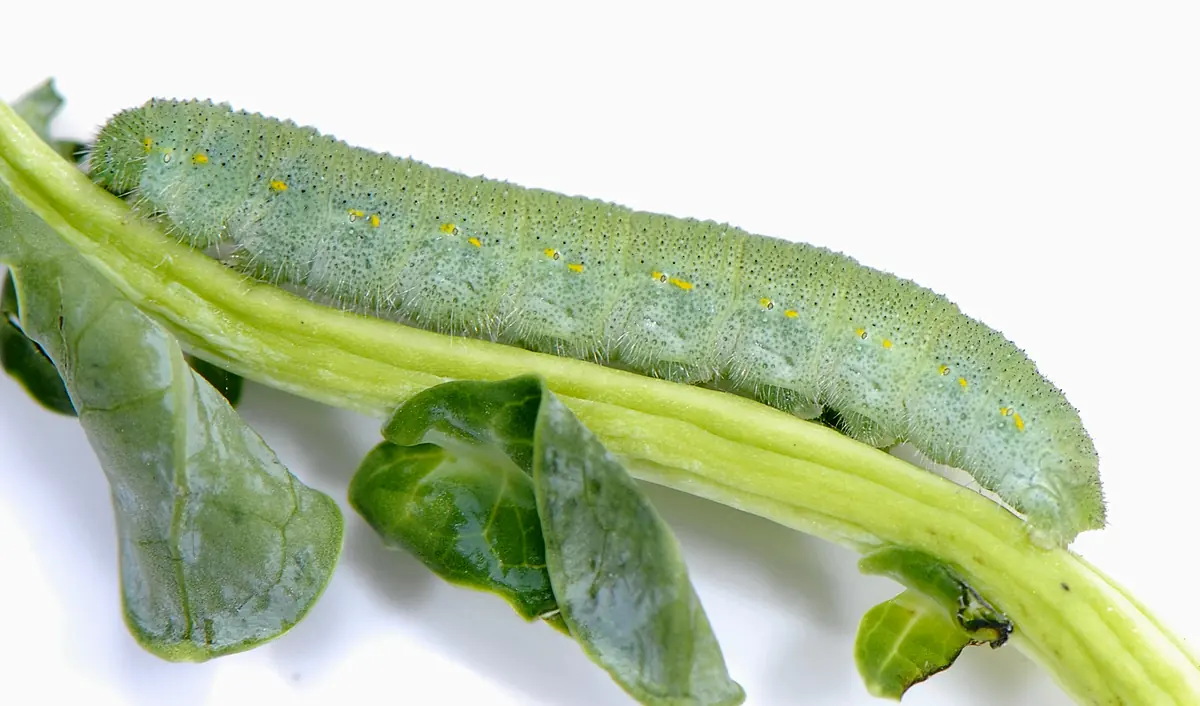
- The imported cabbageworm is velvety green with a faint yellow line down the back, grows to about 1 inch long and moves slowly when you prod it.
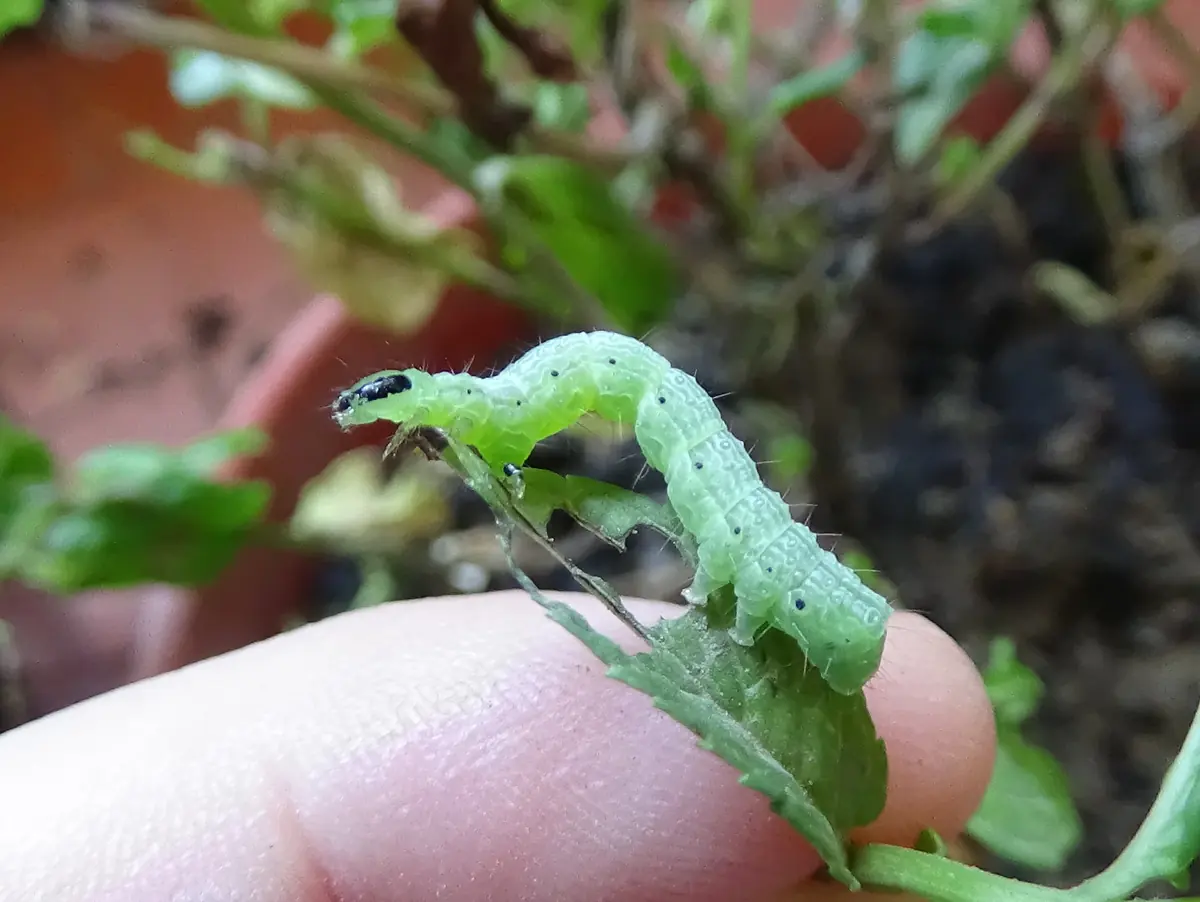
- The cabbage looper is pale green with thin white side lines, grows to about 1.5 inches, and arches its back into a loop as it walks because it has no legs in the middle of its body.
- The diamondback moth caterpillar is only about 1/3 inch long, tapers at both ends, wriggles fast and often drops on a silk thread, and it leaves see-through windowpane patches where it scrapes the leaf.

What it is often confused with
Flea beetles
Flea beetles make many tiny round shot holes, often on seedlings, and the tiny shiny beetles jump when you touch the plant. Cabbage worm holes are larger and ragged, and you will find caterpillars and green droppings.
Slugs and snails
Slugs also chew ragged holes in brassica leaves, but they feed at night and leave silvery slime trails rather than green pellets of frass.
When and where it is worst
The imported cabbageworm is found in every state and is the one most home gardeners meet. In the upper Midwest it spends the winter as a pupa, the butterflies appear from mid-May, and three to five overlapping generations follow until frost. Cabbage loopers cannot survive cold northern winters, so in the Midwest and Northeast they arrive on the wind from the South in July and August, while in Texas, Florida, California and the Southwest deserts they are active for much of the year.
Diamondback moth survives the winter in sheltered spots, has several generations a year, and is often the most numerous cole crop caterpillar in the Southeast, where Clemson reports it all year round. Fall and winter brassicas in the South, Florida and the low deserts carry caterpillars right through the cool season.
Plants it attacks
These plants in our library list it as a problem to watch for.
How to prevent it
- Cover cabbage, broccoli, kale and other brassicas with lightweight floating row cover from the day you plant or transplant, and seal the edges with soil so butterflies and moths cannot get in to lay eggs.
- Leave the cover on until harvest, because cole crops do not need insects to pollinate them for the leaves, heads or roots you eat.
- Check both sides of the leaves at least once a week after planting, and more often in midsummer, looking for the yellow upright eggs of the cabbageworm and the small white dome-shaped eggs of the looper.
- Pull out wild mustard, shepherd's purse and other weedy relatives of cabbage nearby, because they feed the caterpillars between crops.
- Clear away old brassica stalks and leaves as soon as you finish harvesting so pupae have fewer places to spend the winter.
- Leave paper wasps, lady beetles and the small parasitic wasps alone, since they kill a large share of caterpillars in an unsprayed garden.
Organic control, step by step
- Pick off caterpillars and eggs by hand and drop them into a bucket of soapy water, which is quick work on a few plants.
- Rinse broccoli and cauliflower heads in a bowl of salted water after harvest so any hidden caterpillars float out.
- Spray Bacillus thuringiensis subspecies kurstaki (Bt) on both sides of the leaves while the caterpillars are small, and repeat after rain or every 7 to 10 days while they are active, because it only works when they eat it.
- Use spinosad if Bt is not keeping up, applying it in the evening when bees are not foraging, and rotate it with Bt rather than using it alone all season.
- Try neem (azadirachtin) on young caterpillars, which stops them feeding and slowly kills them.
Conventional control
- Pyrethrins give quick knockdown but must hit the caterpillars directly, so spray the undersides of leaves and into the heads.
- Permethrin, bifenthrin, cyfluthrin and carbaryl are sold in home garden products labeled for cabbage worms on many cole crops, but they also kill the wasps and beetles that control caterpillars for you, so keep them for heavy outbreaks.
- Diamondback moth has developed resistance to many insecticides in parts of the South, so switch between products with different active ingredients rather than spraying the same one again and again.
- Read the label every time, check that the crop you are treating is listed, and keep to the pre-harvest interval before you pick.
Frequently asked questions
Are the white butterflies in my garden harmful?
The white butterflies with black wing spots are the adults of the imported cabbageworm. They do no damage themselves, but each one lays eggs on your cabbage family crops, so seeing them is your cue to cover plants or start checking leaves for eggs and caterpillars.
Is it safe to eat broccoli or cabbage with caterpillar holes?
Yes. Cut away badly chewed parts, soak heads of broccoli and cauliflower in salted water for 15 to 30 minutes to float out any caterpillars, then rinse well. The holes do not make the rest of the plant unsafe.
How much damage can my plants take before I need to act?
University of Minnesota Extension suggests that established cole crops tolerate some leaf loss, but you should not let defoliation pass about 30 percent of the leaves. Seedlings and young transplants are far less forgiving, so act early on them.
Why did Bt stop working on my kale?
Bt works best on young caterpillars and breaks down in sunlight and rain within days, so large caterpillars and long gaps between sprays are the usual reasons. Diamondback moth can also become resistant where Bt is used heavily, so rotate it with spinosad.
Related problems
Sources: University of Minnesota Extension, Caterpillars on cole crops; Clemson Cooperative Extension HGIC, Cabbage, broccoli and other cole crop insect pests; UMass Extension, Imported cabbageworm. Identification and control follow these sources. Always read and follow the product label.