
Clubroot: identify, prevent, control
Updated October 2026
Worst in cool to warm, wet, acid soils, typically showing from late spring through fall, and common in the Pacific Northwest, Northeast and Great Lakes states.
Clubroot is a soil-borne disease of cabbage family plants caused by Plasmodiophora brassicae, a microorganism that lives inside roots and makes them swell into hard galls. Swollen roots cannot take up water and nutrients, so plants stunt, wilt and fail to head. Its resting spores survive in soil for many years, so once a bed is infested, management becomes long term.
Plasmodiophora brassicae
.jpg)
How to identify it
- Plants wilt on warm, sunny afternoons and recover overnight, even when the soil is moist.
- Growth slows, lower leaves turn yellow or purplish, and cabbage, broccoli and cauliflower form small heads or none at all.
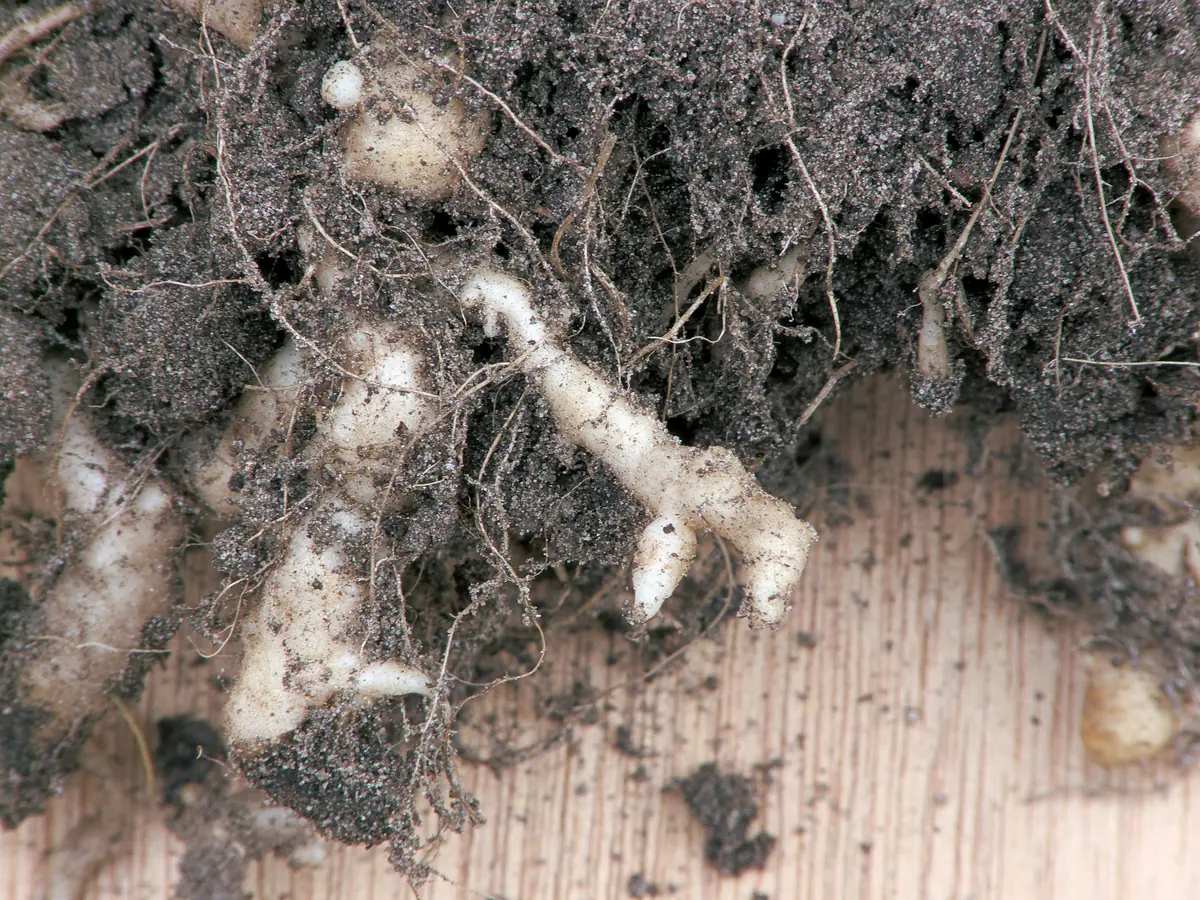
- Dig a plant up and you will find swollen, spindle-shaped or club-shaped roots, from small swellings on the fine roots to large galls on the main root.
- The galls are firm and white or tan at first, then darken and rot, often with a bad smell.
- On turnips, rutabagas, radishes and kohlrabi, the swellings form on the side roots below the edible root, which helps you tell them apart from the normal root.
- Affected plants usually appear in patches, often in the wettest or most acid part of the bed.
What it is often confused with
Root-knot nematodes
Root-knot nematodes make small, bead-like galls along the roots, mostly in warm, sandy southern soils. Clubroot galls are larger, smoother swellings that distort whole roots.
Cabbage maggot
Cabbage maggots tunnel into brassica roots and leave brown channels and small white larvae, not swollen galls.
When and where it is worst
Clubroot spores germinate in wet soil with a pH below about 7.0, and the disease is worst in heavy, poorly drained, acid soils once the soil has warmed in late spring. In the US it is most common in the Pacific Northwest west of the Cascades, the Northeast and the Great Lakes states, and it turns up in home gardens wherever acid soil and frequent brassica planting meet.
The resting spores spread on infested soil carried on tools, boots and transplants, in runoff water, and in manure from animals fed infected plants. They survive in soil for 7 to 10 years or longer, and wild mustards, shepherd's purse and other cabbage family weeds keep them going.
Plants it affects
These plants in our library list it as a problem to watch for.
How to prevent it
- Raise soil pH with lime to 7.2 or above in beds with a history of clubroot, test the soil each year, and add lime again when it drops below 7.2.
- Grow your own transplants in fresh mix, or buy only from a reliable source, since clubroot often arrives on infected seedlings.
- Rotate cabbage family crops, including kale, broccoli, cabbage, radish, turnip and Asian greens, out of an infested bed for at least four to seven years.
- Improve drainage with raised beds and avoid overwatering.
- Control wild mustard, shepherd's purse and other cabbage family weeds in and around the garden.
- Clean soil off tools, boots and wheelbarrow tires after working in an infested bed, and do not move soil from it to other beds.
Organic control, step by step
- Pull infected plants with as much of the root as possible before the galls rot, and bin them; do not compost them.
- Grow resistant varieties where available, which include some cabbage, Chinese cabbage, broccoli, cauliflower and kale varieties.
- Use agricultural lime or dolomitic lime, which are allowed in organic growing, to raise and hold soil pH at 7.2 or above.
- Grow brassicas in containers or a new raised bed filled with clean soil while you wait out a long rotation.
Conventional control
- No fungicides are registered for clubroot control in US home gardens.
- Liming to raise pH, rotation, drainage and clean transplants are the controls available to home gardeners.
- If you use any soil product in a brassica bed, read the label, check that your crop is listed, and keep to the pre-harvest interval shown for that crop.
Frequently asked questions
How long does clubroot stay in soil?
The resting spores survive for many years, with Cornell giving 7 to 10 years or longer. A long rotation helps, but it does not guarantee the bed will be clean.
Does lime cure clubroot?
Lime does not kill the spores, but raising the pH to 7.2 or above greatly reduces infection. It works best combined with good drainage, rotation and clean transplants.
Can I eat broccoli or turnips from plants with clubroot?
Yes. Clubroot does not make the vegetables unsafe to eat. The harvest is usually small, and you should not put the roots in your compost.
Which brassicas are least affected?
Some radish and turnip varieties are only mildly susceptible, and resistant varieties of cabbage, Chinese cabbage, broccoli and cauliflower are available. Check seed catalogs for clubroot resistance, but strains of the pathogen vary, so resistance may not hold everywhere.
Related problems
Sources: UC IPM, Clubroot; NC State Extension, Clubroot of Brassicas; Cornell Vegetables, Clubroot of Crucifers; Oregon State University Extension, Integrated Clubroot Management for Brassicas (EM 9148). Identification and control follow these sources. Always read and follow the product label.