
Anthracnose: identify, prevent, control
Updated October 2026
Worst in warm, rainy weather, especially during bloom and fruit set in Florida, Hawaii, south Texas and the humid Southeast.
Anthracnose is the name for several fungal diseases that cause dark, sunken spots on fruit, leaves, twigs and flowers. Most are caused by Colletotrichum fungi, which hit mango, avocado, papaya, guava and other tropical fruit in Florida and Hawaii, as well as peppers, watermelons and beans across the country. Infections often stay hidden in green fruit and only show up as the fruit ripens, so a crop that looked clean on the tree can rot on the counter.
Colletotrichum species (also Elsinoe veneta on blackberries)
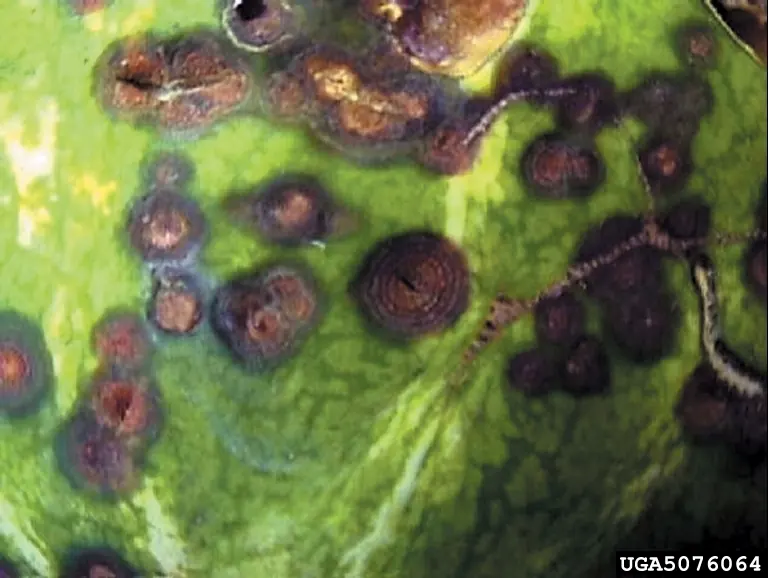

How to identify it
- On mango, avocado, papaya and other tropical fruit, ripening fruit develops round, slightly sunken black or gray-black spots that spread and run together, and the flesh underneath rots.
- In wet weather the centers of the spots carry pink, salmon or orange sticky spore masses.
- Mango flower panicles get small black spots and blacken and die, so few fruit set, and young leaves get brown spots and dead patches along the margins.
- On peppers and chilies, fruit shows small circular sunken spots that grow, develop rings and fill with salmon colored spores.
- On watermelons and other cucurbits, leaves get brown to black spots that fall out, and the rind develops sunken, dark, often ringed lesions.
- On blackberries, canes carry small purple spots that become gray-centered with a purple border, and the bark may crack.
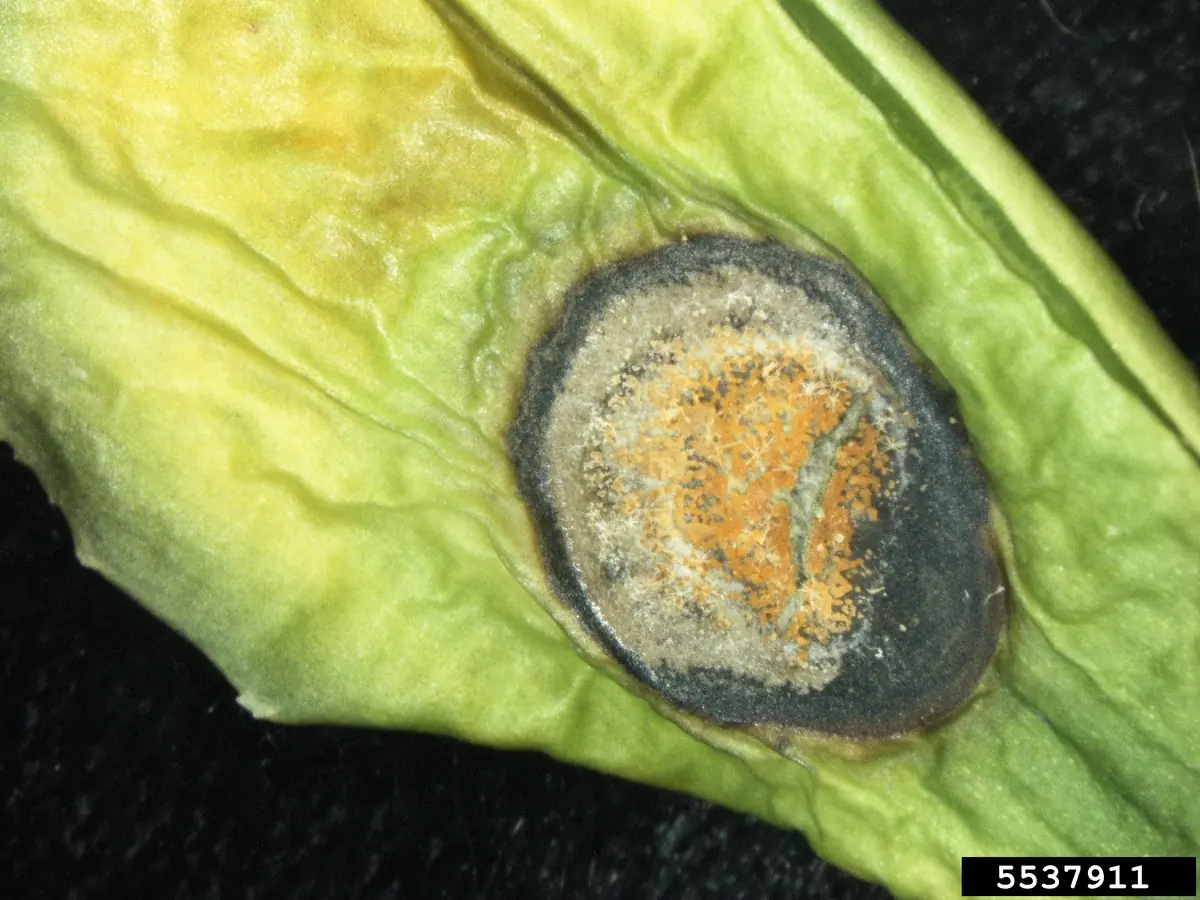
_5537911-_Cesar_Calderon,_Cesar_Calderon_Pathology_Collection,_USDA_APHIS_PPQ,_Bugwood.org.jpg)
What it is often confused with
Leaf spot
Leaf spots stay flat and dry and seldom affect fruit. Anthracnose spots on fruit are sunken and develop pink or orange slime in wet weather.
Bacterial black spot of mango
Bacterial black spot makes raised, angular black spots on mango leaves and star-shaped cracked lesions on fruit that ooze, while anthracnose spots are sunken and smooth edged.
Blossom end rot
Blossom end rot on peppers is a dry, leathery sunken patch only at the bottom of the fruit, with no rings or spore masses.
When and where it is worst
Anthracnose is the most important mango disease in Florida, and it is common on mango, avocado, papaya, guava, starfruit, lychee, longan, dragon fruit, custard apple and soursop in South Florida, Hawaii, south Texas and southern California wherever it rains during bloom and fruit set. Peppers, watermelons and yardlong beans are hit hardest in the hot, humid Southeast, Gulf Coast and Mid-Atlantic in mid to late summer. Olive anthracnose is mainly a problem in wet years in California, and walnut anthracnose appears after wet springs in the Midwest and East.
The fungi spread in splashing rain and irrigation water and survive on dead twigs, old leaves, mummified fruit and crop debris. Warm temperatures around 80°F with rain or heavy dew favor infection, and new leaf flushes and flowers that open in wet weather are the most vulnerable.
Plants it affects
These plants in our library list it as a problem to watch for.
How to prevent it
- Grow mango and avocado varieties with some anthracnose tolerance, and for peppers, beans and melons choose resistant varieties when they are offered.
- Prune tropical fruit trees to open the canopy and remove dead twigs, fallen leaves and old fruit from under the tree.
- Water at the base of vegetables rather than overhead, and use mulch so soil does not splash onto fruit.
- Pick mango, papaya and avocado at the right stage and handle them gently, since bruises let latent infections take hold.
- Rotate peppers, melons and beans away from beds where anthracnose occurred for at least two years.
- Harvest peppers once they start to color and finish ripening indoors.
Organic control, step by step
- Remove and destroy spotted fruit, dead twigs and fallen leaves as soon as you see them.
- Spray copper fungicide on mango trees from when the flower buds start to expand through fruit set, repeating at the label interval while wet weather continues.
- Use copper as a protectant on avocado, papaya, peppers and cucurbits where the label lists the crop.
- On blackberries, cut out infected canes after harvest and apply lime sulfur as a delayed dormant spray before buds break if the label allows.
- Biological fungicides containing Bacillus subtilis or Bacillus amyloliquefaciens can add some protection to vegetables when used before symptoms.
Conventional control
- Chlorothalonil products labeled for home vegetable gardens protect peppers, watermelons and other cucurbits when started at flowering or at the first spots.
- Mancozeb products for home use are labeled as protectants on some vegetables and fruit, so check that your crop is on the label.
- Protectant sprays must be on the plant before rain, so keep to the label interval during wet spells and reapply after heavy rain where the label permits.
- Always read the label, check that your crop is listed and keep to the pre-harvest interval before you pick.
Frequently asked questions
Can I eat a mango with anthracnose spots?
Small surface spots can be cut away and the rest of the fruit eaten if the flesh beneath is firm and clean. Once the rot has spread into the flesh, the fruit tastes off and should be discarded.
Why do my mangoes look perfect on the tree and then rot?
Anthracnose can infect green fruit and stay dormant until the fruit ripens. Spraying during bloom and fruit set and keeping the canopy open reduces those hidden infections.
Is anthracnose on my blackberries the same as on my mango?
No. Blackberry anthracnose is caused by a different fungus, Elsinoe veneta, that attacks the canes. Both diseases spread in wet weather, so pruning and sanitation help in both cases.
When should I spray my mango tree?
UF/IFAS advises keeping a protectant coating on the tree from when the flower buds begin to expand until fruit set, because the flowers and young fruit are the most vulnerable. Your county Extension office can give a local schedule.
Related problems
Sources: UF/IFAS Extension St. Lucie County, Mango anthracnose and its management; NC State Extension, Anthracnose of pepper. Identification and control follow these sources. Always read and follow the product label.