
Botrytis gray mold: identify, prevent, control
Updated October 2026
Worst in cool, cloudy, wet spells at bloom and harvest, from spring strawberries in the South and California to late summer berries and fall flowers in the North.
Gray mold is caused by Botrytis cinerea, a fungus that attacks hundreds of plants and rots fruit, flowers, buds and soft stems. It usually gets in through old flower petals or damaged tissue and then spreads by contact from fruit to fruit. It is the most common reason home-grown strawberries, grapes and raspberries rot before or soon after picking.
Botrytis cinerea
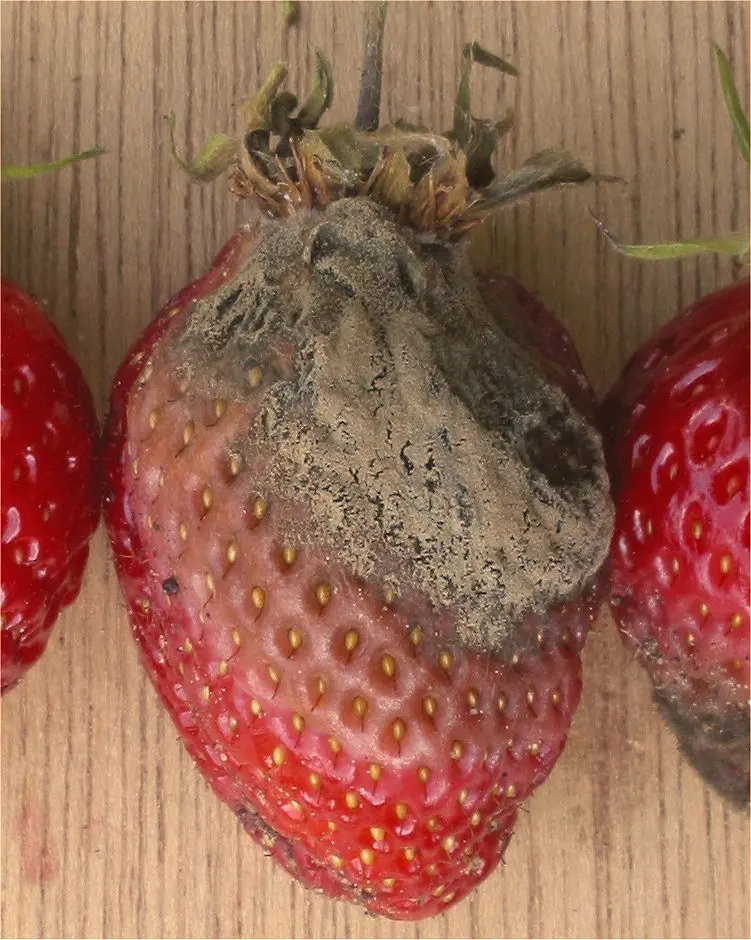

How to identify it
- On strawberries, look first for pale or light brown soft spots near the cap or where a berry touches soil, water or another rotten berry.
- Within a day or two the rot is covered in velvety gray to gray-brown fuzz that puffs out a cloud of spores when you touch it.
- On grapes, blueberries, blackberries and boysenberries, ripe berries turn soft and brown, then gray and fuzzy, and the rot spreads through tight clusters.
- Flowers of dahlias, snapdragons, sunflowers and globe artichokes show brown, water-soaked petals and buds that later carry the gray fuzz.
- On herbs such as thyme and on soft stems, the mold starts on dead leaves or wounds and causes brown, collapsing patches.
- Kiwifruit can look sound at harvest and then develop a soft rot from the stem end in storage.
What it is often confused with
Anthracnose
Anthracnose makes firm, sunken dark spots with pink or orange spores. Gray mold makes soft rot with fluffy gray growth.
Powdery mildew
Powdery mildew is a thin white coating on living leaves. Botrytis is thick gray fuzz on rotting fruit, flowers and dead tissue.
When and where it is worst
Botrytis is a cool weather fungus. It grows best around 60 to 75°F with long periods of high humidity or wet surfaces, such as cloudy, rainy weeks during bloom and harvest. That makes it a spring problem for strawberries in Florida, the Southeast and California, an early summer problem for berries in the Northeast, Midwest and Pacific Northwest, and a late summer and fall problem for grapes and flowers.
The fungus survives on dead leaves, old flower parts and plant debris, so it is present in almost every garden. It infects strawberry flowers during bloom and then sits quietly until the berries ripen, which is why a wet bloom often means rotten berries a month later.
Plants it affects
These plants in our library list it as a problem to watch for.
How to prevent it
- Space plants for good air movement, thin strawberry runners, and open up grape and berry canopies by pruning and leaf thinning.
- Water with drip or a soaker hose, and water in the morning so plants dry by evening.
- Mulch strawberries with straw or plastic so berries do not touch the soil.
- Do not overfeed with nitrogen, which grows dense, soft foliage that stays wet.
- Pick ripe fruit every day or two, handle it gently and refrigerate it promptly, and remove every rotten or damaged berry from the patch.
- Remove dead leaves from strawberries just before bloom and deadhead dahlias and snapdragons regularly.
Organic control, step by step
- Pick off and bin all moldy fruit and spent flowers, taking them right out of the garden.
- Thin grape leaves around clusters after fruit set so the bunches dry quickly.
- Biological fungicides based on Bacillus subtilis or Bacillus amyloliquefaciens are labeled for gray mold on berries and some vegetables and work best when started at bloom.
- Copper products are labeled for gray mold on brambles and strawberries in some home garden products; they protect but do not cure.
Conventional control
- Captan is labeled for gray mold on strawberries, grapes, blueberries and brambles in home garden products; protection matters most from early bloom through harvest in wet weather.
- Chlorothalonil is labeled for Botrytis blight on many ornamental flowers in home products.
- Spray during bloom when wet weather is forecast, because flower infections cause most fruit rot.
- Read the label, check that your crop is listed, and keep to the pre-harvest interval shown for that crop.
Frequently asked questions
Can I eat strawberries from a plant that has gray mold?
Yes, eat the sound berries and throw away any with soft spots or fuzz. Pick often and keep picked fruit cold, because gray mold spreads from berry to berry in the bowl.
Why do my strawberries rot before they ripen?
The fungus infects the flowers during wet weather and stays hidden until the fruit softens. Keeping berries off the soil, picking often and protecting the flowers in wet weather all help.
Is gray mold the same as the mold on fruit in my fridge?
Often it is. Botrytis cinerea keeps growing slowly at refrigerator temperatures, which is why berries picked from an infected patch can mold within days.
Should I compost moldy fruit?
A hot compost pile will break it down, but most home piles are not hot enough to kill the fungus. Bag or bury moldy fruit away from the garden in a wet year.
Related problems
Sources: NC State Extension, Gray Mold or Botrytis Fruit Rot of Strawberry; Clemson HGIC, Gray Mold (Botrytis Blight) on Flowers, Fruits, and Vegetables; UC IPM, Botrytis Rot (Gray Mold) on Strawberries; Penn State Extension, Strawberry Disease: Gray Mold. Identification and control follow these sources. Always read and follow the product label.