Leaf spot: identify, prevent, control
Updated October 2026
Worst in warm, humid weather with frequent rain or overhead watering, usually from midsummer into fall, and through winter in Florida and the Gulf Coast.
Leaf spot is a catch-all name for several fungi that kill small, round patches of leaf tissue. The three you meet most are Cercospora leaf spot on beets, chard and spinach, Septoria leaf spot on parsley and celery, and Alternaria leaf spot on zinnias and other flowers. One spot does no harm, but when spots merge the leaves die early, which costs you greens to harvest and weakens root crops.
Cercospora, Septoria, Alternaria and related fungi
.jpg)
How to identify it
- The first sign is a scattering of small spots, often on the older, outer leaves near the ground where splashing water lands first.
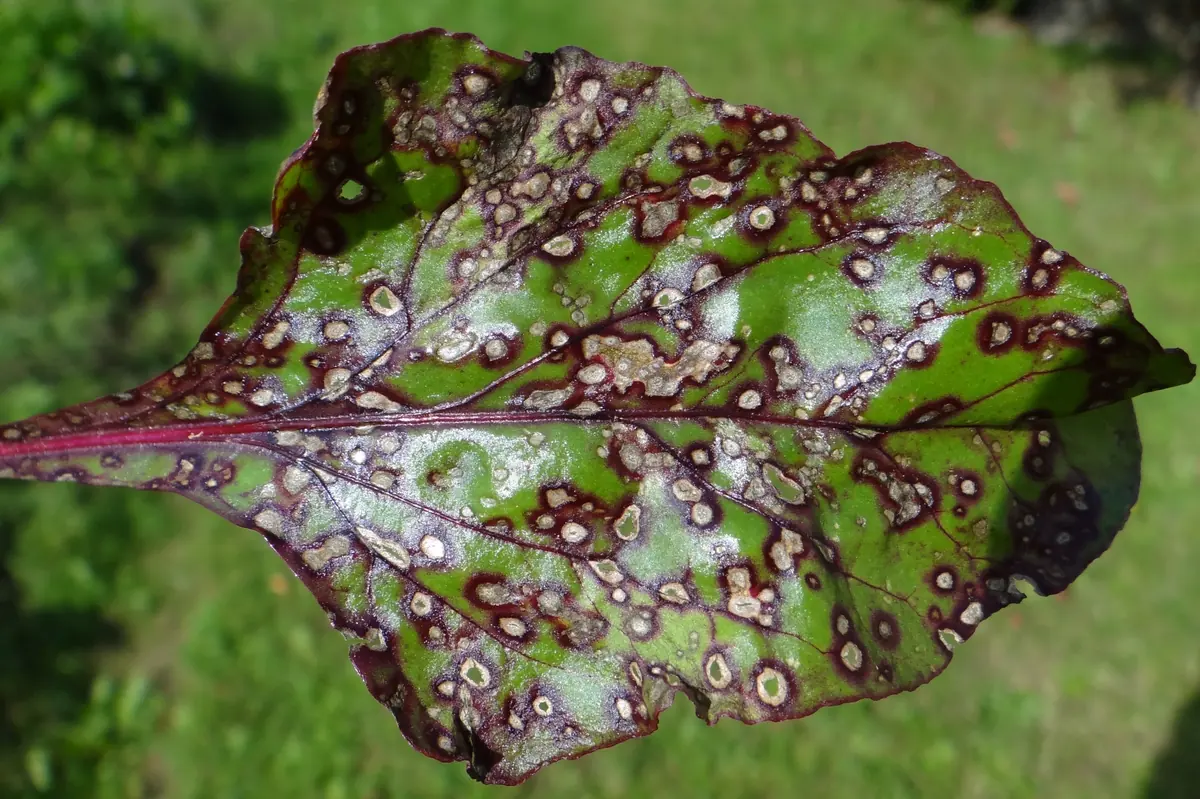
- Cercospora leaf spot on beets, Swiss chard and spinach makes round spots about 1/8 inch across with tan or gray centers and a reddish-purple border.
- Septoria leaf spot on parsley, celery and celeriac makes small, somewhat angular tan to brown spots that may have red-brown margins; look closely and you will see tiny black dots in the centers.
- Alternaria leaf spot on zinnias, calendula and other flowers makes reddish-purple to brown spots that grow larger and often show faint target rings.
- As spots multiply they join into dead patches, the centers may fall out to leave holes, and the oldest leaves yellow and collapse.
- On currants and gooseberries, leaf spot shows as small brown spots in early summer and the bushes may drop many leaves by late summer.
What it is often confused with
Downy mildew
Downy mildew on spinach and chard makes yellow patches with gray-purple fuzz underneath. Fungal leaf spots are round, have defined borders and no fuzz.
Anthracnose
Anthracnose spots are often larger, sunken and dark, and they also attack stems and fruit. Leaf spots stay small on the leaves.
Leaf miner
Leaf miners on beets, chard and spinach make pale blotches or winding trails you can see through, with a larva or its droppings inside.
When and where it is worst
Leaf spot fungi spread by splashing rain and irrigation water and need wet leaves to infect. Cercospora prefers warm, humid weather, roughly the 75 to 90°F range, so it peaks in mid to late summer across the Southeast, Mid Atlantic and Midwest, and through the cool season in Florida and South Texas. Septoria on parsley and celery prefers milder weather and is common in spring and fall plantings and through winter in California.
The fungi survive on crop debris and on seed. Septoria spores can stay alive on dead, dry leaves for a few years, and many outbreaks start from infected parsley or celery seed.
Plants it affects
These plants in our library list it as a problem to watch for.
How to prevent it
- Buy good-quality seed from a reliable seller, and use hot-water treated seed for parsley and celery where you can find it.
- Water at the base with drip or a soaker hose, or water early in the morning so leaves dry quickly.
- Space plants so air moves between them and keep weeds down around beets, chard and parsley.
- Do not grow the same crop group in the same bed more than once every three years, rotating beets, chard and spinach together as one group.
- Mulch the soil to stop spores splashing up from the ground onto the lower leaves.
- Clean up and remove spotted leaves and crop debris at the end of the season.
Organic control, step by step
- Pick off the first spotted outer leaves of chard, beets and parsley and bin them, then harvest from the clean center.
- Keep feeding and watering steady, because stressed plants lose more leaves to leaf spot.
- Fixed copper products give some protection on many leafy vegetables and herbs when sprayed before spots build up and repeated after heavy rain.
- Biological products based on Bacillus subtilis or Bacillus amyloliquefaciens can be part of a regular protective program on listed crops.
Conventional control
- Chlorothalonil is labeled for leaf spot on a range of vegetables in home garden products; start at the first spots and repeat on the label interval.
- Copper products sold for conventional gardens also list many vegetables, herbs and ornamentals for leaf spots.
- Myclobutanil is labeled for leaf spots on many ornamentals such as zinnias and hibiscus, but check the label before using it on any food crop.
- Read the label, check that your crop is listed, and keep to the pre-harvest interval shown for that crop.
Frequently asked questions
Can I eat chard or beet greens with leaf spot?
Yes. The spots are unsightly but the fungus does not make the leaves unsafe. Trim off spotted parts, and remove badly affected leaves so the plant puts its energy into new growth.
Will Cercospora leaf spot ruin my beet roots?
Not directly, but heavy leaf loss means the plant has fewer leaves to feed the root, so beets stay small. Plants often push out new leaves from the center, which uses even more of their reserves.
Why does my parsley get spots every year?
Septoria often arrives on seed and survives on old leaves left in the bed. Start with fresh, good-quality seed, plant in a new spot, and clear out old parsley plants when they go to seed.
Is it the same disease on my zinnias and my spinach?
No. Zinnia leaf spot is usually Alternaria, while spinach and chard get Cercospora. Each fungus mostly stays on its own hosts, but the prevention steps are the same.
Related problems
Sources: University of Maryland Extension, Cercospora Leaf Spot of Vegetables; Penn State Extension, Cercospora Leaf Spot on Table Beets; UC IPM, Septoria Leaf Spot on Cilantro and Parsley; UC IPM, Fungal Leaf Spots. Identification and control follow these sources. Always read and follow the product label.