Fruit tree borers: identify, prevent, control
Updated October 2026
Larvae feed from spring to fall, and the wasp-like moths fly from late spring through early fall depending on species and region.
Fruit tree borers are the larvae of clearwing moths that look like wasps. The peachtree borer tunnels into the base of peach, nectarine, apricot, plum and cherry trunks, the lesser peachtree borer attacks wounds and cankers higher up the trunk and limbs, and the currant borer hollows out the canes of currants and gooseberries. Left alone they weaken and can kill young trees and canes.
Synanthedon exitiosa, Synanthedon pictipes, Synanthedon tipuliformis

How to identify it
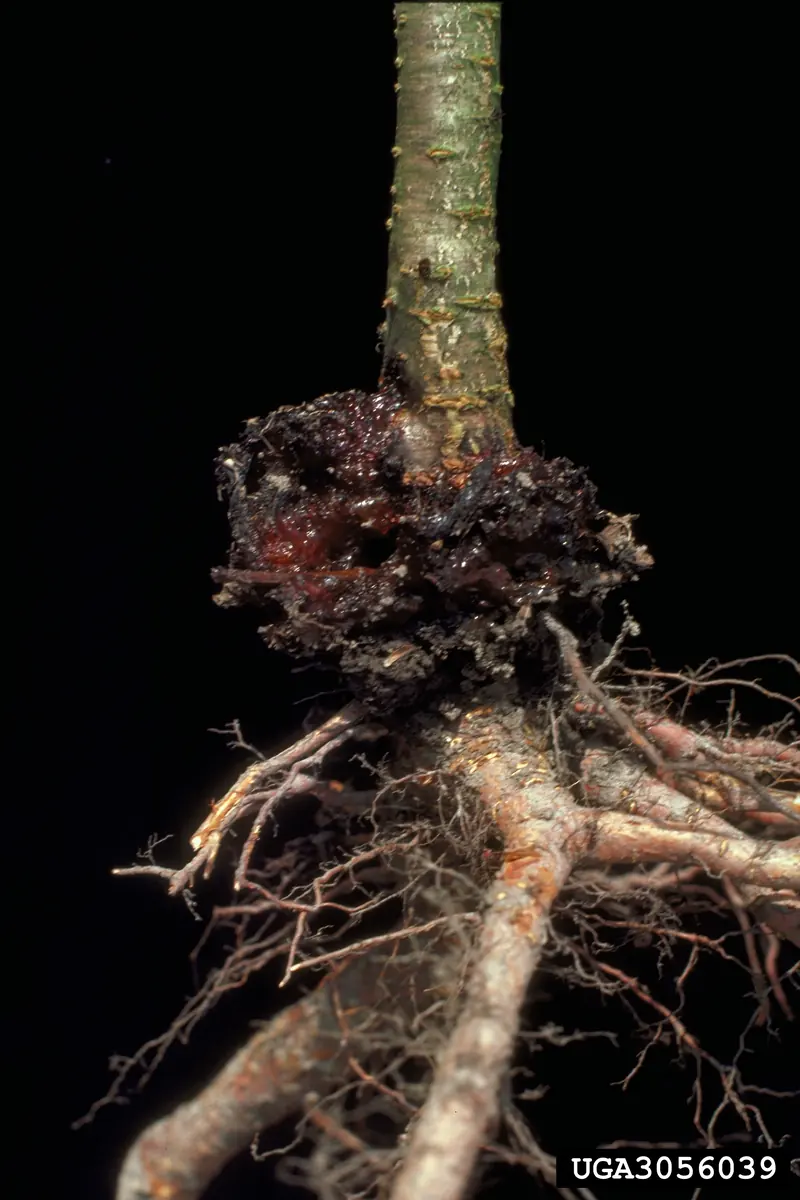
- On peach, nectarine and apricot, the first sign is usually a mass of amber gum at the base of the trunk, from about 3 inches below the soil to 1 foot above, mixed with sawdust and brown frass.
- Higher up the trunk and in the crotches of scaffold limbs, gum oozing from cankers or old pruning wounds with frass in it points to lesser peachtree borer; gum with no sawdust or frass is usually caused by disease or injury, not borers.
- Scrape back the soil and gum and you may find white to cream larvae with brown heads, up to 1.5 inches long for peachtree borer and about 1 inch for the lesser species.
- Empty brown pupal skins sticking out of the bark in summer show where moths have emerged.
- On currants and gooseberries, infested canes leaf out weakly or wilt in spring, and if you cut one you find a dark hollow tunnel running down the center.
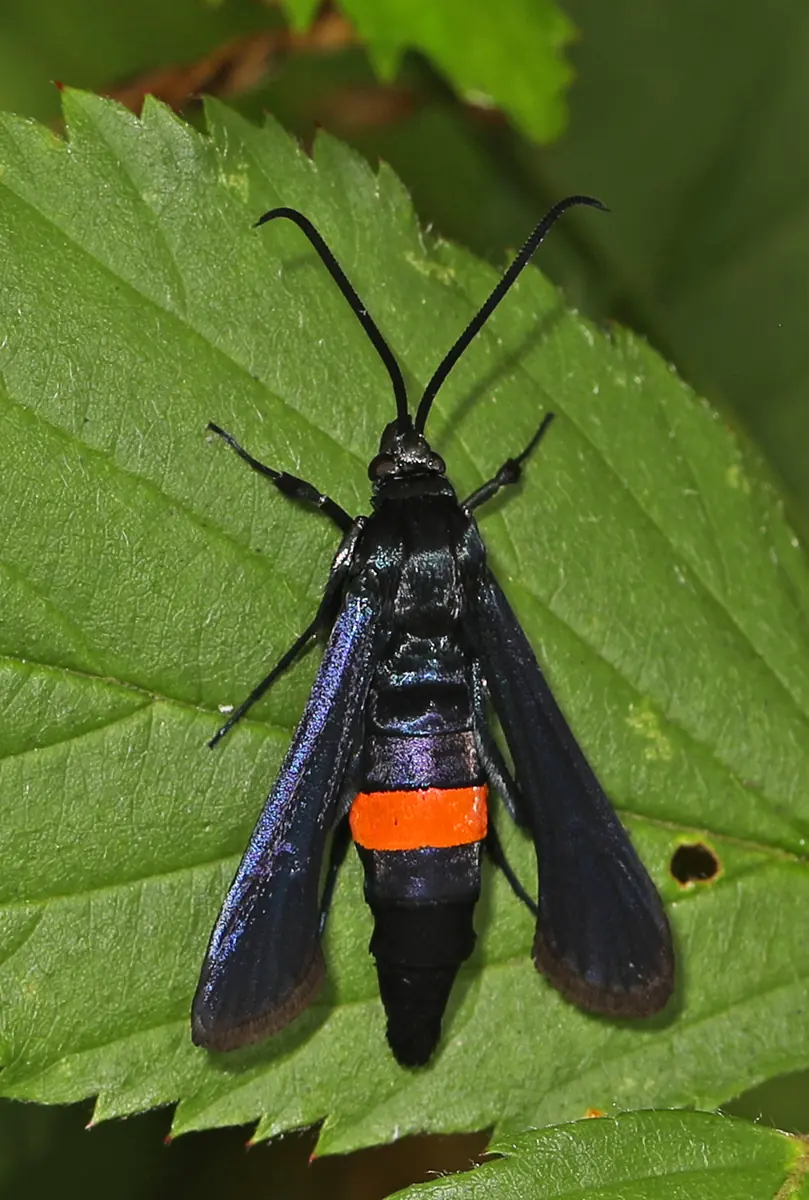
- The adults are day-flying clearwing moths; the female peachtree borer is steel blue with a broad orange band around the body, and the currant borer is blue black with narrow yellow bands.
.jpg)
What it is often confused with
Bacterial canker and gummosis
Stone fruit trees ooze gum from cankers, frost injury and mechanical wounds too. If the gum has no sawdust or frass in it and you find no larvae, the cause is probably disease or injury rather than borers.
Crown rot
Crown and root rots cause decline and dark, soft bark at the trunk base, but without gum mixed with frass or larvae tunneling under the bark.
When and where it is worst
Peachtree borer is a native pest found mainly east of the Rocky Mountains, from the Northeast and Midwest through the Southeast and Texas, with a western form attacking stone fruit in the Mountain West and Pacific states. Larvae spend the winter in the trunk, resume feeding in April, and pupate in early summer. In Pennsylvania most moths fly and lay eggs from July to August, while in the South flight runs later into September. There is one generation a year.
Lesser peachtree borer has two generations a year in the East, with moths in May and June and again in August and September, and it is drawn to trees with Cytospora canker and wounds. Currant borer lays eggs on currant and gooseberry canes in early summer, and larvae spend the winter inside the canes. For jackfruit grown in South Florida and Hawaii, we did not find a US extension source naming a particular borer, so if you see sawdust or frass coming from a jackfruit trunk or branch, take a sample to your county Extension office for identification.
Plants it attacks
These plants in our library list it as a problem to watch for.
How to prevent it
- Keep peach, nectarine and apricot trees well watered and fed, because drought stressed, winter injured and neglected trees are the most likely to be attacked.
- Protect trunks from mower and string trimmer damage, since moths are drawn to wounded bark.
- Keep mulch, weeds and grass pulled back several inches from the base of the trunk so you can inspect it and moths have fewer sheltered spots.
- Prune stone fruit in dry weather and manage cankers, which reduces the wounds lesser peachtree borer uses.
- Prune out and destroy currant and gooseberry canes that leaf out poorly, cutting below any hollow section, before about June 1 so moths cannot emerge, and remove old canes routinely.
- Hang a peachtree borer pheromone trap near your trees in early June to find out when males are flying, which tells you when to treat.
Organic control, step by step
- In fall or early spring, scrape away the soil and gum at the base of each infested tree and kill larvae by pushing a stiff wire or pocketknife into each tunnel, a practice old orchardists call worming.
- Apply insect-parasitic nematodes (Steinernema species) to the gum and soil at the trunk base when larvae are active, accepting that control has been inconsistent in trials.
- Remove and destroy severely infested trees and currant canes so they do not keep breeding moths.
Conventional control
- Permethrin and esfenvalerate are the active ingredients Penn State names for home trunk sprays against peachtree borer; use only a product labeled for peach or the stone fruit you grow.
- Wet the lower 10 to 12 inches of the trunk, and the soil right around it, about 7 to 10 days after the first male is caught in a pheromone trap, or from early August to late September if you are not trapping, repeating as the label allows.
- For lesser peachtree borer, thoroughly wet the trunk and scaffold limbs at peak flight in late June and again in late summer, keeping spray off the fruit.
- Read the label every time, check that the crop you are treating is listed, and keep to the pre-harvest interval before you pick.
Frequently asked questions
What is the gummy sap at the base of my peach tree?
If the gum is mixed with sawdust and brown frass and sits at or just below soil level, it is almost certainly peachtree borer. Clear gum with no frass is more likely from a canker, frost crack or wound.
Can a peach tree recover from borers?
Yes, if you remove the larvae early and the tree is otherwise healthy. Young trees, and trees with several borers girdling the trunk, are at real risk of dying.
Why are my currant canes dying in spring?
Weak, wilting canes with a dark hollow center are a sign of currant borer. Cut them out well below the damage and destroy them before early summer, when the moths emerge.
Do these borers attack apple trees?
Peachtree borers stick to stone fruit such as peach, nectarine, apricot, plum and cherry. Apples have their own borers, such as the roundheaded and flatheaded apple tree borers, which need different handling.
Related problems
Sources: Penn State Extension, Peachtree borer in the home fruit planting; Penn State Extension, Lesser peachtree borer in the home fruit planting; Penn State Extension, Peachtree borer; Pacific Northwest Insect Management Handbook, Currant and gooseberry: currant borer. Identification and control follow these sources. Always read and follow the product label.