Bacterial canker: identify, prevent, control
Updated October 2026
Infects in cool, wet weather from fall through spring, with damage showing at bloom and in early summer, worst in the Pacific Northwest, California and the Southeast.
Bacterial canker is caused by common bacteria that live on the surface of many plants and invade stone fruit trees through frost cracks, leaf scars and pruning wounds in cool, wet weather. Sweet cherries and apricots suffer most, and young trees can be killed outright when a canker rings the trunk. There is no cure, so the aim is to keep trees unstressed and avoid giving the bacteria a way in.
Pseudomonas syringae pv. syringae, Pseudomonas syringae pv. morsprunorum

How to identify it
- In spring, buds fail to open or blossoms and young leaves suddenly turn brown and die, which growers call blossom blast.
- Sunken, dark, often elongated cankers form on branches, spurs or the trunk, frequently around a bud, spur or pruning cut.
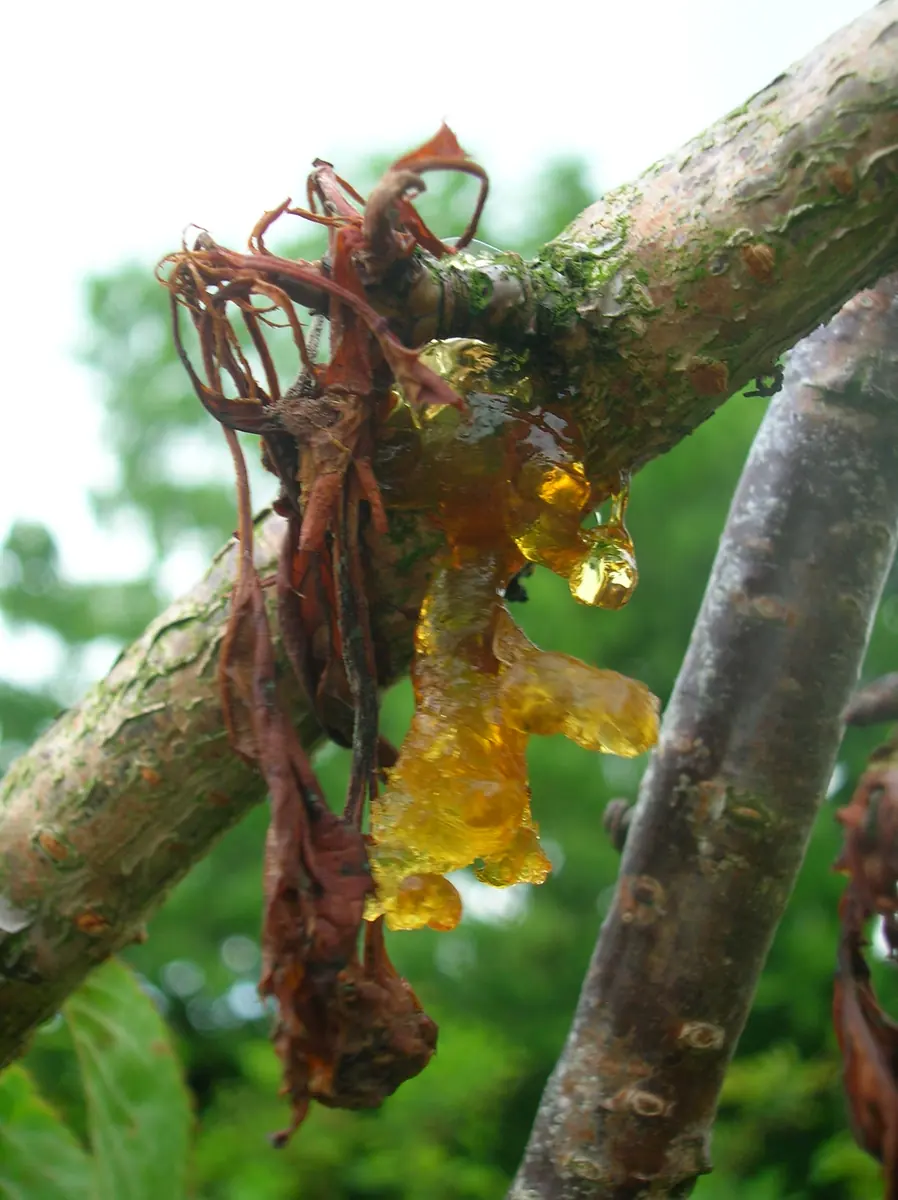
- Amber-colored gum oozes from the edge of the cankers, especially in spring, though gum alone can also come from insects or injury.
- If you cut into the bark at the edge of a canker you see orange-brown to reddish streaks in the inner bark, and the wood may smell sour.
- Leaves get small, dark, water-soaked spots that dry and fall out, leaving a shot-hole look, and some cherry fruit shows dark sunken spots.
- A limb above a canker leafs out and then suddenly wilts and dies in late spring or summer once the canker girdles it.
What it is often confused with
Peachtree borer
Borer damage also produces gum near the base of the trunk, but the gum is mixed with sawdust-like frass and you can find larvae or their tunnels under the bark.
Brown rot blossom blight
Brown rot also kills blossoms and twigs, but dead flowers soon carry powdery tan spore tufts in damp weather, which bacterial canker never produces.
Cytospora canker
Cytospora canker is a fungal canker that also oozes gum, often on sunburned or winter-injured bark, and it develops tiny pimple-like black fruiting bodies on the dead bark.
When and where it is worst
Bacterial canker is a major problem west of the Cascades in Oregon and Washington, in Northern California and in other areas with cool, wet springs. In the Southeast it is part of peach tree short life, where ring nematodes in sandy soils, fall pruning and winter cold damage combine with the bacteria to kill young peach trees. The bacteria multiply on buds and leaves in cool, wet weather, and the ice-nucleating proteins they produce make frost injury worse, opening more wounds.
Most infection happens from leaf fall in autumn through bloom in spring, and the damage shows up at bloom and in early summer. Young trees, trees stressed by poor drainage, low soil pH or poor nutrition, and trees in sandy soil with nematodes suffer most. Kiwifruit has its own bacterial canker (Psa, Pseudomonas syringae pv. actinidiae), a separate disease that has not been found in the United States. USDA APHIS restricts imports of kiwifruit plants to keep it out, so report any suspicious kiwifruit cankers or leaf spots to your state department of agriculture or county Extension office.
Plants it affects
These plants in our library list it as a problem to watch for.
How to prevent it
- Choose a well-drained site, test the soil and correct low pH with lime before planting, and keep trees well fed and watered.
- Prune in summer or during dry weather in late winter, not in fall or in wet weather, so the bacteria cannot enter fresh cuts while they are active.
- Avoid replanting stone fruit where old stone fruit trees grew, and in the sandy soils of the Southeast ask your Extension office about testing for ring nematodes.
- Plant on a rootstock and variety recommended for your area, since some, such as Guardian peach rootstock in the Southeast, are less prone to tree short life.
- Paint the trunks of young trees with diluted white latex paint to reduce winter sunscald and frost cracks, which become entry points.
- Avoid late-summer nitrogen feeding that pushes soft growth into the fall.
Organic control, step by step
- Inspect trees at bloom and again in early summer, and mark limbs with cankers or blasted blossoms.
- In dry weather in summer, cut out cankered limbs several inches below the visible damage, and disinfect pruners between cuts with 70 percent alcohol or a 10 percent bleach solution.
- Remove and dispose of the cut wood rather than leaving it in the orchard.
- A fixed copper spray labeled for stone fruit, applied at leaf fall in autumn and again before bud break, can reduce bacterial numbers on apricots and peaches, though copper-resistant strains are common, especially on cherries.
Conventional control
- Fixed copper products are the only home garden bactericides for bacterial canker, applied at leaf fall and before bud swell, but results are often poor on cherries because of copper resistance.
- No product cures existing cankers, so prevention and timely pruning out of infected wood matter most.
- Read the label, check that your stone fruit is listed, and keep to the pre-harvest interval.
Frequently asked questions
Is the gum on my cherry tree always bacterial canker?
No. Stone fruit trees ooze gum from many injuries, including borers, mechanical damage, frost and other cankers. Bacterial canker gum comes from sunken, dead bark with reddish-brown streaks underneath.
Can a tree with bacterial canker recover?
Older trees often survive if infected limbs are pruned out and the tree is kept unstressed. Young trees with a canker that rings the trunk usually die and are best replaced on a better site.
Why do my young peach trees keep dying in spring in the Southeast?
This is often peach tree short life, where ring nematodes, fall pruning and cold injury combine with bacterial canker. Prune in late winter, test for nematodes and use a recommended rootstock such as Guardian.
Is kiwifruit bacterial canker in the United States?
Kiwifruit bacterial canker, known as Psa, is a separate disease that has not been reported in the United States and is regulated by USDA APHIS. If you see oozing cankers or angular leaf spots with yellow halos on kiwifruit, contact your state department of agriculture or county Extension office.
Related problems
Sources: Pacific Northwest Plant Disease Management Handbook, Apricot bacterial canker and blast; Michigan State University IPM, Bacterial canker (blossom blast); Clemson Cooperative Extension HGIC, Peach diseases; USDA APHIS, Federal Order DA-2010-11 on Pseudomonas syringae pv. actinidiae. Identification and control follow these sources. Always read and follow the product label.