
Brown rot: identify, prevent, control
Updated October 2026
Blossom blight in wet springs and fruit rot in the last two to three weeks before harvest, worst in the humid East and South and in wet springs on the West Coast.
Brown rot is the most common disease of peaches, nectarines, plums, apricots and cherries in home orchards. It strikes twice: in spring it kills blossoms and twigs, and as fruit ripens it can rot a whole crop in a few days of warm, wet weather. The fungus overwinters in shriveled fruit mummies and twig cankers, so clean-up is the foundation of control.
Monilinia fructicola, Monilinia laxa
.jpg)
How to identify it
- In spring, blossoms wilt, turn brown and stay stuck to the twig, often with a gummy ooze where the flower meets the wood.
- The infection can move from the dead flower into the twig, leaving a sunken, gummy canker that may girdle and kill the shoot beyond it.
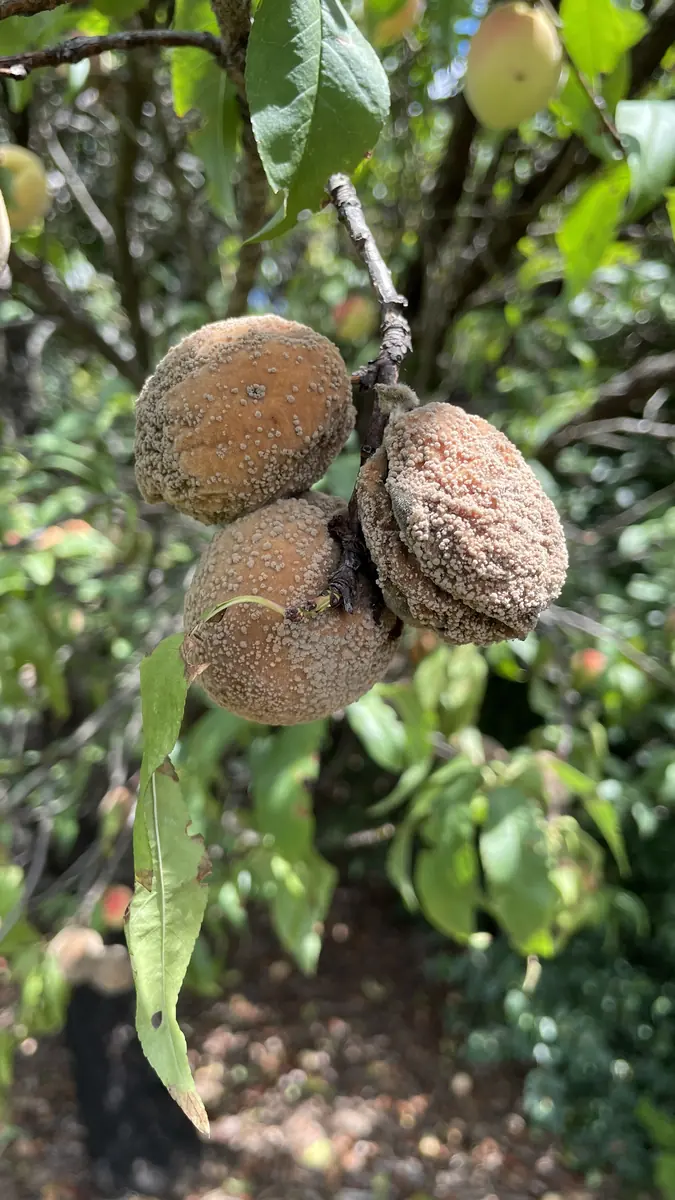
- On ripening fruit, a small, round, light brown spot appears and spreads quickly until the whole fruit is soft and brown.
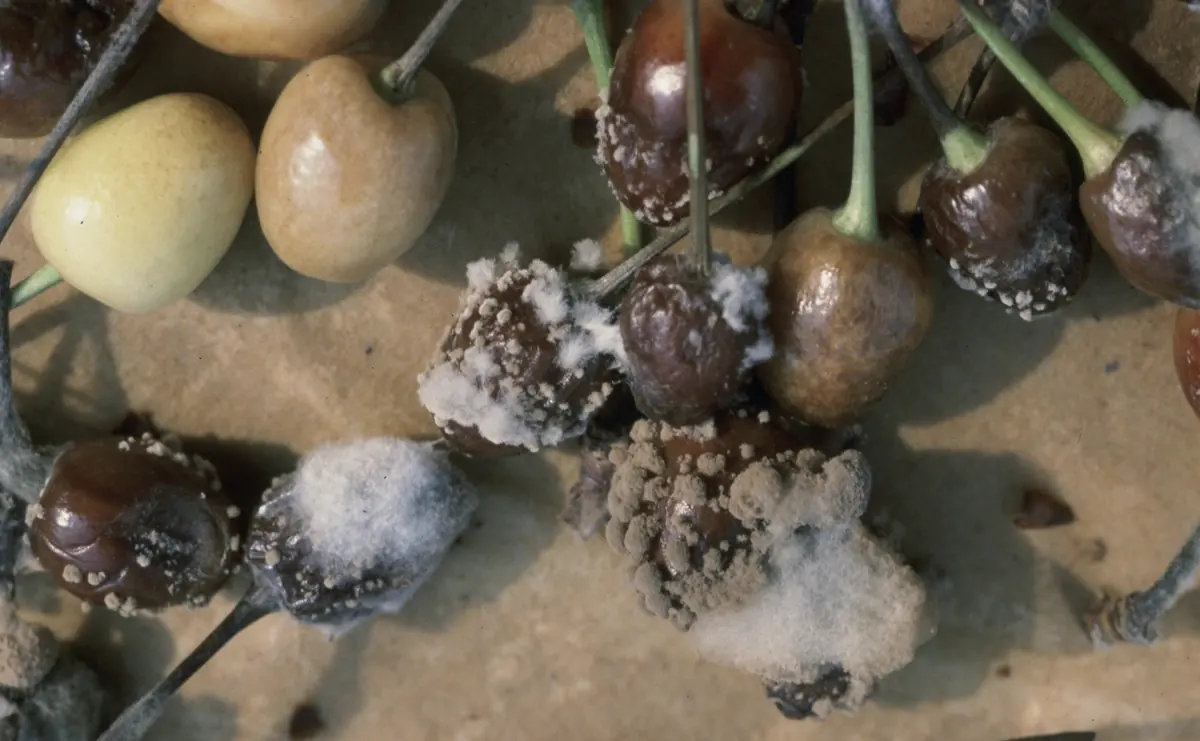
- Within a day or two in humid weather, the rotted fruit is covered in powdery gray to tan tufts of spores, often in rings.
- Rotted fruit either falls or dries on the tree into a hard, wrinkled, black mummy that can hang on all winter.
- On almonds the disease shows mainly as blighted blossoms and dead twig tips in wet springs, rather than as fruit rot.

What it is often confused with
Bacterial canker
Bacterial canker also kills blossoms and makes gummy cankers, but it does not produce tan spore tufts on the flowers, and its cankers are on larger limbs and the trunk as well as twigs.
Gray mold
Gray mold rots soft fruit too, but its spore growth is a looser, fuzzy gray-brown coat rather than the tight, powdery tufts of brown rot, and it is more common on cherries in cool, damp spells.
Rhizopus rot
Rhizopus rot on very ripe fruit is watery and leaky, and its mold is coarse, whiskery and white turning black, unlike the powdery tan tufts of brown rot.
When and where it is worst
Brown rot occurs wherever stone fruit is grown but is most severe in the humid Northeast, mid-Atlantic, Southeast and Midwest, where summer rain falls as fruit ripens. In California and the Pacific Northwest, a second species, Monilinia laxa, mainly causes blossom and twig blight on apricots, almonds and cherries during rainy springs, while the summer fruit rot phase is worst in years with late rain or heavy irrigation.
Blossoms are at risk from pink bud to petal fall whenever they stay wet for several hours in mild weather. Fruit becomes most susceptible in the last two to three weeks before harvest, and any wound from insects such as plum curculio, oriental fruit moth or stink bugs, hail or cracking lets the fungus in. Warm, humid weather with temperatures around 70 to 80°F speeds it up.
Plants it affects
These plants in our library list it as a problem to watch for.
How to prevent it
- Remove every mummified fruit from the tree and the ground in late fall or winter and put them in the trash, because mummies are the main source of spring spores.
- Prune out dead twigs and cankers during dormant pruning, cutting several inches into healthy wood.
- Thin fruit so the fruits do not touch each other, because rot spreads quickly from fruit to fruit where they hang in clusters.
- Prune to an open center or open canopy so air moves through the tree and fruit dries quickly after rain.
- Control fruit-wounding insects and pick fruit promptly as it ripens rather than letting it hang overripe.
- Pick up and dispose of fallen and rotting fruit during the season, and cool harvested fruit quickly.
Organic control, step by step
- Start with the sanitation steps above, which reduce disease more than any single spray.
- During bloom in wet weather, apply sulfur or a Bacillus-based biological fungicide labeled for stone fruit to protect the blossoms.
- From about three weeks before harvest, protect ripening fruit with sulfur or a labeled biological fungicide, repeating after rain.
- Remove rotting fruit as soon as you see it, bag it, and put it in the trash rather than the compost.
- Pick ripe fruit every day or two and refrigerate it soon after picking to slow any infection that has already started.
Conventional control
- At bloom, captan or propiconazole protects the flowers in wet weather; do not use combination home orchard sprays at bloom, because their insecticide harms bees.
- From about a month before harvest, captan, myclobutanil or propiconazole applied every 7 to 10 days protects ripening fruit, and myclobutanil is best saved for this ripening stage.
- Rotate between products from different chemical groups so the fungus does not develop resistance.
- Read the label, check that peaches, plums, cherries or your crop are listed, and keep to the pre-harvest interval.
Frequently asked questions
Can I eat fruit from a tree with brown rot?
Yes, sound fruit from the same tree is fine to eat. Use it quickly, because fruit picked from an infected tree can rot in a day or two at room temperature. Discard any fruit with soft brown spots.
Why do the mummies matter so much?
Mummified fruit on the tree and on the ground produce spores the following spring, including from small mushroom-like cups on buried mummies. Removing all of them breaks the cycle and makes every later step work better.
Which stone fruits get brown rot worst?
Peaches, nectarines, apricots, sweet cherries and plums are all very susceptible as fruit ripens. Apricots, almonds and sour cherries often suffer most from the blossom blight stage.
Can I compost rotted fruit?
It is safer not to. The fungus can keep producing spores on rotting fruit, so bag it for the trash or bury it at least a foot deep away from your trees.
Related problems
Sources: Penn State Extension, Stone fruit disease: Brown rot; Virginia Cooperative Extension, Brown rot of stone fruits (450-721); University of Minnesota Extension, Brown rot of stone fruit; Clemson Cooperative Extension HGIC, Peach diseases. Identification and control follow these sources. Always read and follow the product label.