Fire blight: identify, prevent, control
Updated October 2026
Infects during warm, humid or rainy weather at bloom and on fast-growing shoots in late spring and early summer, in almost every region.
Fire blight is a bacterial disease native to North America that attacks pears, apples, quince, loquat and many ornamental relatives in the rose family. Infected shoots look as if they have been scorched by fire, and the bacteria can run down into larger limbs and the trunk and kill a whole tree, especially pears. It is managed by choosing resistant varieties, avoiding soft growth and pruning out infections promptly and correctly.
Erwinia amylovora
.jpg)
How to identify it
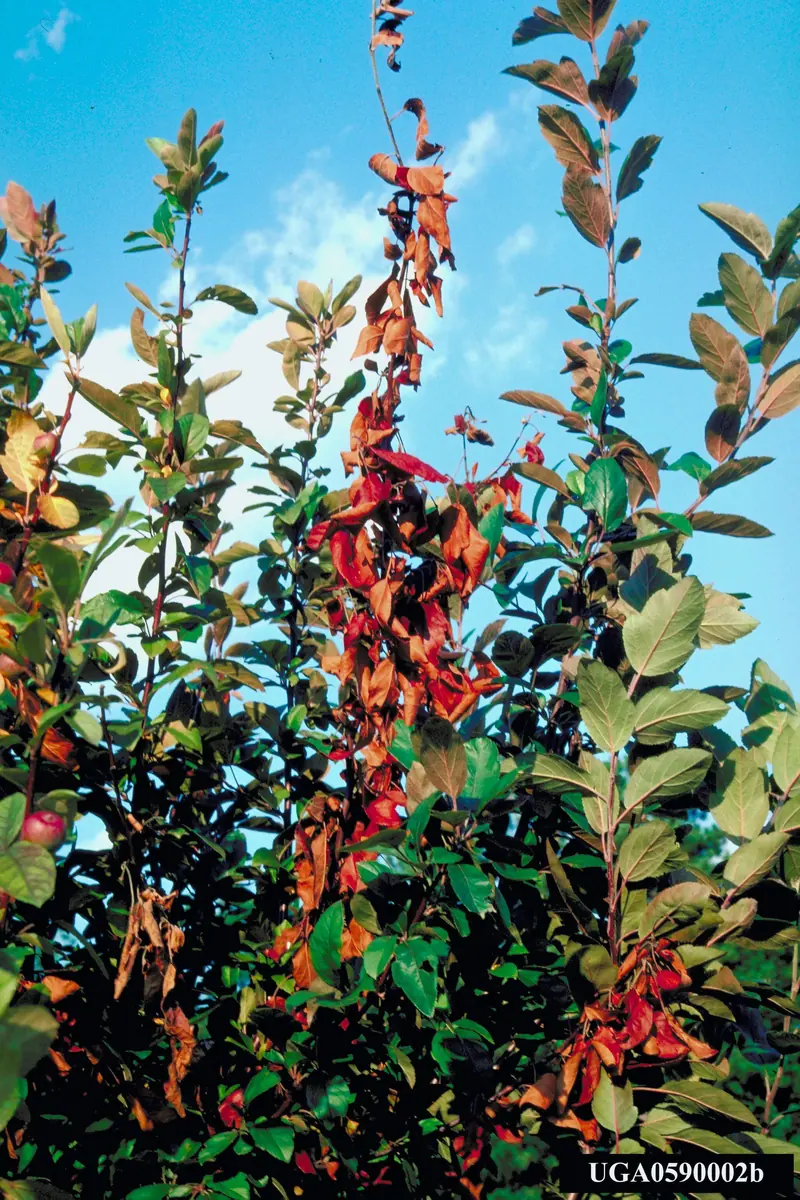
- Shortly after bloom, blossom clusters wilt, turn brown on apples or black on pears, and stay hanging on the spur.
- Young shoot tips wilt, darken and bend over into a hook called a shepherd's crook, and the dead leaves stay attached through the season.
- In warm, humid weather, drops of cream to amber bacterial ooze appear on infected shoots, fruit and cankers.
- Sunken, dark, sometimes cracked cankers form on branches and the trunk where the infection has spread down from a blossom or shoot.
- If you scrape the bark at the edge of an active canker, the wood beneath shows reddish-brown to orange streaks.
- Young fruit on infected spurs turns brown to black, shrivels and stays on the tree, sometimes beaded with ooze.
What it is often confused with
Borer or wood-boring beetle damage
Shoots killed by borers or twig girdlers also wilt, but you will find a tunnel, frass or a neat cut in the twig, and there is no ooze or blackened blossom cluster.
Frost and winter injury
Frost kills blossoms and shoot tips all at once across the tree after a cold night, whereas fire blight appears in scattered clusters days after warm, wet weather and keeps spreading.
Pear blossom blast
Blossom blast from Pseudomonas bacteria kills pear flowers in cold, wet springs but rarely moves into the shoots or forms shepherd's crooks and ooze.
When and where it is worst
Fire blight occurs across the United States and is a frequent problem in the East, the South, the Midwest, the Mountain West and parts of California and the Pacific Northwest. Pears and quince are extremely susceptible, apples and crabapples often get it, and loquat, pyracantha, cotoneaster and hawthorn can be infected as well. The bacteria overwinter at the edges of old cankers and start oozing as trees bloom.
Insects, bees and splashing rain move the bacteria to open flowers, and blossom infection is most likely when daytime temperatures are around 75 to 85°F with rain, heavy dew or high humidity during bloom. Late or second blooms on pears and loquats are often hit hard. Shoots stay susceptible while they are growing quickly in late spring and early summer, and hail or storms that wound leaves can trigger outbreaks.
Plants it affects
These plants in our library list it as a problem to watch for.
How to prevent it
- Choose resistant varieties: among pears, Honeysweet, Kieffer, Magness, Moonglow and Seckel are far more resistant than Bartlett, Bosc or D'Anjou, and among apples avoid highly susceptible ones such as Gala, Fuji, Granny Smith, Jonathan and Golden Delicious where fire blight is common.
- Go easy on nitrogen fertilizer and do not prune heavily in winter, because both push soft, fast shoot growth that blight attacks.
- Pick off late or straggling blossoms on pears and apples that open after the main bloom.
- Cut out old cankers during dormant pruning in winter, when the bacteria are inactive.
- Remove wild or neglected pears, crabapples and pyracantha nearby that carry blight, if you can.
- Control sap-sucking insects such as aphids and leafhoppers, which spread bacteria between shoots.
Organic control, step by step
- Inspect trees every few days from bloom through early summer and remove blighted shoots as soon as you see them in dry weather.
- Cut at the next branch junction below the visible infection, or at least 12 inches below the dead tissue into healthy wood, without leaving stubs.
- Disinfect pruners between cuts with 70 percent alcohol or a 10 percent bleach solution, then oil them later to prevent rust.
- Bag the prunings and remove them from the orchard; do not leave them on the ground.
- During bloom in warm, wet weather, a weak fixed copper or Bordeaux spray, or a biological product based on Bacillus subtilis or Aureobasidium pullulans labeled for fire blight, can reduce new blossom infections, though copper can russet some fruit.
Conventional control
- Streptomycin is the most effective blossom spray and is acceptable for home use, though it can be hard to find; use it only from bloom to petal fall, no more than three or four times a season, and never on shoot blight or cankers, where it does not work and breeds resistance.
- A fixed copper or Bordeaux spray before bud break reduces bacteria on the bark, and copper or mancozeb products labeled for pears and apples can protect new growth from bud break to petal fall.
- Apply blossom sprays only when warm, wet weather coincides with open flowers, and repeat every 4 to 5 days through bloom.
- Read the label, check that pears, apples or your crop are listed, and keep to the pre-harvest interval.
Frequently asked questions
When should I prune out fire blight?
Remove active strikes as soon as you see them in dry weather in spring and early summer to stop them reaching larger wood. Cut out old cankers in winter when the bacteria are dormant, and always disinfect tools between cuts.
Can a pear tree survive fire blight?
Yes, if infections are removed quickly and the trunk is not girdled. Repeated severe infections on a very susceptible variety such as Bartlett can kill the tree, so replacing it with a resistant pear may be the better long-term answer.
Does fire blight affect loquat and quince?
Yes. Quince is extremely susceptible, and loquat is a common host in the South and California, where its late fall and winter flowers can be infected in mild, wet weather.
Is the fruit safe to eat?
Healthy fruit from a tree with fire blight is safe to eat. The bacteria do not harm people, but infected fruit will be shriveled and black and is not worth eating.
Related problems
Sources: UC IPM Pest Notes, Fire blight; Penn State Extension, Fire blight in home apple and pear orchards; Purdue Extension, Fire blight (BP-30-W); University of Georgia Extension, Fire blight: symptoms, causes and treatment (C 871). Identification and control follow these sources. Always read and follow the product label.