
Spotted wing drosophila: identify, prevent, control
Updated October 2026
Worst from midsummer to fall as fruit ripens, with late ripening berries hit hardest when fly numbers peak.
Spotted wing drosophila is an invasive vinegar fly from East Asia, first found in California in 2008 and now present across much of the United States. Unlike ordinary fruit flies, which go for overripe or damaged fruit, the female cuts into firm, ripening fruit to lay her eggs. The larvae feed inside, so blueberries, raspberries, blackberries, cherries and strawberries turn soft and collapse soon after picking.
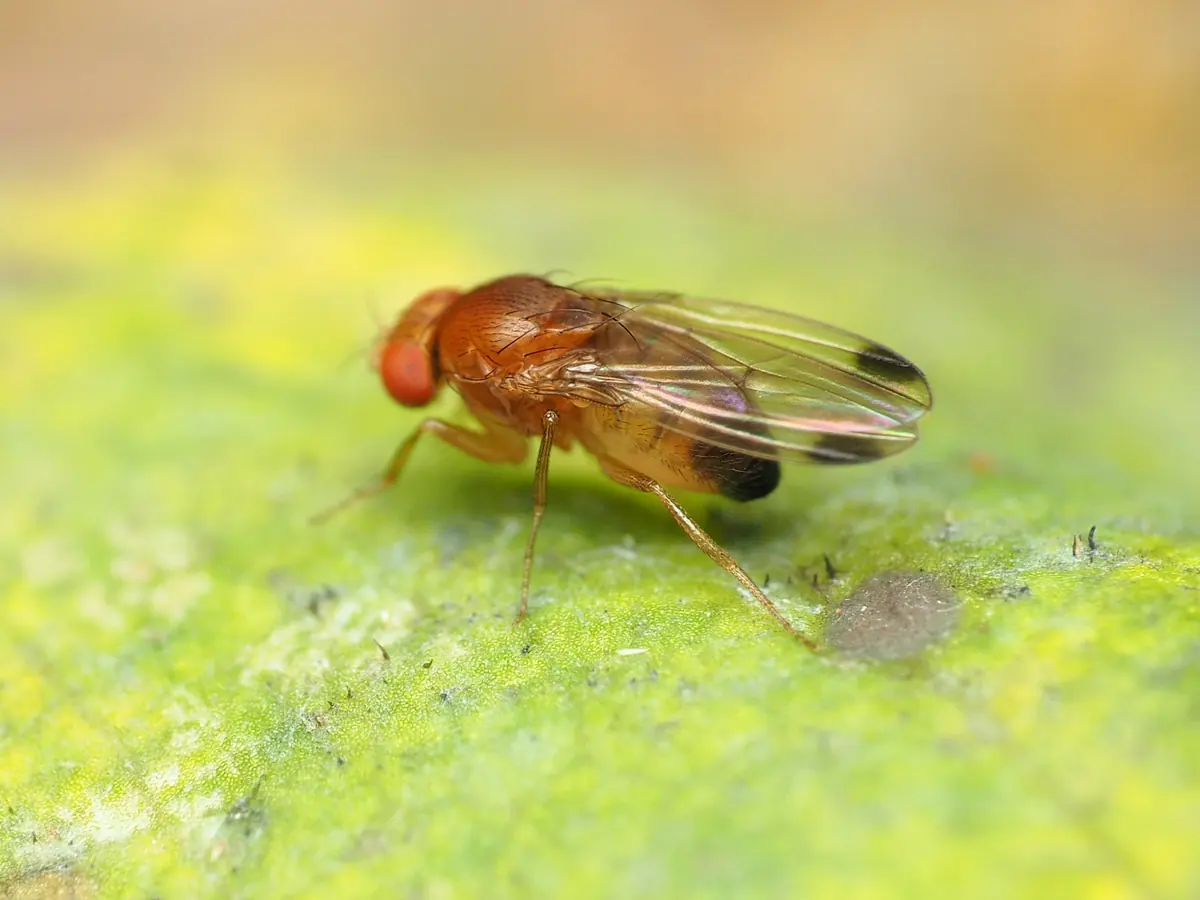
Drosophila suzukii

How to identify it
- The first sign is usually berries that look fine on the bush but go soft, leak juice or collapse a day or two after picking.
- Look closely at the skin and you may see tiny pinholes or scars where eggs were laid, with sunken, wrinkled patches around them.
- Squeeze a soft berry or break it open and you may find small white larvae, under 1/8 inch long, moving inside.
- The flies are tiny, about 1/16 to 1/8 inch long, tan with red eyes; males have a dark spot near the tip of each wing.
- Females have no wing spots but carry a large saw-like egg-laying organ at the tip of the abdomen, which you need a hand lens to see.
What it is often confused with
Common vinegar flies
Ordinary fruit flies look very similar but only lay eggs in overripe, split or rotting fruit. If sound, just-ripe berries contain larvae, spotted wing drosophila is the likely cause.
Blueberry maggot
In the eastern states, blueberry maggot is the larva of a larger fruit fly with banded wings, and usually only one maggot is found per berry. Spotted wing drosophila larvae are smaller and there can be several in one berry.
When and where it is worst
Spotted wing drosophila now occurs in most fruit growing regions of the United States, including California, the Pacific Northwest, the Northeast, the Midwest and the Southeast. It favors mild, humid weather and is less active in hot, dry spells. It can complete as many as 10 generations a year, with a life cycle of one to several weeks depending on temperature.
Numbers start low in early summer and build quickly, so early ripening blueberries and June strawberries often escape, while late blueberries, fall raspberries and blackberries take the worst damage from late July to October.
Plants it attacks
These plants in our library list it as a problem to watch for.
How to prevent it
- Pick ripe fruit every day or two and do not leave ripe or overripe berries on the bushes.
- Collect fallen and damaged fruit and seal it in a bag in the trash rather than composting it, since larvae can finish developing in compost.
- Cover blueberry bushes with very fine insect netting, about 1 mm mesh or smaller, before the fruit starts to color, sealing the edges at the base.
- Chill picked berries in the refrigerator right away, which slows or stops eggs and larvae developing.
- Prune bushes to keep them open, because the flies prefer shady, humid cover.
- Hang simple traps of apple cider vinegar with a drop of dish soap from early summer and check weekly for males with spotted wings, so you know when the flies arrive.
Organic control, step by step
- Rely on netting, frequent picking and sanitation first, because they do more than sprays in a home planting.
- Check fruit by placing a handful of crushed berries in salt water and looking for small larvae floating out after about 15 minutes, so you know whether flies are laying.
- Spray spinosad once fruit begins to change color, which UC IPM rates as effective with the least effect on the environment, and repeat as the label directs while fruit ripens.
- Spray in the evening when bees are not foraging, and cover the whole plant because the flies rest inside the canopy.
Conventional control
- Pyrethrins and other home garden insecticides labeled for fruit flies on blueberries can be used once fruit begins to color, but they kill only the flies they hit and need repeating.
- Keep to short intervals between sprays during harvest, because new flies arrive constantly and residues break down quickly.
- Do not spray during bloom, and spray when bees are not active.
- Read the label every time, check that the crop you are treating is listed, and keep to the pre-harvest interval before you pick.
Frequently asked questions
Are berries with spotted wing drosophila larvae safe to eat?
The larvae are not harmful if eaten, but most people prefer to avoid them. Eating or freezing fruit soon after picking, and discarding soft berries, reduces the chance of finding them.
Why are my late blueberries worse than my early ones?
Fly numbers build through the summer with each generation, so berries ripening in late summer and fall face far more egg-laying females than those ripening in June.
Will regular bird netting keep the flies out?
No. Bird netting has holes far too large. You need fine insect exclusion netting, about 1 mm mesh, put on before the fruit starts to color.
Related problems
Sources: UC IPM, Spotted-wing drosophila; Penn State Extension, Spotted wing drosophila part 1: overview and identification. Identification and control follow these sources. Always read and follow the product label.