Japanese beetle: identify, prevent, control
Updated October 2026
Adults feed for six to eight weeks from late June to August, and the grubs feed in lawns in late summer and fall.
The Japanese beetle is an invasive beetle first found in New Jersey in 1916 that now covers most of the eastern United States and keeps moving west. Adults feed on the leaves, flowers and fruit of more than 300 kinds of plants, and the grubs eat grass roots in lawns. Damage is usually cosmetic, but heavy feeding can ruin flowers such as zinnias and coneflowers and strip roses, grapes and fruit trees.
Popillia japonica
How to identify it
- You first notice leaves that look like lace, with the tissue between the veins eaten away and only the veins left, usually starting at the top of the plant.
- Flowers such as zinnias, coneflowers and roses are chewed ragged, often with several beetles feeding together in one bloom.
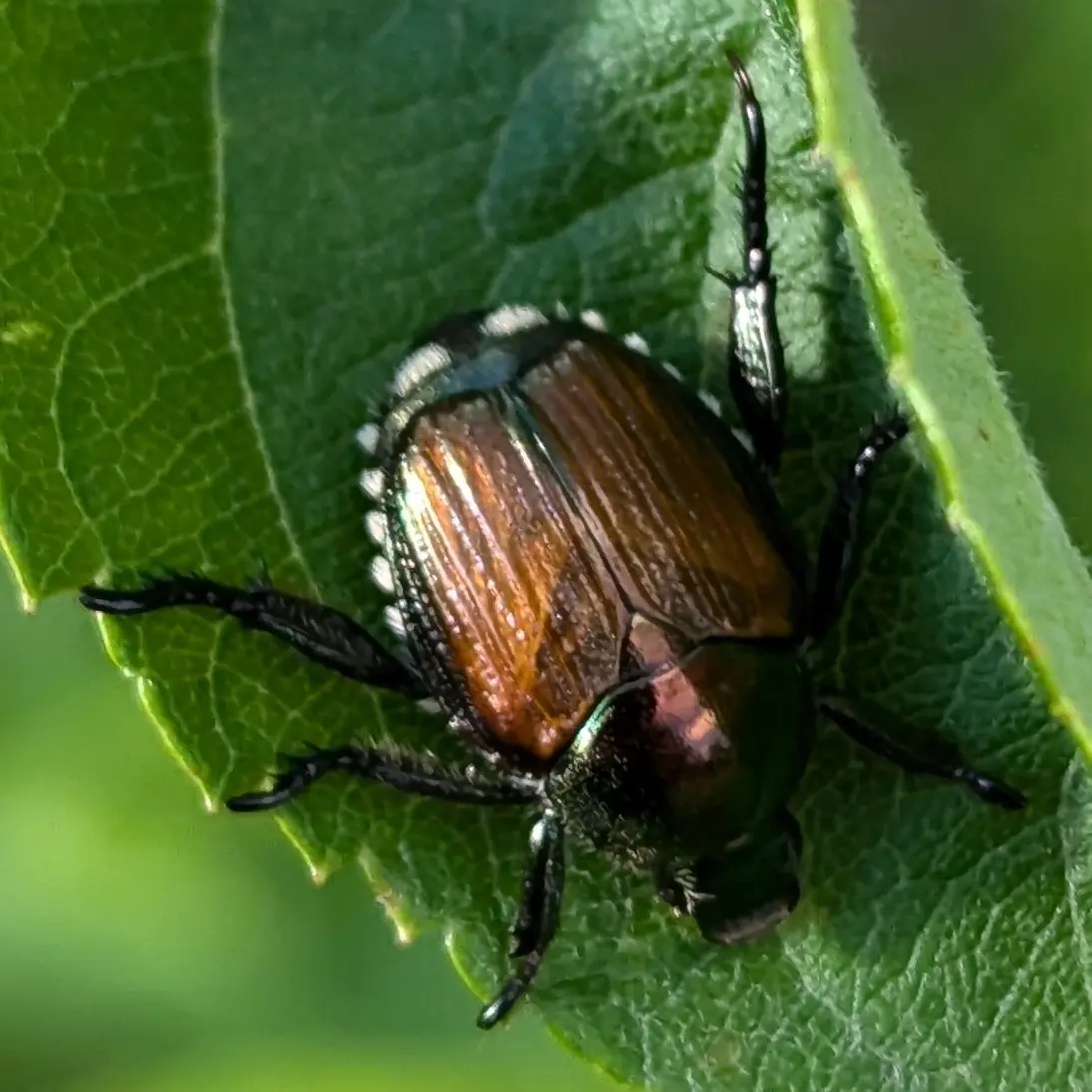
- The adults are about 1/3 to 1/2 inch long, with a shiny metallic green head and thorax and copper brown wing covers.
- Five small tufts of white hair line each side of the abdomen, with two more at the tip, which separate it from look-alikes.
- Beetles cluster on a few favorite plants while similar plants nearby are left almost untouched.
- In lawns, C-shaped white grubs with tan heads feed on roots in late summer, and damaged turf peels back like loose carpet.
What it is often confused with
Green June beetle and other scarabs
The green June beetle is larger, about an inch long, and dull green with tan edges, and it feeds mostly on ripe fruit. Japanese beetles are smaller and shiny, with white hair tufts along the sides.
Rose chafer
Rose chafers are tan and slender with long spiny legs and feed on similar plants in early summer, especially in sandy soils. They lack the metallic green and copper colors.
When and where it is worst
Japanese beetles are established throughout the eastern United States except Florida, and across much of the Midwest. Populations have been found and are being eradicated in parts of the West, including Oregon and Washington, and western states protect themselves through a USDA APHIS program to stop beetles arriving on aircraft and nursery stock. If you live west of the Rocky Mountains and think you have found one, report it to your state department of agriculture or county Extension office.
Adults emerge from the soil in late June or early July and feed until mid to late August, with a few into September. Females lay eggs in lawns and pastures, and the grubs feed on grass roots until cold weather sends them deeper. Dry summers reduce egg survival and often lead to fewer beetles the next year.
Plants it attacks
These plants in our library list it as a problem to watch for.
How to prevent it
- Start looking for beetles in late June and act as soon as the first ones appear, because damaged leaves give off scents that draw in more beetles.
- Do not hang Japanese beetle traps in or near the garden, because research at the University of Kentucky showed they attract more beetles than they catch.
- Choose less favored plants for new beds, such as daylily, clematis, chrysanthemum, geranium, magnolia, lilac and most conifers.
- Cover small fruit plants with fine netting once they have finished flowering and set fruit, but do not cover plants in bloom that need bees.
- Leave beetles carrying small white eggs on the back of the thorax alone, because these are parasitized by the winsome fly and will die within days.
Organic control, step by step
- Knock or pick beetles into a bucket of soapy water every day, ideally in the early morning or evening when they are cool and sluggish.
- Spray neem oil on favored plants to deter feeding for a few days, repeating as needed, though it is weaker when beetles are very numerous.
- Use a Bacillus thuringiensis galleriae product, which University of Minnesota Extension rates as moderately effective for one to two weeks and low risk to bees.
- Use pyrethrins sprayed directly on the beetles for quick knockdown, avoiding open flowers that bees are visiting.
- Treat lawns, not gardens, with beneficial nematodes such as Heterorhabditis bacteriophora if grubs are damaging turf, accepting that results vary.
Conventional control
- Bifenthrin, cyfluthrin, lambda cyhalothrin, permethrin and carbaryl give two to three weeks of protection on labeled plants, but all are toxic to bees, so do not spray zinnias, coneflowers or other flowers bees are visiting.
- Avoid soil-applied imidacloprid or dinotefuran on or near pollinator plants such as echinacea and zinnia, because these systemic insecticides move into the pollen and nectar.
- Treating lawn grubs will not reduce the beetles on your flowers, because adults fly in from untreated areas, so only treat grubs to protect a damaged lawn.
- Read the label every time, check that the plant you are treating is listed, and keep to the pre-harvest interval on any fruit or vegetable.
Frequently asked questions
Do Japanese beetle traps work?
Not for protecting plants. The traps use a sex pheromone and floral lure that pull in beetles from a wide area, and many land on your plants instead of in the trap. They were designed for monitoring, not control.
Will Japanese beetles kill my plants?
Healthy, established plants almost always survive, even when they look badly skeletonized. Flowers and fruit may be ruined for the season, and young plants and newly planted trees suffer most.
Which plants do Japanese beetles like most?
Favorites include rose, grape, linden, apple, crabapple, cherry, plum, raspberry, basil, hollyhock, marigold and zinnia. Echinacea is also attacked in many areas.
Is milky spore worth using?
Results with milky spore against Japanese beetle grubs have been inconsistent in research, and it does nothing to stop adults flying in from neighboring properties. Focus on protecting the plants you care about most.
Related problems
Sources: University of Minnesota Extension, Japanese beetles; USDA APHIS, Japanese beetle program. Identification and control follow these sources. Always read and follow the product label.