
Verticillium wilt: identify, prevent, control
Updated October 2026
Worst in cool to mild weather, roughly 70 to 75°F, so it often shows in late spring and early summer and in cooler regions such as the Northeast, northern Midwest and the West.
Verticillium wilt is a soil-borne fungus that enters through the roots and plugs the water-conducting tissue, so leaves yellow and wilt and branches die back. Verticillium dahliae attacks hundreds of plants, including eggplant, tomato, potato, okra, mint, strawberry, olive and many trees and shrubs. It forms tiny resting bodies that survive in soil for many years, so the main defense is to keep it out and to grow resistant plants.
Verticillium dahliae and Verticillium albo-atrum
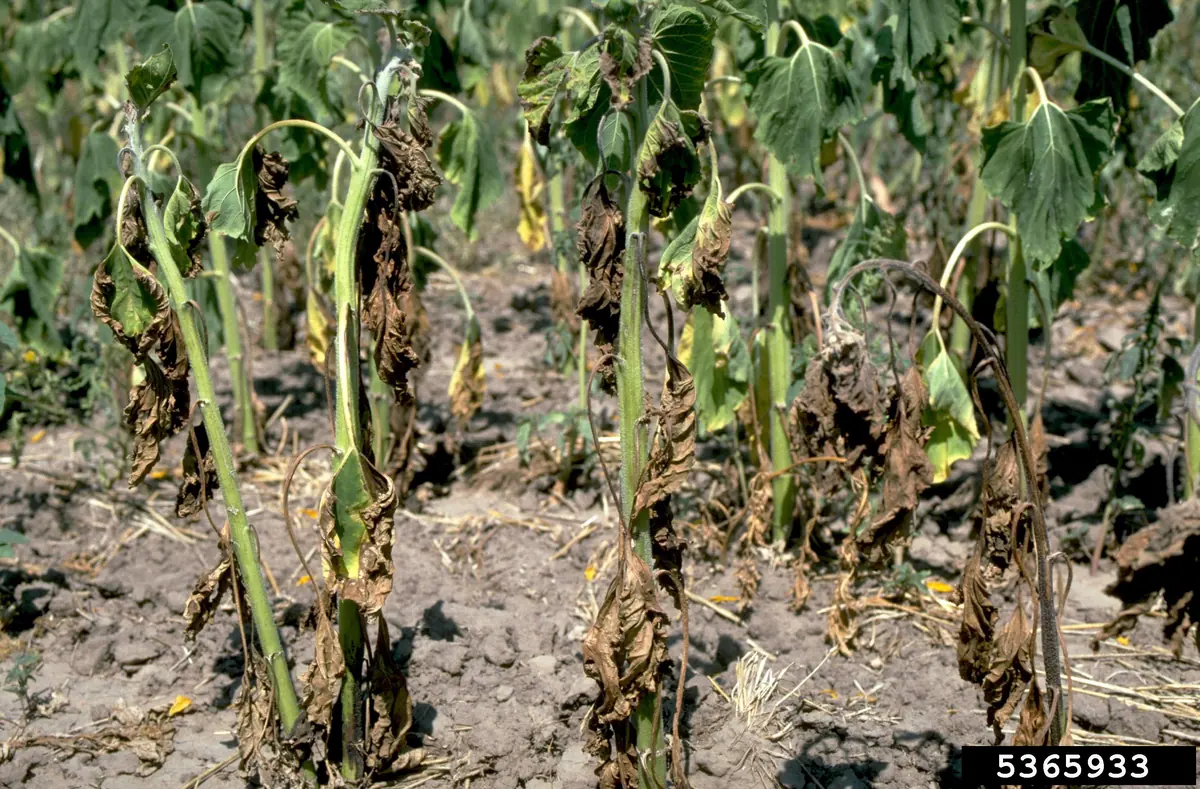

How to identify it
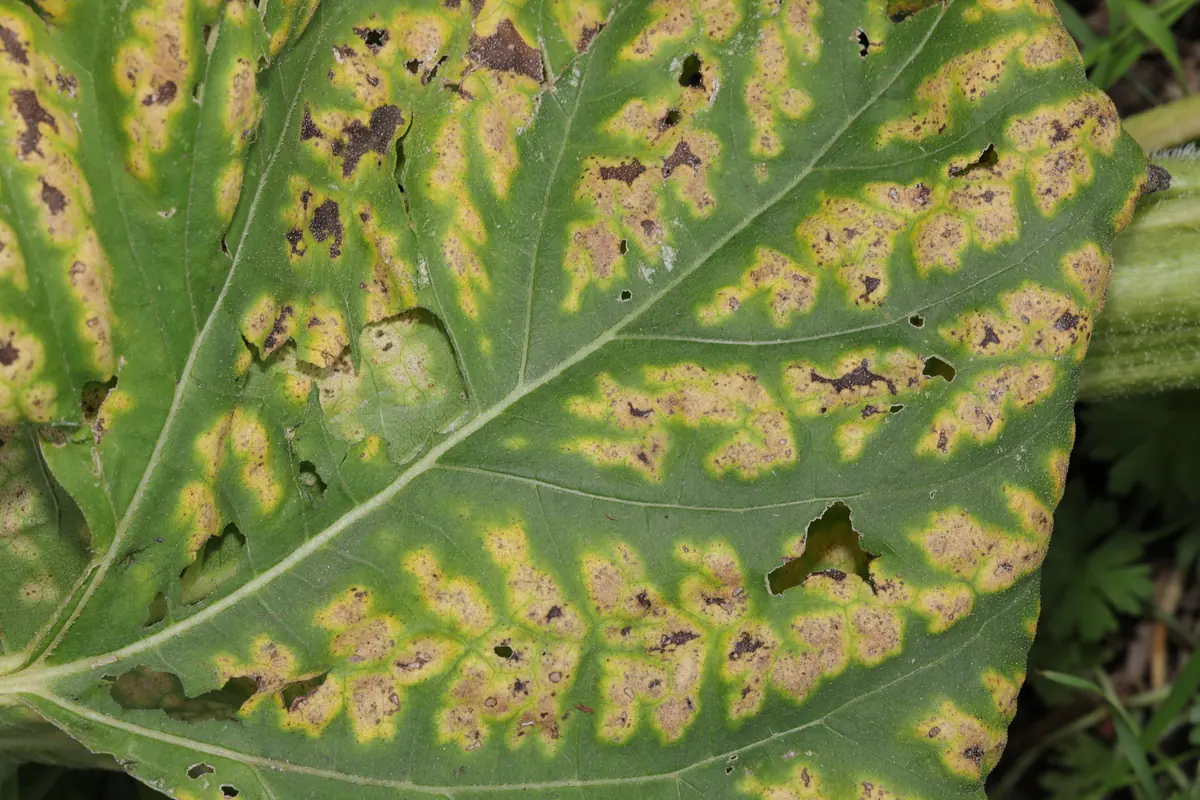
- The first sign is yellowing on the lower leaves, often in a V shape that starts at the leaf edge and points toward the midrib.
- The yellow patches turn brown and dry, and leaves wilt in the afternoon, often on one side of the plant or one branch at a time.
- Cut the base of the stem lengthwise and you will see light brown streaks in the tissue under the skin.
- On eggplant the plant stunts, leaves drop from the bottom up and fruit stays small.
- On mint, shoots stunt, curl, yellow and die in patches that spread through the bed over a few seasons.
- On olive trees, one or more branches wilt suddenly in spring, the leaves turn brown but stay attached, and the dead branch stands out against healthy growth.

What it is often confused with
Fusarium wilt
Fusarium wilt likes warmer soil and usually darker stem streaks. The two are hard to separate by eye, so send a sample to your county Extension office or state diagnostic lab when it matters.
Root rot
Root rot turns the roots dark and soft. With Verticillium wilt the roots look sound and the browning is inside the stem.
When and where it is worst
Verticillium wilt is favored by mild temperatures, with symptoms often most obvious when a cool, moist spell is followed by hot weather that stresses plants. It is widespread in the northern US, the Pacific Northwest, Colorado and the Mountain West, and in California, where it is a serious problem in olives, strawberries, tomatoes and mint.
The fungus lives in soil as microsclerotia that can survive for many years without a host, and it builds up wherever tomatoes, potatoes, eggplant, peppers and strawberries are grown repeatedly. Broadleaf weeds such as nightshades and pigweed can carry it between crops.
Plants it affects
These plants in our library list it as a problem to watch for.
How to prevent it
- Grow resistant varieties: many tomato varieties carry the letter V for Verticillium resistance, and resistant strawberry and mint varieties are available.
- Rotate eggplant, tomatoes, potatoes, peppers and strawberries to beds where none of them have grown for four to five years, using corn, beans, lettuce or other non-hosts in between.
- Keep broadleaf weeds under control, since many are hosts of the fungus.
- Buy certified disease-free mint roots, strawberry plants and potato seed tubers, and do not move soil or plants from an affected bed.
- Water evenly and avoid stressing plants with drought or heavy nitrogen.
- In hot summer areas, solarize infested beds under clear plastic for four to six weeks in the hottest part of summer.
Organic control, step by step
- Pull up and dispose of infected annual plants, including roots, and do not compost them.
- For mint, dig out the whole affected patch and replant clean roots in a new spot.
- On olives and other trees, prune out dead branches and keep the tree well watered and fed; trees often recover from mild cases.
- Add compost and grow broccoli as a rotation crop where you can, which some studies show can lower Verticillium levels in soil.
Conventional control
- No fungicide sold for home gardens cures Verticillium wilt once a plant is infected.
- Resistant varieties, rotation, clean planting stock and weed control are the effective controls for home gardeners.
- If you use any product on plants with wilt, read the label, check that your crop is listed, and keep to the pre-harvest interval shown for that crop.
Frequently asked questions
How long does Verticillium stay in the soil?
Many years. The fungus forms tiny resting bodies called microsclerotia that survive without a host. That is why long rotations and resistant varieties matter more than any treatment.
Can I still grow eggplant if I have Verticillium?
Eggplant is very susceptible and has few resistant varieties. Grow it in a bed or container with fresh soil where tomatoes, potatoes, peppers and strawberries have not been grown, or graft it onto a resistant rootstock.
Will my olive tree die from Verticillium wilt?
Not always. Olives often recover if the infection is limited and dead branches are pruned out. Avoid planting olives where tomatoes, cotton or other host crops grew before.
Related problems
Sources: University of Wisconsin Extension, Verticillium Wilt of Vegetables; NC State Extension, Verticillium Wilt of Tomato and Eggplant; UC IPM, Verticillium Wilt (Plants); UC IPM, Verticillium Wilt on Peppermint. Identification and control follow these sources. Always read and follow the product label.