Root-knot nematodes: identify, prevent, control
Updated October 2026
Worst in summer in warm, sandy soils, especially in Florida, the Southeast, Texas and California.
Root-knot nematodes are microscopic roundworms that live in soil and feed inside plant roots, causing them to swell into knots or galls. The damaged roots cannot take up water and nutrients well, so plants wilt, yellow and yield poorly. They attack a very wide range of vegetables, and once they are in the soil you manage them rather than get rid of them.
Meloidogyne species
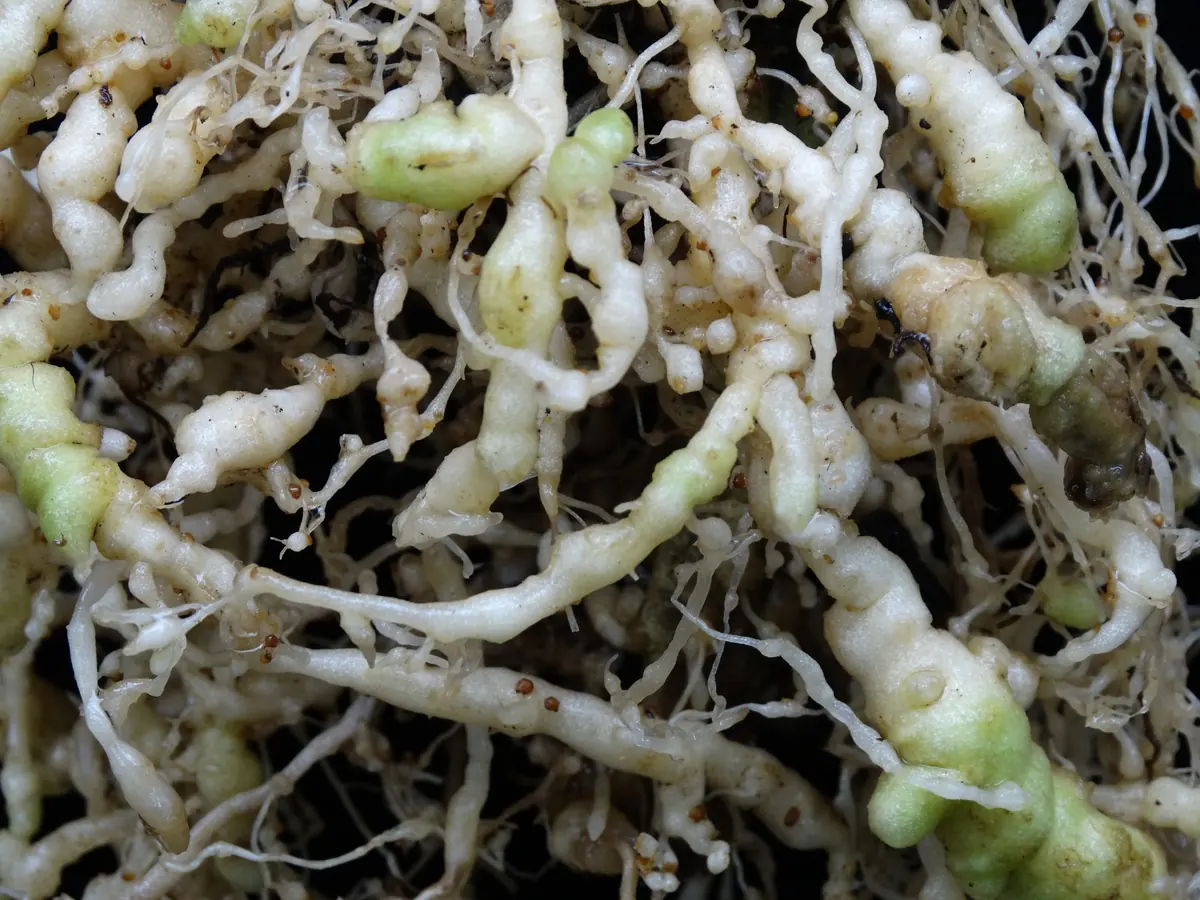
.jpg)
How to identify it
- Above ground you first notice patches of plants that are stunted, yellowish or wilt in the afternoon heat even when the soil is moist, often in irregular areas of the bed.
- Pull up an affected plant and the roots are swollen with knots, from small beads to large, fused lumps, sometimes making the whole root system look like a mass of galls.
- The galls are part of the root and cannot be rubbed off, unlike the nitrogen-fixing nodules on bean and pea roots, which pop off easily and are often pink inside.
- On carrots the roots are forked, hairy and lumpy with small warts, and on peanuts both roots and pods can be galled.
- Damage builds from year to year in the same bed, especially where the same crops are grown repeatedly.
What it is often confused with
Clubroot
Clubroot also swells roots, but only on cabbage family plants and the swellings are large, smooth clubs. Root-knot galls are smaller, knobbly and occur on many crops.
Fusarium wilt
Fusarium wilt makes plants wilt and yellow, often on one side, with brown streaks inside the stem but normal looking roots. Root-knot nematodes leave obvious galls, and the two problems often occur together.
Legume root nodules
Southern peas, lima beans and peanuts naturally carry nitrogen-fixing nodules on their roots, which are helpful. Nodules sit on the side of the root and rub off; nematode galls are swellings of the root itself.
When and where it is worst
Root-knot nematodes are found throughout the United States but do the most harm in warm regions with sandy soils, including Florida, the Southeast coastal plain, Texas and the South, the Southwest deserts and California's Central Valley. They are active when soil is warm and multiply through several generations over a long summer, so damage is worst on summer crops and builds steadily in beds that are never rested.
Tomatoes, carrots, okra, beans, peas, squash, cucumbers, peppers and eggplant are all common hosts, and southern peas, lima beans and peanuts can be badly affected. Nematodes spread mostly in infested soil, on transplants and in runoff water, and they cannot travel far on their own.
Plants it attacks
These plants in our library list it as a problem to watch for.
How to prevent it
- Buy transplants from a reliable nursery and check their roots for galls before planting, and clean soil off tools and boots after working an infested bed.
- Choose tomato varieties with the letter N in the disease resistance code, such as VFN, which UC IPM found yielded almost six times more than a susceptible variety in infested gardens, though resistance weakens in very hot soil.
- Rotate susceptible vegetables with a resistant crop or a cover crop such as French marigold, sunn hemp, hairy indigo or velvetbean, grown densely for a full season.
- Dig in compost and other organic matter every year, which helps the soil hold water and supports the fungi and other soil life that attack nematodes.
- Pull up roots of finished crops right away, rather than leaving them to keep feeding nematodes.
- Keep weeds out, because many weeds are hosts and keep numbers high between crops.
Organic control, step by step
- Solarize the bed in the hottest part of summer by tilling, watering, then covering the soil tightly with clear plastic for at least four to six weeks, which can reduce nematodes in the top 6 to 8 inches.
- Do not dig deeply after solarizing, so you do not bring untreated soil back to the surface.
- Set out larger, older transplants rather than tiny seedlings, as they tolerate nematodes better.
- Grow crops in containers or raised beds filled with fresh mix if a bed is heavily infested.
Conventional control
- UC IPM states that no chemical nematicides or soil fumigants are currently available to home gardeners for nematode control, so cultural methods are the whole toolkit.
- Be wary of products sold as nematode killers for home gardens and check that any product you consider is EPA registered for that use on the crop you grow.
- Read the label every time, check that the crop you are treating is listed, and keep to the pre-harvest interval before you pick.
Frequently asked questions
Are the bumps on my bean and pea roots nematodes?
Not necessarily. Beans, peas, southern peas and peanuts carry helpful nitrogen-fixing nodules that are attached to the side of the root and rub off easily. Root-knot galls are swellings of the root itself and stay put.
Do marigolds really control nematodes?
French marigolds can lower root-knot nematode numbers when grown as a dense cover crop for a whole season and then turned in. A few marigolds dotted among the tomatoes do little.
How can I confirm I have root-knot nematodes?
Galls on the roots are a good sign. For a definite answer and to identify other kinds of nematodes, send a soil and root sample through your county Extension office to a nematode diagnostic lab.
Can I get rid of nematodes for good?
Not usually. Once present they stay in the soil, but solarization, resistant varieties, rotation, cover crops and organic matter can keep numbers low enough to grow good crops.
Related problems
Sources: UF/IFAS Extension, Nematode management in the vegetable garden (NG005); UC IPM Pest Notes, Nematodes. Identification and control follow these sources. Always read and follow the product label.