
Raised Garden Beds: Sizes, Safe Materials, Soil and Layouts
Updated November 2026
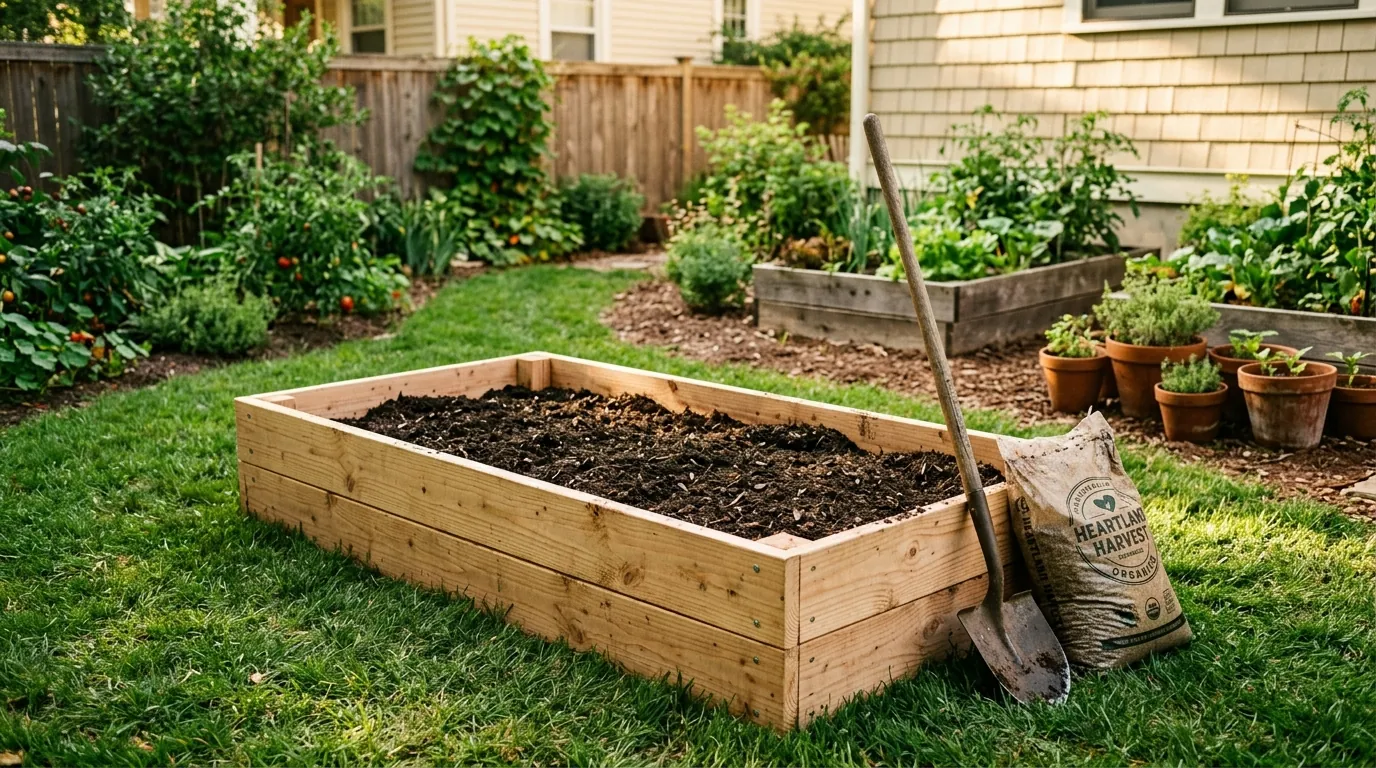
A raised bed lets you bring in good soil, warms up earlier in spring, drains well and saves your back. This page covers the sizes that work, what to build with and which lumber is safe, how much soil to buy, how to fill the bed layer by layer, and three ready-made layouts for a 4 by 8 foot bed.
When a raised bed is worth building
A raised bed makes the most sense when the soil you have is the problem: heavy clay, sand that will not hold water, compacted ground, rocky soil or soil you do not trust. It also suits anyone who wants the garden at a comfortable height and tidy edges that keep lawn grass out. If your ground is already dark, crumbly and drains well, you can plant straight into it and save the cost. Our how to build a raised garden bed guide shows the construction step by step, and the vegetable garden planning guide helps you decide how many beds you need.
Raised garden bed sizes
| Measurement | What works | Why |
|---|---|---|
| Width | 3 to 4 feet | You can reach the middle from both sides without stepping on the soil. Keep it under 2 feet against a fence or wall. |
| Length | 4, 6 or 8 feet | Standard lumber lengths make the cutting simple. Beds longer than 8 feet need a brace across the middle so wet soil does not bow the sides. |
| Height | 8 to 12 inches | Enough for most vegetables. Add height for root crops, or for easier access. |
| Height for easy reach | 18 to 24 inches | Cuts down on bending. It needs a lot more soil, so price the fill first. |
| Height for wheelchair access | About 30 inches | Keep the bed no wider than 3 feet so the middle is within reach from the edge. |
| Paths | 18 to 24 inches (36 inches for a wheelchair) | Room for a wheelbarrow and for kneeling. |
| Sun | 6 to 8 hours | Run the long side north to south where you can, and keep beds away from tall trees and fences on the south side. |
How deep does the soil need to be for each crop?
Roots only get the soil in the bed when you build over concrete, paving or hard clay, so match the depth to the crop. These minimum depths come from the pot sizes in our plant data.
| Soil depth | Crops |
|---|---|
| 6 in (15 cm) | Radishes and basil |
| 8 in (20 cm) | Lettuce, arugula, parsley, garlic and strawberries |
| 10 in (25 cm) | Spinach, and peas with a trellis |
| 12 in (30 cm) | Chard, kale, peppers, cucumbers, carrots and beets |
| 16 in (40 cm) | Tomatoes, eggplant and broccoli |
| 20 in (50 cm) | Potatoes and zucchini |
Pumpkins and sweet corn are not suited to confined soil in our data, so grow them in a bed built over open ground where the roots can go down into the soil below.
What to build a raised bed from
| Material | What to know |
|---|---|
| Cedar, redwood or cypress | Naturally rot-resistant, good looking and food safe. The standard choice, at a higher price. In the deep South, cypress and composite last longest against rot and termites. |
| Untreated pine or fir | The cheapest option and fine for a few seasons. It rots faster than cedar, so plan to replace boards in a few years. |
| Composite or recycled plastic lumber | Does not rot and needs no liner. The most expensive way to build, but it lasts. |
| Galvanized steel | Durable and tidy, and sold in kits. In hot climates, sun on the metal can overheat the soil at the edges, so mulch the inside edges or shade them. |
| Concrete blocks, brick or stone | Essentially permanent and easy to stack without tools. Open block cores can hold a few herbs or marigolds. |
| Old railroad ties and unknown old lumber | Avoid. We do not recommend them for food beds, because creosote and old arsenic-based preservatives are the usual concerns. |
The old guide on this site, written for warm climates, points out that in hot, sandy areas such as Florida a bed dries out quickly. The extension source behind it, UF/IFAS Gardening Solutions, recommends adding extra compost to hold moisture, mulching the surface and considering drip irrigation. Our mulching guide and watering guide cover both.
Is treated lumber safe for a vegetable bed?
The answer depends on the preservative and the age of the wood. In 2002 the US EPA announced that CCA (chromated copper arsenate) lumber would be phased out of consumer and residential products, and manufacturers agreed to end most residential uses from December 31, 2003. Purdue Extension notes that existing stockpiles could still be sold afterwards, and extension services do not ask anyone to tear out old structures.
The replacement preservatives are arsenic-free. ACQ (alkaline copper quaternary) is rated for above-ground and ground contact, and copper azole is limited to above-ground use, according to Purdue. Neither is singled out for vegetable beds in the sources we read.
Experts disagree about how much risk CCA poses to food plants. Colorado State University says it is rare to find vegetables contaminated with arsenic in beds surrounded by treated wood, because the arsenic stays in the area the wood occupies. Other researchers have reported higher arsenic levels in lettuce and tomatoes grown in CCA beds, so the safe practical approach is a cautious one.
What we recommend: build new food beds from cedar, redwood or cypress, composite lumber, steel or blocks. If you inherit a bed built from old green-tinted lumber, line the inner walls with heavy plastic, leaving the base open for drainage, and keep the soil away from the wood. We avoid railroad ties and lumber of unknown history for edible crops.
Soil volume calculator
Enter the inside size of your bed to see how much fill to order. The calculator adds 10 percent for settling and splits the total into our one third topsoil, one third compost and one third aeration recipe. Ordering in bulk by the cubic yard from a landscape supplier is far cheaper than buying bagged soil.
Mulching the finished bed? The mulch calculator works out the bags or cubic yards for the top layer.
How to fill a raised bed, layer by layer
| Layer | What goes in |
|---|---|
| Base | Flattened plain cardboard over the grass or weeds, with the tape removed. Skip the plastic, which traps water. |
| Bottom 4 to 6 inches (optional) | Coarse material such as small branches, bark chunks and leaves, only in beds deeper than about 18 inches. It rots down and the bed settles, so top up the soil later. |
| Main fill, about 6 to 8 inches deep for a 12-inch bed | One third quality topsoil, one third compost and one third aeration material (coarse sand, perlite or pine bark fines). Mix it on a tarp before shoveling it in. |
| Top 2 inches | Finished compost, raked level. This is the layer your seedlings and transplants meet first. |
| Mulch, 2 to 3 inches | Straw, shredded leaves or wood chips, kept a little away from plant stems. It holds moisture and cuts weeds. |
The mix is the one in our build guide, which cites UF/IFAS Gardening Solutions. Water the bed deeply after filling, wait a few days for it to settle, and top it up before you plant. Add compost every season, because the organic matter breaks down. Do not skimp on compost in sandy-soil regions, where it is what holds water and nutrients.
Three seasonal layouts for a 4 by 8 foot bed
All three layouts use a bed 4 feet wide and 8 feet long, with the tall crops on the north side so their shade falls off the bed. Spacings come from our plant data. When to plant each crop depends on your region, so open the what to plant now calendar for your region, and use the bed planner to move plants around and check companions. Our frost dates and hardiness zone pages tell you when each layout opens in your area.
Summer bed: tomatoes, peppers and basil
For the warm season after frost has passed. Grow tomatoes, peppers, basil and cucumbers.
| Where in the bed | What to plant | Spacing from our plant data |
|---|---|---|
| Back row, north side (so tall plants do not shade the rest) | 4 tomatoes in cages or on stakes | 24 inches apart |
| Middle row | 5 peppers | 18 inches apart |
| Front row | 8 basil plants with 4 marigolds tucked between them | Basil 10 inches apart, marigolds 10 inches apart |
| End of the bed | 2 cucumbers on a trellis | 20 inches apart |
Early spring bed: peas and greens
For the cool start to the season, as soon as the soil can be worked. Grow peas, spinach, lettuce and radishes.
| Where in the bed | What to plant | Spacing from our plant data |
|---|---|---|
| Back row, north side | Peas on a trellis | 4 inches apart, in a double row |
| Middle row | Spinach, about 12 plants | 8 inches apart |
| Front row | 8 lettuce plants, with radishes sown in the gaps | Lettuce 10 inches apart, radishes 2 inches apart |
Fall bed: brassicas and garlic
For the cool end of the season. Grow broccoli, kale and garlic.
| Where in the bed | What to plant | Spacing from our plant data |
|---|---|---|
| Back row, north side | 4 broccoli plants | 18 inches apart |
| Middle row | 5 kale plants | 16 inches apart |
| Front row | About 16 garlic cloves, pointed end up | 6 inches apart |
Looking after a raised bed
Raised beds dry out faster than the ground, so mulch the surface and water deeply rather than often. A drip line or soaker hose along the bed saves time, and it keeps leaves dry. Rotate crop families from bed to bed each year, and feed hungry crops during the season. Our composting hub shows how to make your own compost, and companion planting explains which plants help each other.
Frequently Asked Questions
How tall should a raised garden bed be?
Eight to 12 inches of soil is enough for most vegetables. Go to 18 to 24 inches to cut down on bending, and to about 30 inches if you garden from a wheelchair. Our plant data suggests about 12 inches for carrots and chard, 16 inches for tomatoes and 20 inches for potatoes.
What is the best soil mix for a raised garden bed?
A good starting mix is one third quality topsoil, one third compost and one third aeration material such as coarse sand, perlite or pine bark fines. Do not fill a bed with pure potting soil or pure native clay, and top up the compost every season.
How much soil do I need for a 4 by 8 foot raised bed?
A bed 4 feet by 8 feet filled 12 inches deep holds 32 cubic feet, or about 1.2 cubic yards. Allow 10 percent for settling and order about 35 cubic feet, which is roughly 1.3 cubic yards.
Is pressure treated lumber safe for a vegetable garden?
Lumber treated with copper chrome arsenate (CCA) was withdrawn from most residential uses at the end of 2003, and the arsenic-free treatments sold now, ACQ and copper azole, are the usual replacements. Experts disagree about how much risk older lumber poses, so for food beds we suggest cedar, redwood or cypress, composite boards, steel or blocks, and a plastic liner if you keep treated boards.
How wide should a raised bed be?
Three to 4 feet, so you can reach the middle from either side without stepping on the soil. Against a fence or wall, keep it under 2 feet.
Do raised beds need a bottom?
No. Leave the base open so roots and drainage can reach the ground below, and lay flattened plain cardboard under the soil to smother grass and weeds. Over concrete or paving, build the bed deeper and make sure water can drain out the sides.
Sources
- UF/IFAS Gardening Solutions, Raised Bed Gardening.
- Purdue University, Treated Lumber and Alternatives in the Garden.
- Colorado State University Extension, Treated lumber and gardening.
- Planting Season plant data for depths and spacings, checked November 13, 2026.
See what to plant this month
Pick your region for a month-by-month calendar tuned to your climate.
Find your region →See also: Annual vs perennial, Chicken tractor over a raised bed, Greenhouse guide, Peat moss vs coco coir.