
When to Harvest Onions: Signs They Are Ready and How to Cure Them
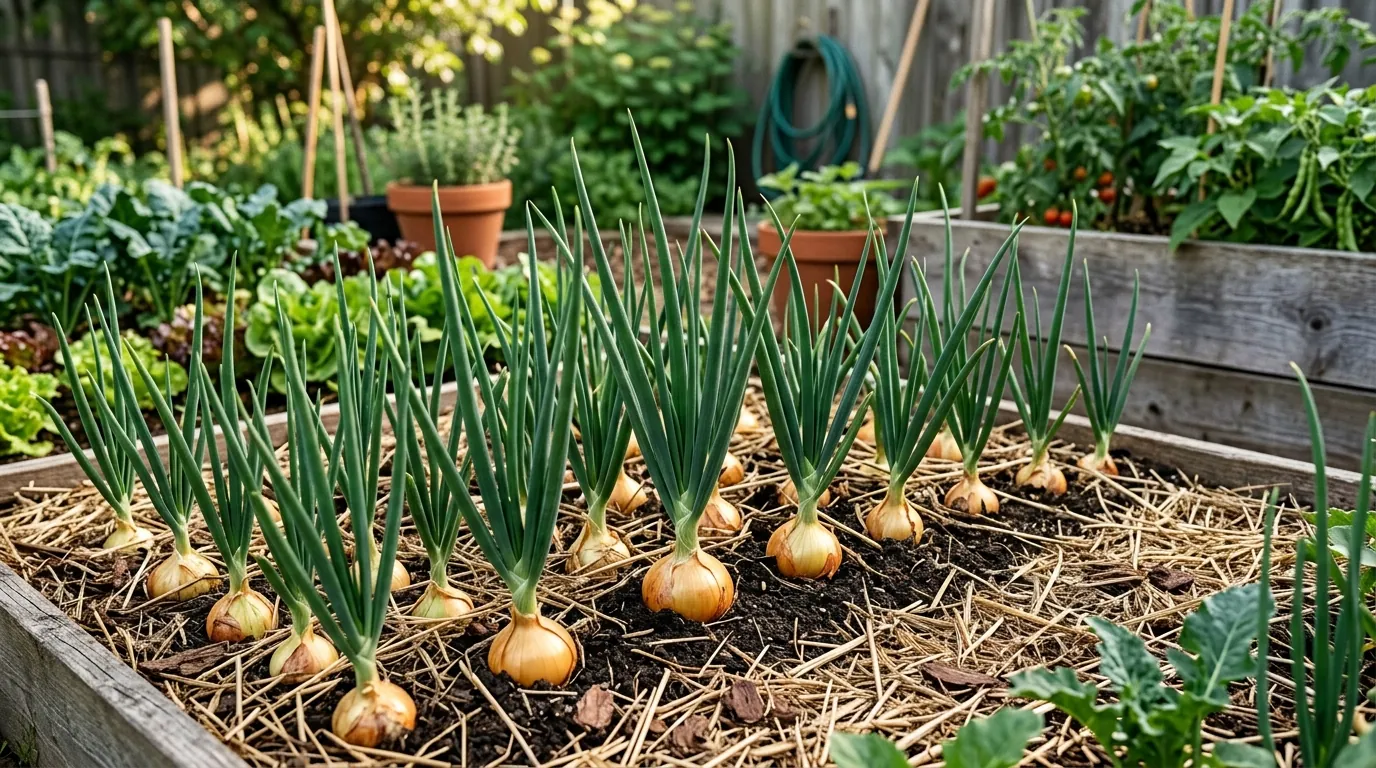
Onions tell you when they are finished, by flopping over. The tops soften at the neck, fall over and begin to yellow and dry, and that is the signal to lift them. Illinois Extension gives a usual window of late July or early August for dry onions in its region, and our chart shows the equivalent window for each US region.
How to care for onions
Onions have shallow roots and compete poorly with weeds, so care comes down to steady water, light feeding early, a clean bed and a firm stop once the tops fall over.
- Water: keep the soil evenly moist, about 1 inch a week (Michigan State University Extension) and more in hot, dry spells. Roots are shallow, so drought stress shrinks the bulbs, and Utah State Extension suggests moistening the soil about 12 inches deep.
- Feed: side-dress with nitrogen in two light doses about a month apart, in late spring and early summer, following your soil test or the product label. Utah State Extension stops feeding by mid-July in its region. Late nitrogen makes thick necks and bulbs that store poorly, so stop once the tops start to fall, and in warmer regions count back from your own harvest month.
- Weed: hoe shallowly or hand-pull, especially in the first two months while the plants are small and slow. Do not hill soil up around bulbs grown for drying, because Illinois Extension notes hilling can cause neck rot in storage.
- Mulch: an organic mulch such as compost, grass clippings or leaves conserves water and smothers weeds (Utah State Extension).
- When to stop watering: when the tops begin to fall over. Utah State Extension says watering after that delays curing and causes storage problems, so let the soil dry out until harvest.
Once the tops are down, the next job is harvest and curing, which the rest of this page covers. For planting and varieties, see the onion growing guide.
Signs onions are ready
| Sign | What it means |
|---|---|
| Tops falling over | The neck has softened and the bulb has stopped growing. Pick when most of the tops are down. |
| Tops yellowing and drying | The bulb is sealing its neck. Iowa State Extension harvests once most tops have collapsed and started to dry. |
| Dry outer skin | The papery skins are tight and rustle. Iowa State Extension notes this comes during curing. |
Pull or lift the bulbs on a dry day with the tops still attached, as Iowa State Extension advises. Utah State Extension notes that the tops help protect the bulbs from the sun while they dry.
Harvest months by region
| Region | Jan | Feb | Mar | Apr | May | Jun | Jul | Aug | Sep | Oct | Nov | Dec |
|---|---|---|---|---|---|---|---|---|---|---|---|---|
| North Florida | · | · | ✓ | ✓ | ✓ | ✓ | ✓ | ✓ | · | · | · | · |
| Central Florida | · | · | ✓ | ✓ | ✓ | ✓ | ✓ | ✓ | · | · | · | · |
| South Florida | · | · | · | ✓ | ✓ | ✓ | ✓ | · | · | · | · | · |
| Gulf South | · | · | ✓ | ✓ | ✓ | ✓ | ✓ | ✓ | · | · | · | · |
| Desert Southwest | · | · | · | ✓ | ✓ | ✓ | · | · | · | · | · | · |
| Texas | · | · | · | ✓ | ✓ | ✓ | ✓ | ✓ | · | · | · | · |
| Southern California | · | · | ✓ | ✓ | ✓ | ✓ | ✓ | ✓ | ✓ | · | · | · |
| Mid-South | · | · | ✓ | ✓ | ✓ | · | · | ✓ | ✓ | ✓ | · | · |
| Pacific Northwest | · | ✓ | ✓ | ✓ | · | · | · | ✓ | ✓ | ✓ | ✓ | · |
| Northeast & New England | · | · | · | · | · | · | · | · | · | ✓ | ✓ | ✓ |
| Mid-Atlantic | · | · | · | · | · | · | · | · | ✓ | ✓ | ✓ | · |
| Midwest & Great Lakes | · | · | · | · | · | · | · | · | · | ✓ | ✓ | ✓ |
| Upper Midwest & Northern Plains | ✓ | · | · | · | · | · | · | · | · | · | ✓ | ✓ |
| Mountain West | · | · | · | · | · | · | · | · | · | ✓ | ✓ | ✓ |
| Southern Plains | · | · | · | · | · | · | · | · | ✓ | ✓ | ✓ | · |
| Northern California & Central Valley | · | ✓ | ✓ | ✓ | ✓ | ✓ | ✓ | ✓ | · | · | · | · |
| Hawaii | · | · | · | ✓ | ✓ | ✓ | ✓ | ✓ | ✓ | ✓ | · | · |
| Alaska | ✓ | · | · | · | · | · | · | · | · | · | ✓ | ✓ |
Counted from seed, using our planting months and about 180 days to maturity. Onions grown from sets or transplants mature sooner, so in the North the real harvest often comes by late summer. Use the tops, not the calendar.
Curing and storage
- Cure: two to three weeks, according to Iowa State Extension, until the tops and necks are completely dry. Penn State says it can take two to four weeks.
- Where: a warm, shaded, airy place. University of Minnesota Extension suggests 75 to 90°F (24 to 32°C).
- Trim: once the neck is tight and dry, cut the tops to about an inch
- Store: keep the cured onions in a cool, dry, airy place in mesh bags or crates, and use any with thick necks first.
In a humid or wet region, Penn State Extension notes onions are usually taken out of the field to cure, so lay them under cover with good airflow instead of leaving them in the rain.
More on growing is in the onion growing guide. If your onions bolt before they finish, read why onions bolt.
Common questions
How do you care for onions?
Keep the soil evenly moist, weed shallowly, feed lightly with nitrogen in late spring and early summer, add an organic mulch, and stop feeding and watering as the tops fall over so the bulbs can cure.
How often should I water onions?
About 1 inch a week, and more in hot, dry weather. Onion roots are shallow, so water deeply enough to moisten the soil about 12 inches down rather than sprinkling the surface.
When should you stop watering onions?
When the tops begin to fall over. Utah State Extension says watering after that delays curing and causes storage problems.
How do you know when onions are ready to harvest?
Most of the tops have fallen over and started to dry. Iowa State Extension says to harvest when most tops have collapsed, and Penn State puts it at one-third to one-half of the tops down.
Can I pull onions before the tops fall?
Yes, you can eat them early as fresh onions. Bulbs for storage should wait until most of the tops are down and then be cured.
How long do onions need to cure?
Two to three weeks, according to Iowa State Extension, until the tops and necks are completely dry and the outer scales rustle. Penn State says two to four weeks depending on the weather.
What temperature is best for curing onions?
University of Minnesota Extension suggests a warm, well-ventilated place at 75 to 90°F (24 to 32°C).
Why do onions rot at the neck in storage?
Illinois Extension says neck rot comes from curing onions for too short a time, or from fungal infection of the leaves during the season.
- Iowa State University Extension, How do you harvest, dry, and store onions?, for tops down and the 2 to 3 week cure.
- Penn State Extension, Onion Production, for one-third to one-half of the tops down and curing under cover.
- University of Minnesota Extension, Growing onions in home gardens, for curing temperature.
- Utah State University Extension, How to Grow Onions in Your Garden, for leaving the tops on.
- University of Illinois Extension, Onion, for neck rot and timing.
- Utah State University Extension, How to Grow Onions in Your Garden, for the care steps, mulch and when to stop watering.
- Michigan State University Extension, Onions (E1307), for the weekly water guide.
- Planting months and days to harvest are from the Planting Season plant data for this site.
Keep reading
How to grow onionsWhy onions boltOnion setsOnion plant pageThe harvestHarvest calculatorAll growing guides