Citrus canker: identify, prevent, control
Updated October 2026
Spreads in warm, rainy, windy weather, especially in summer storms and hurricanes, in Florida and quarantined parts of Texas, Louisiana and Alabama.
Citrus canker is a bacterial disease that spots the leaves, fruit and twigs of citrus trees and causes early leaf and fruit drop on badly affected trees. It is a federally regulated disease: USDA APHIS lists it as established in Florida and in limited areas of Alabama, Louisiana and Texas, and moving citrus plants or fruit out of quarantined areas is against the rules. Anywhere outside those areas, a suspected case should be reported right away.
Xanthomonas citri subsp. citri

How to identify it
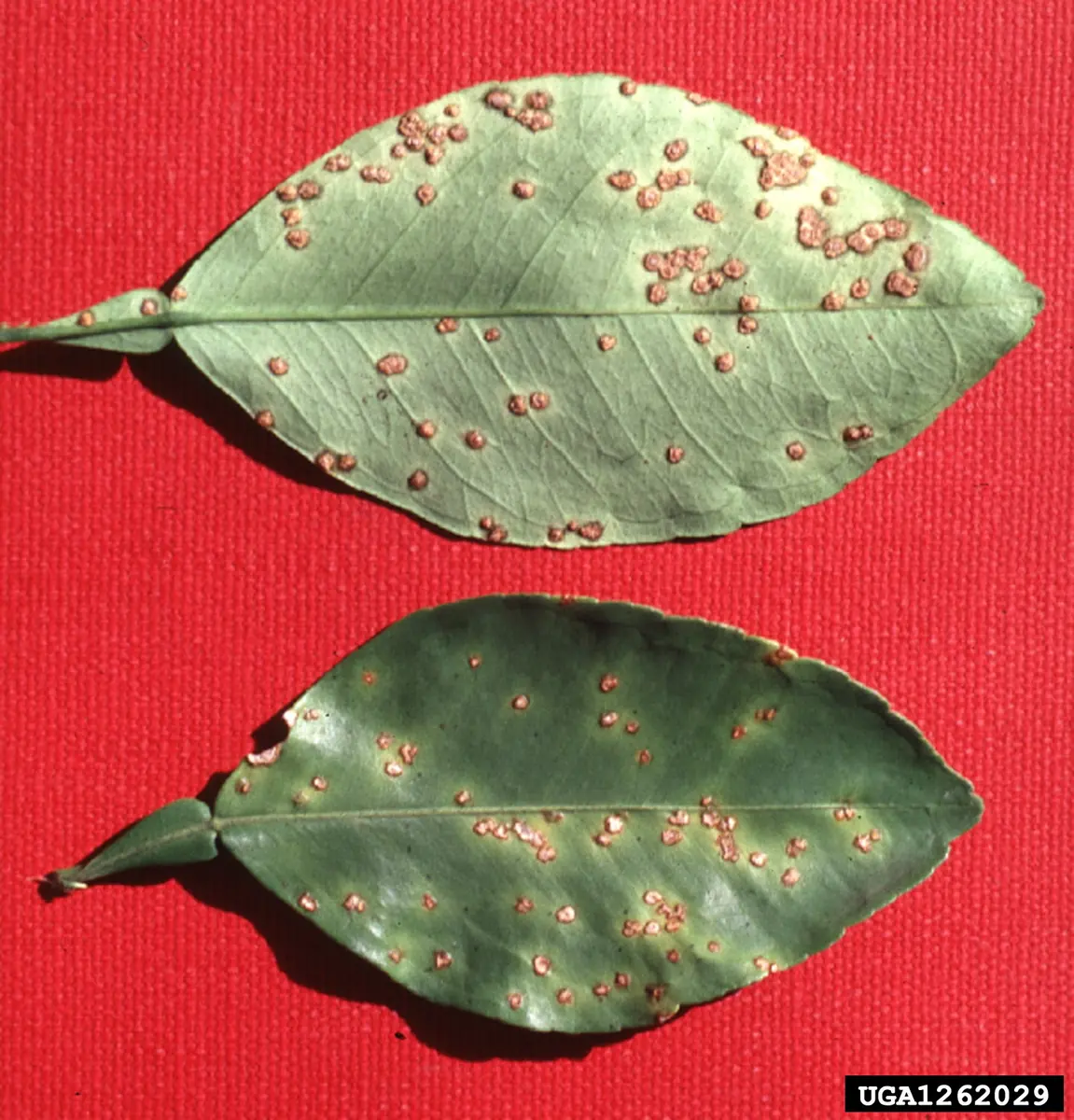
- Small, raised, blister-like spots appear on leaves, usually showing on both the upper and lower surfaces.
- The spots turn tan to brown, become corky and rough, and are usually ringed by a water-soaked margin and a bright yellow halo.
- Older spots may lose the yellow halo and develop a sunken, crater-like center, and on leaves damaged by citrus leafminer the spots often follow the mines.
- On fruit, raised, corky, brown spots with a crater-like center form on the rind, sometimes with a yellow ring, and heavily infected fruit may drop early.
- On green twigs and stems the lesions are raised, rough and corky.
- Badly affected trees drop leaves and fruit and look thin, though canker rarely kills a tree on its own.
What it is often confused with
Citrus scab
Scab forms raised, warty bumps that are usually on only one side of the leaf, often distort young leaves and lack the water-soaked margin and yellow halo of canker.
Melanose
Melanose specks are tiny, dark and sandpaper-like and do not have a yellow halo or a crater-like center.
Greasy spot
Greasy spot makes yellow to dark brown, slightly raised, greasy-looking blotches mostly on the underside of mature leaves, without the corky, cratered spots of canker.
When and where it is worst
In the United States, APHIS lists citrus canker as found throughout Florida and in limited areas of Alabama, Louisiana and Texas, where federal and state quarantines apply. In Texas, quarantined areas in Cameron and Hidalgo counties in the Rio Grande Valley were expanded in 2025. The quarantine maps change, so check your state department of agriculture or APHIS for the current boundaries.
The bacteria spread in wind-driven rain, and storms with winds above about 18 to 20 mph force them into the leaf pores and wounds, so summer thunderstorms and hurricanes cause the biggest spread. People also move it on infected plants, untreated fruit, clippings, tools and equipment. Wounds from citrus leafminer and thorns greatly increase infection. UF/IFAS rates grapefruit and Mexican (Key) lime as the most susceptible, lemons and early oranges as moderately susceptible, Valencia oranges and tangelos as less susceptible and tangerines as the least.
Plants it affects
These plants in our library list it as a problem to watch for.
How to prevent it
- Buy citrus trees only from certified nurseries in your state, and never bring citrus plants, budwood or leaves home from another state or country.
- If you live in a quarantined area, do not mail or carry home-grown citrus fruit, plants or clippings out of that area.
- Plant a windbreak of non-citrus trees or shrubs on the side of prevailing storms, which UF/IFAS reports reduces canker spread and severity.
- Control citrus leafminer on new flushes of growth, because its mines are easy entry points for the bacteria.
- Avoid overhead sprinklers that wet the canopy, and do not prune or work in trees while they are wet.
- Clean pruners, gloves and tools after working on citrus, especially before moving to another tree.
Organic control, step by step
- If you are outside a known canker area and see the symptoms, photograph the spots and call your state department of agriculture or county Extension office before you do anything else.
- In areas where canker is established, prune out heavily infected twigs during dry weather and bag the prunings rather than moving them around the yard.
- Apply a fixed copper product labeled for citrus and allowed in organic growing to protect new flushes and young fruit through the rainy season, which can suppress small infections.
- Keep trees well fed and watered so they recover from leaf loss, and pick up dropped infected fruit.
Conventional control
- Fixed copper products, such as copper hydroxide, are the home garden option; they only protect new growth and young fruit for a short time, so repeat them through the rainy season and after storms.
- No spray cures existing lesions or removes the bacteria from an infected tree.
- Read the label, check that citrus is listed, and keep to the pre-harvest interval.
Frequently asked questions
Is fruit with citrus canker safe to eat?
Yes. Canker does not harm people, and the spots stay in the rind. The fruit is safe to eat at home, but you must not move it out of a quarantined area.
Do I have to remove my tree if it has canker?
Not in areas where canker is established. In Florida the current federal and state program does not require removal of affected trees, which marks a change from the earlier eradication campaign. Outside known areas, regulators decide what happens, so report it and wait for their advice.
How do I report suspected citrus canker?
Contact your state department of agriculture, your county Extension office or the USDA APHIS State Plant Health Director for your state. Do not move samples yourself unless they ask you to.
Can I bring citrus from Florida to another state?
Only commercially packed fruit that has been treated under the federal rules may leave quarantined areas. Home-grown fruit, plants and clippings must stay where they are.
Related problems
Sources: USDA APHIS, Citrus canker; UF/IFAS Citrus Research and Education Center, Management recommendations for citrus canker and windbreaks; UF/IFAS Florida Citrus Production Guide, Citrus canker (CG040); Citrus Industry Magazine, Citrus canker quarantines established, expanded in Texas (July 2025). Identification and control follow these sources. Always read and follow the product label.