
Citrus scab: identify, prevent, control
Updated October 2026
Infects new leaves and young fruit in wet weather during the spring flush and for two to three months after petal fall, in Florida, the Gulf states, Texas and Hawaii.
Citrus scab is a fungal disease that grows raised, corky, wart-like scabs on young leaves, twigs and fruit. It is mainly a cosmetic problem, but on very susceptible trees such as lemons and some tangerines it distorts leaves and can make fruit lumpy and unsightly. A related disease, sweet orange scab, attacks sweet oranges and is under federal regulation, so it is worth knowing which one you have.
Elsinoe fawcettii; Elsinoe australis (sweet orange scab)
.jpg)
How to identify it
- Small, pale, slightly raised spots appear on young, expanding leaves, usually on one side, with a matching dent on the other side of the leaf.
- The spots grow into light brown to gray, corky, wart-like pustules, and badly affected leaves become puckered, twisted or stunted.
- On young green twigs you see raised, light brown, circular scabs.
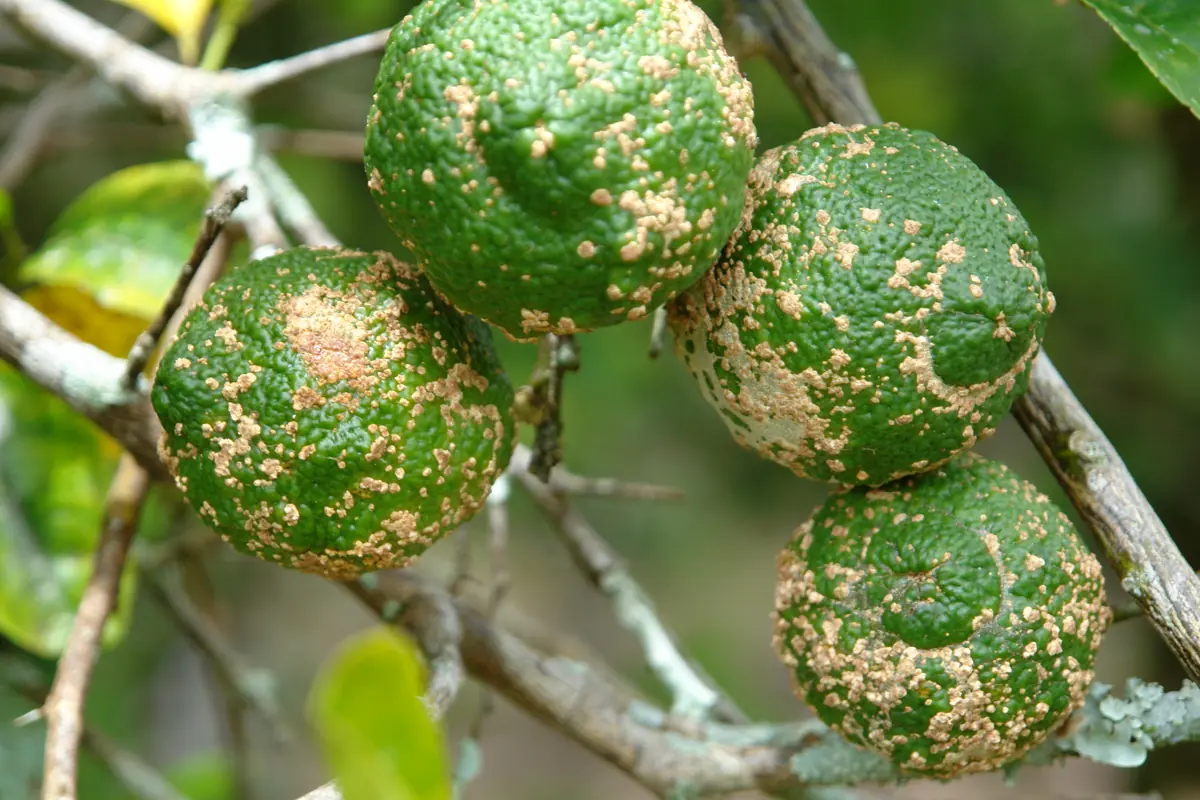
- On fruit, irregular raised scabs form on the rind, starting pinkish or light brown and turning gray, cracked and warty, and they can merge into large rough patches.
- Fruit infected very young may be lumpy or misshapen, but the flesh and juice are normal.
- On sweet oranges, including navel and blood oranges, similar warty scabs on fruit and puckered leaves may be sweet orange scab, which should be reported.
What it is often confused with
Citrus canker
Canker spots go through to both sides of the leaf, have a water-soaked margin and a yellow halo and often a cratered center, while scab pustules are mostly on one side, lack a halo and distort the leaf.
Melanose
Melanose specks are tiny, dark and flat-topped, giving a sandpaper feel, while scab pustules are larger, paler, corky and wart-like.
Wind scar and thrips damage
Wind rub and citrus thrips leave flat, silvery or gray scarring on the rind, often in rings around the stem end, rather than raised corky warts.
When and where it is worst
Citrus scab needs frequent rain or overhead watering while trees are putting out new growth. It is common in Florida, along the Gulf Coast, in South Texas and in the wetter parts of Hawaii, and it is rarely seen in the dry citrus areas of California and Arizona. Spores are made on old scabs on leaves, twigs and fruit in the canopy, and they splash onto new growth in rain. Only three to four hours of wetness are needed for infection, so rainy springs bring the worst outbreaks.
Leaves are susceptible while they are expanding and become resistant just before they reach full size. Fruit is susceptible from petal fall until about two to three months later. Rough lemon, sour orange, lemons, Rangpur lime, some limes, tangelos, Temple orange and many tangerines such as Murcott are hosts, while sweet oranges are not attacked by citrus scab itself. Sweet orange scab, caused by Elsinoe australis, was first found in the United States in 2010 in residential trees in Texas and has since been confirmed by USDA APHIS in Alabama, Arizona, California, Florida, Louisiana, Mississippi and Texas.
Plants it affects
These plants in our library list it as a problem to watch for.
How to prevent it
- Choose less susceptible types for wet areas, since lemons, rough lemon and many tangerines and tangelos scab far more than most sweet oranges.
- Plant citrus in full sun with room for air to move, so leaves and fruit dry quickly after rain.
- Water at the base of the tree and avoid overhead sprinklers, especially during the spring flush and early fruit set.
- Prune out heavily scabbed twigs and thin the canopy during the dry season to reduce the spores carried over to next spring.
- Buy trees from certified nurseries and do not move citrus trees between properties or states, which APHIS says is the fastest way sweet orange scab and other citrus diseases spread.
Organic control, step by step
- Prune out and dispose of scabby twigs and leaves, and rake up fallen scabbed fruit.
- If scab was heavy last year, apply a fixed copper product labeled for citrus and allowed in organic growing when the spring flush is about a quarter expanded.
- Apply a second copper spray at petal fall and a third about three weeks later, while young fruit is still susceptible.
- Skip the sprays in years when the previous season's foliage was clean, because carryover is low and pruning may be enough.
Conventional control
- Fixed copper products, such as copper hydroxide or copper octanoate, are the main home garden fungicides labeled for citrus scab, applied at a quarter leaf expansion, at petal fall and about three weeks later.
- Commercial groves rely on other fungicides as well, but copper alone gives fair control on home trees when timing is right, though it is less effective where scab pressure is very high.
- If you suspect sweet orange scab, report it to your state department of agriculture or the USDA APHIS State Plant Health Director before treating or moving the tree.
- Read the label, check that citrus is listed, and keep to the pre-harvest interval.
Frequently asked questions
Is scabby citrus safe to eat?
Yes. Scab only affects the rind, and the flesh and juice are normal. Lumpy fruit is still fine for juice and cooking.
Why does my lemon have scab but my orange does not?
Lemons are very susceptible to citrus scab, while sweet oranges are not attacked by that fungus. If your orange does develop warty scabs, it may be sweet orange scab, which you should report.
Is sweet orange scab dangerous to my tree?
It is mainly cosmetic, but it is regulated because it affects fruit marketing. Report suspected cases and do not move fruit, plants or clippings from the tree until your state agency advises you.
When is spraying too late?
Once leaves are full size and fruit is more than two to three months past petal fall, they resist infection and sprays do little. Plan for next spring's flush instead.
Related problems
Sources: UF/IFAS Florida Citrus Production Guide, Citrus scab (CG020); University of Hawaii CTAHR, Citrus scab (PD-60); USDA APHIS, Sweet orange scab. Identification and control follow these sources. Always read and follow the product label.