Asian citrus psyllid: identify, prevent, control
Updated October 2026
Present all year where citrus grows outdoors, with numbers peaking whenever trees push new flush, mainly spring to fall.
The Asian citrus psyllid is a small sap-feeding insect that lives on citrus and close relatives such as curry leaf and orange jasmine. Its own feeding twists new leaves, but the real threat is that it spreads the bacterium behind huanglongbing (HLB), also called citrus greening, which has no cure and kills trees within a few years. Every backyard tree matters, because untreated home citrus can keep the psyllid and the disease going in a neighborhood.
Diaphorina citri

How to identify it
- You usually notice twisted, curled or notched new leaves on citrus or curry leaf, often sticky or dusted with white.
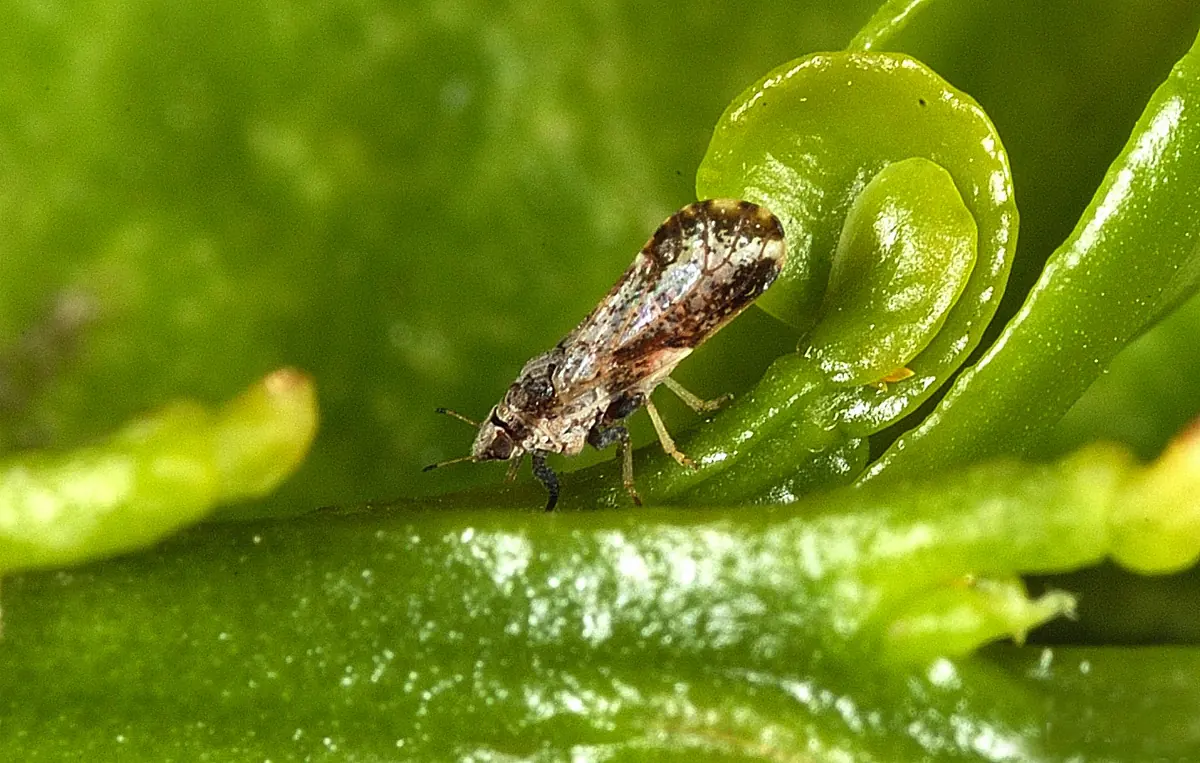
- Look closely at the tender new shoots for mottled brown adults about 1/8 inch long that feed with the head down and the body tilted up at about 45 degrees, like a thorn.
- Yellow to orange, flat nymphs cluster on new shoots and produce white, curly waxy threads that end in a little bulb, which no other citrus pest makes.
- Tiny yellow-orange eggs sit tucked into the folds of unopened leaf buds.
- Trees infected with HLB show blotchy, uneven yellow mottling on leaves that does not match on either side of the midrib, plus small, lopsided, bitter fruit that stays green at the bottom.
- Yellow sticky cards hung in the tree can catch adults if you are unsure what you are seeing.
What it is often confused with
Leaf miners
Citrus leafminer also distorts new flush, but it leaves silvery tunnels inside the leaf rather than insects and white wax threads on the shoot. Both often appear on the same new growth.
Aphids
Aphids also curl new citrus leaves, but they are pear-shaped with short rear tubes and sit flat on the leaf. Psyllid adults tilt their bodies up at an angle and nymphs make curly wax threads.
When and where it is worst
The psyllid is established in Florida, Texas, Louisiana and other Gulf Coast states, Southern California, and parts of Arizona, and it is also present in Alabama, Mississippi, Georgia, South Carolina, Hawaii and Puerto Rico. HLB is widespread in Florida and has been confirmed in Texas, Louisiana, Georgia, South Carolina and Southern California. Federal and state quarantines limit moving citrus plants, curry leaf and other host plants out of affected areas, and the list of regulated areas changes, so check with your state department of agriculture.
Psyllids lay eggs only on soft new flush, so numbers rise each time a tree pushes new growth, mostly from spring through fall and almost year round in South Florida. Warm weather speeds up their life cycle.
Plants it attacks
These plants in our library list it as a problem to watch for.
How to prevent it
- Buy citrus, finger lime and curry leaf plants only from licensed local nurseries, and never bring citrus plants, budwood or leaves across state or quarantine lines.
- Check new flush on lemons, limes, oranges, mandarins, grapefruit, kumquats and curry leaf every week or two through the growing season.
- Report a suspected psyllid or HLB symptoms in a state or county where they are not yet known; in California call the CDFA Exotic Pest Hotline at 1-800-491-1899, and elsewhere contact your county Extension office or state department of agriculture.
- If you live in a quarantine area, move only fruit that is washed and free of leaves and stems, as the California rules require, and check your own state's rules.
- Dry clippings or double-bag them before disposal so psyllids on them cannot fly to new trees.
- Remove a tree confirmed to have HLB, as advised by your state agriculture department, because it will not recover and keeps feeding the disease to nearby trees.
Organic control, step by step
- Hose new flush firmly to dislodge nymphs, and prune off small infested shoot tips and bag them.
- Protect the tiny parasitic wasp Tamarixia radiata and lady beetles by avoiding broad-spectrum sprays when psyllid numbers are low.
- Spray horticultural oil or insecticidal soap on new flush every 7 to 14 days while leaves are expanding, covering the shoot tips thoroughly.
- Do not spray anything while trees are blooming, because bees work citrus flowers heavily.
Conventional control
- A soil drench of imidacloprid applied in summer or fall gives one to two months of control of nymphs on citrus in many states; in California only licensed applicators may now apply it to outdoor fruit trees.
- Carbaryl or malathion sprays labelled for citrus give quick knockdown of adults and nymphs on new flush, but they harm bees and natural enemies.
- Never apply any of these to trees in bloom or about to bloom.
- Read the label, check that the crop is listed, and keep to the pre-harvest interval.
Frequently asked questions
Can I eat fruit from a tree with citrus greening?
Yes, HLB does not affect people. The fruit is often small, lopsided and bitter, but it is safe to eat. The concern is that the tree spreads the disease to other citrus through the psyllid.
Is there a cure for citrus greening?
No. There is no cure for HLB in home trees. Infected trees decline and usually die within a few years, which is why controlling the psyllid and removing infected trees matters so much.
Why is curry leaf on the list?
Curry leaf and orange jasmine are in the citrus family and are favored hosts of the psyllid, and they can carry the disease. They are covered by the same quarantine rules as citrus plants.
Can I take my citrus tree with me when I move?
Not out of a quarantine area. Moving citrus trees and host plants is the fastest way citrus diseases spread, so leave the tree and buy a certified tree from a nursery in your new area.
Related problems
Sources: UC IPM, Asian Citrus Psyllid and Huanglongbing Disease (Pest Notes); USDA APHIS, Citrus greening and Asian citrus psyllid regulated areas; Texas Department of Agriculture, Asian Citrus Psyllid; California Department of Pesticide Regulation, Neonicotinoid pesticides for non-agricultural outdoor use. Identification and control follow these sources. Always read and follow the product label.