
Colorado potato beetle: identify, prevent, control
Updated October 2026
Active from when potatoes emerge in spring until late summer, with one to three generations depending on region.
The Colorado potato beetle is the most serious insect pest of potatoes in North America. Both the striped adults and the humpbacked red larvae eat leaves and can strip plants bare, which cuts the size of the tuber harvest. It also feeds on eggplant, tomatillo, tomato and pepper, and it is famous for developing resistance to insecticides.
Leptinotarsa decemlineata
How to identify it
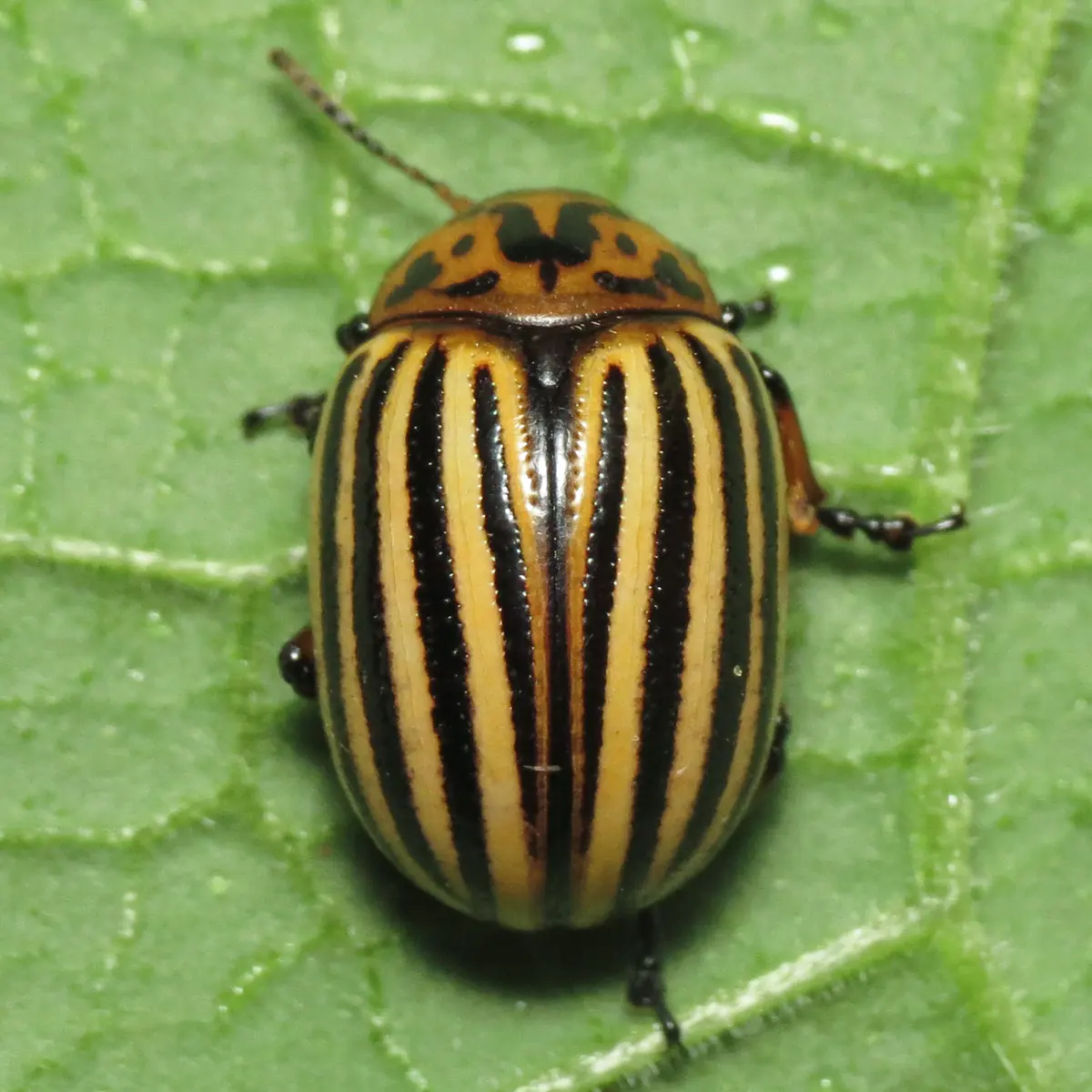
- Early in the season you notice oval beetles about 3/8 inch long with yellowish cream wing covers carrying ten narrow black stripes and an orange area behind the head.
- Look under the leaves for clusters of 10 to 30 bright yellow orange oval eggs standing on end.
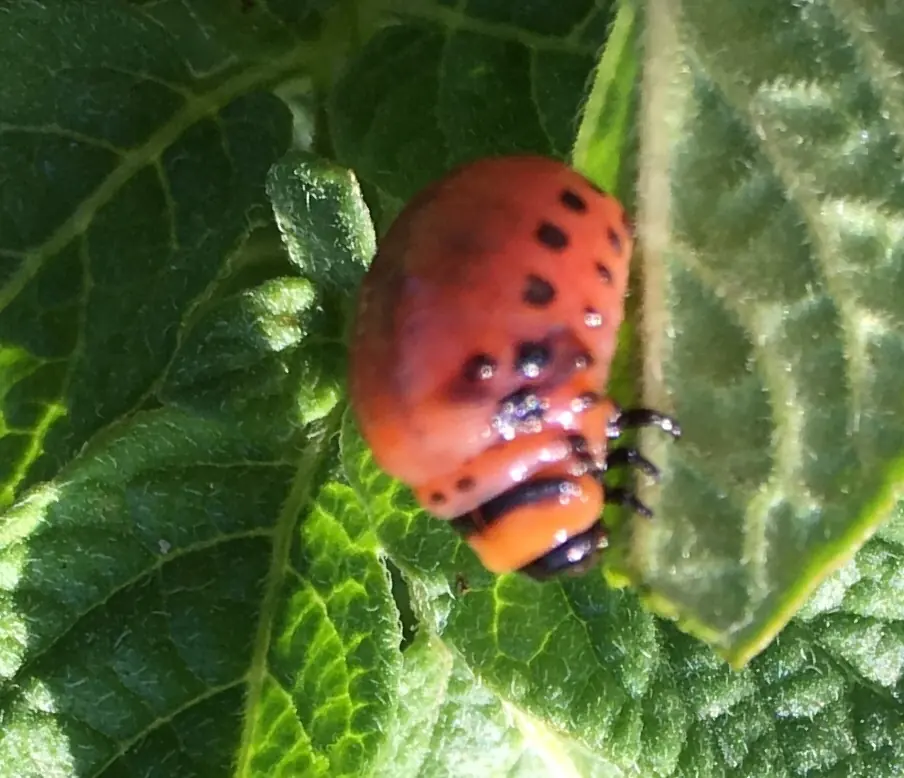
- The larvae are soft and humpbacked, brick red when young and pink to salmon later, with a black head and two rows of black spots along each side.
- Larvae feed in groups and chew leaves from the edges, and the large last-stage larvae do most of the damage.
- Plants that are badly hit are left as bare stems with dark droppings on the remaining leaves.
What it is often confused with
False potato beetle
The false potato beetle looks very similar but has a brown stripe in the middle of each wing cover and feeds mostly on horsenettle and other weeds. It rarely harms potatoes.
Mexican bean beetle larvae
Mexican bean beetle larvae are yellow and covered in branched spines and feed on beans. Colorado potato beetle larvae are smooth, red to pink and feed on potatoes and their relatives.
When and where it is worst
Colorado potato beetle occurs across most of the United States, and it is worst in the Northeast, Mid-Atlantic and Midwest, where it has been a pest for longest and where resistance to insecticides is most widespread. Adults spend the winter 5 to 10 inches deep in the soil of old potato beds and nearby edges, and they come up as the potatoes emerge.
Eggs hatch in four to nine days in warm weather and larvae can finish feeding in 10 days at temperatures in the mid 80s °F. Minnesota usually has a second generation, Kentucky has two and sometimes a partial third, and by midsummer eggs, larvae and adults can all be on the plants at once.
Plants it attacks
These plants in our library list it as a problem to watch for.
How to prevent it
- Plant potatoes in a different part of the garden each year, as far from last year's patch as you can, so emerging adults have to walk to find them.
- Cover the rows with floating row cover before any beetles appear, but only in beds where potatoes, tomatoes or eggplant did not grow last year.
- Lay a thick straw mulch between plants, which makes it harder for beetles to reach the plants and helps predators.
- Choose early maturing varieties, ready in under 80 days, so the crop is made before the summer generation peaks.
- Pull out nightshade, horsenettle and ground cherry around the garden, which feed the beetles.
- Clean up the potato bed at the end of the season to make winter harder for the adults.
Organic control, step by step
- Handpick adults as they emerge in spring, crush the yellow egg clusters under the leaves, and knock larvae into soapy water.
- Spray Bacillus thuringiensis subspecies tenebrionis, where you can buy it, on small larvae less than 1/4 inch long right as the eggs hatch, because it does little against large larvae or adults.
- Use spinosad on young larvae, but alternate it with other products because spinosad resistance has been found in some areas.
- Spray neem (azadirachtin), which stops larvae developing normally when applied while they are small.
- Leave lady beetles and predatory stink bugs alone, because they eat the eggs.
Conventional control
- Time any spray for when most eggs have hatched and larvae are still small, because adults and large larvae are hard to kill.
- Home garden products containing carbaryl or pyrethroids such as permethrin are labeled for potatoes, but this beetle is resistant to more than 50 active ingredients in some areas, so do not expect a single product to work everywhere.
- Switch between products with different modes of action, shown as the IRAC group number on the label, rather than repeating the same one.
- Read the label every time, check that the crop you are treating is listed, and keep to the pre-harvest interval before you pick.
Frequently asked questions
How much leaf can my potatoes lose?
University of Minnesota Extension says potatoes can usually lose up to 30 percent of their leaves before flowering without much loss of yield. Once tubers start to size up after flowering, they can only spare about 10 percent, so that is the time to be most watchful.
Why won't the spray kill them?
The beetle has resistance to many insecticides, and timing matters too. Spraying too early misses beetles that arrive later, and waiting until larvae are full grown makes them much harder to kill.
Do Colorado potato beetles eat tomatoes?
They can, along with eggplant, tomatillo and pepper, but potatoes and eggplant are their favorites. Tomatoes are usually only damaged when beetle numbers are high.
Related problems
Sources: University of Minnesota Extension, Colorado potato beetle; University of Kentucky Entomology, Colorado potato beetle management (ENTFACT-312). Identification and control follow these sources. Always read and follow the product label.