Tomato hornworm: identify, prevent, control
Updated October 2026
Worst from midsummer to early fall, with a first wave in early summer and a larger second generation later.
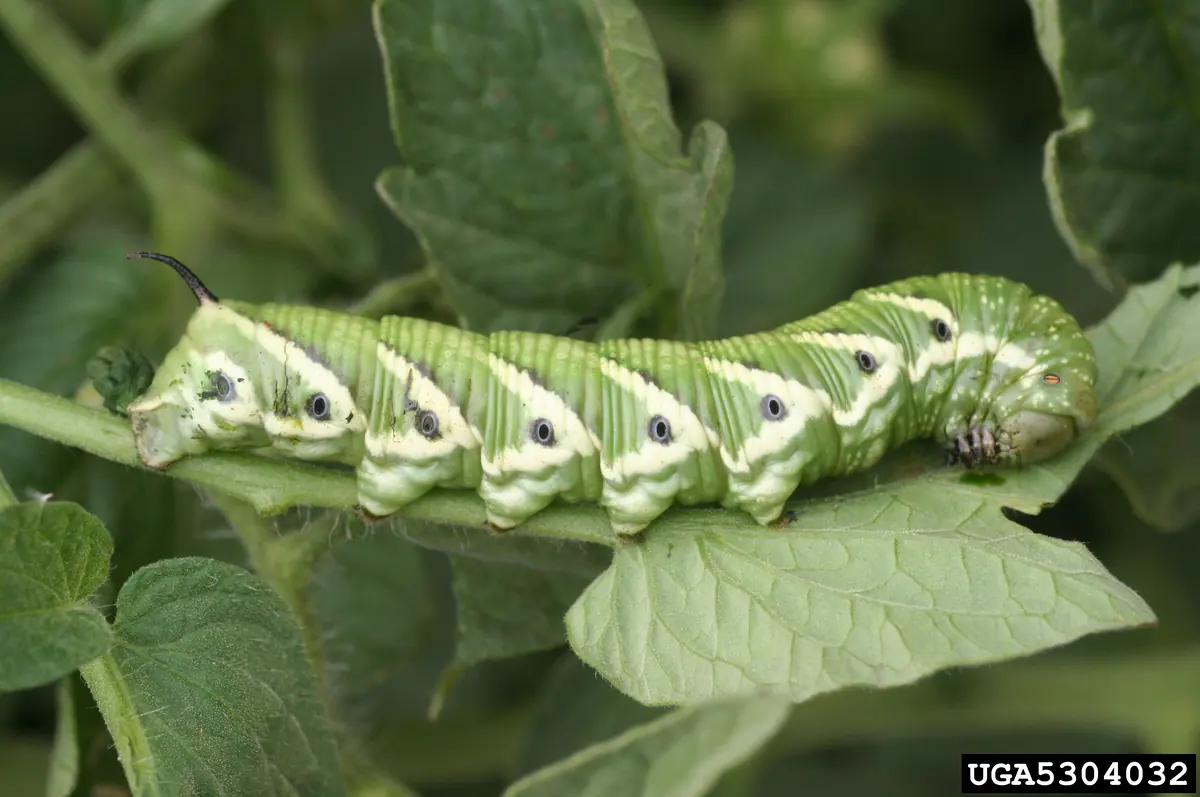
The tomato hornworm is a large green caterpillar, up to 4 inches long, with a horn on its rear end. It eats tomato leaves and green fruit and can strip a plant in a few days, yet it blends in so well that you often see the damage before the caterpillar. Its close relative, the tobacco hornworm, does the same damage and is more common in the South.
Manduca quinquemaculata

How to identify it
- The first sign is usually bare stems at the top of the plant, where whole leaves have vanished overnight.
- Dark green to black pellets of droppings, some as big as a pencil eraser, collect on the leaves and the ground below.
- Look closely along the stems near the damage and you will find a fat green caterpillar with eight white V-shaped marks along each side and a dark, black-edged horn at the tail.
- Large caterpillars also chew big scars and holes into green tomatoes.
- A hornworm carrying white, rice-like cocoons on its back has been parasitized by a small wasp and will soon die.
What it is often confused with
Tobacco hornworm
The tobacco hornworm (Manduca sexta) has seven white diagonal stripes rather than V-shaped marks, and its horn is red. It feeds on the same plants and is managed the same way.
Cabbage looper and other caterpillars
Loopers and armyworms also chew tomato leaves and fruit, but they are much smaller and have no horn on the tail.
When and where it is worst
Tomato hornworms occur across the United States and tobacco hornworms are especially common in the Southeast, Texas and the South, so many gardeners there actually have the tobacco species. Both spend the winter as large brown pupae in the soil and emerge as big gray hawk moths, often called sphinx moths, in late spring.
Moths lay single, smooth, light green eggs on the leaves. Caterpillars are fully grown in three to four weeks, then drop to the soil to pupate. A second generation follows in midsummer, which is when damage peaks, from July to September in most regions. In the low deserts, Texas and Florida activity can start earlier and run later.
Plants it attacks
These plants in our library list it as a problem to watch for.
How to prevent it
- Check tomato plants at least twice a week in summer, looking along the stems near any bare patches and under fresh droppings.
- Look in the evening or early morning, or with an ultraviolet flashlight at night, when the caterpillars are easier to spot.
- Pull out weeds such as horsenettle, jimsonweed and nightshade that feed the caterpillars.
- Dig or till the bed after harvest to break up the pupae in the soil.
- Grow flowering herbs and leave paper wasps alone, because they hunt hornworms.
Organic control, step by step
- Pick hornworms off by hand and drop them into soapy water, which University of Minnesota Extension calls the most effective control for a home garden.
- Leave any hornworm carrying white cocoons in place, because the wasps that emerge will go on to parasitize more hornworms.
- Spray Bacillus thuringiensis subspecies kurstaki (Bt) on the leaves while caterpillars are small, since it only works when they eat it and is far less effective on big ones.
- Use spinosad on young caterpillars if you have too many plants to check by hand, spraying when bees are not foraging.
Conventional control
- Sprays are rarely needed, because handpicking and natural enemies usually keep hornworms in check.
- Carbaryl and permethrin are sold in home garden products labeled for hornworms on tomatoes, but they also kill the parasitic wasps and other helpful insects, so keep them for severe outbreaks.
- Treat while caterpillars are small and before defoliation is severe, because large hornworms are much harder to kill.
- Read the label every time, check that the crop you are treating is listed, and keep to the pre-harvest interval before you pick.
Frequently asked questions
Do tomato hornworms sting or bite?
No. The horn looks threatening but is harmless, and the caterpillars cannot sting. They may thrash about or make a clicking sound when handled.
What are the white things on the back of my hornworm?
Those are cocoons of a small braconid wasp that has laid its eggs inside the caterpillar. The hornworm will stop feeding and die, so leave it in the garden to let a new generation of wasps emerge.
Why can't I find the hornworm when the damage is so obvious?
Hornworms are the same green as tomato leaves and rest stretched along stems. Search from the bare area downward, follow the fresh droppings, and check in the evening or at night with a UV flashlight, which makes them glow.
What does the hornworm turn into?
It becomes a large gray brown hawk moth with a wingspan of 4 to 5 inches and yellow spots along its body. The moths feed on flower nectar at dusk and help pollinate some flowers.
Related problems
Sources: University of Minnesota Extension, Tomato hornworms; UF/IFAS Gardening Solutions, Hornworm caterpillars. Identification and control follow these sources. Always read and follow the product label.