
Cucumber beetles: identify, prevent, control
Updated October 2026
Worst in late spring and early summer when cucurbit seedlings emerge, with a second wave of beetles in late summer.
Cucumber beetles are small yellow beetles marked with black stripes or spots that feed on cucumbers, melons, squash, pumpkins, watermelons and luffa. Adults chew seedlings, leaves, flowers and fruit rinds, and the larvae feed on roots. Their biggest threat is bacterial wilt, a disease they carry that can kill cucumbers and cantaloupes outright.
Acalymma vittatum, Diabrotica undecimpunctata
How to identify it
- You first notice ragged holes in seed leaves and the first true leaves, sometimes with seedlings chewed off entirely.
- Small yellow beetles about 1/5 inch long run or drop off the plant when you approach, and they gather inside squash and pumpkin flowers.
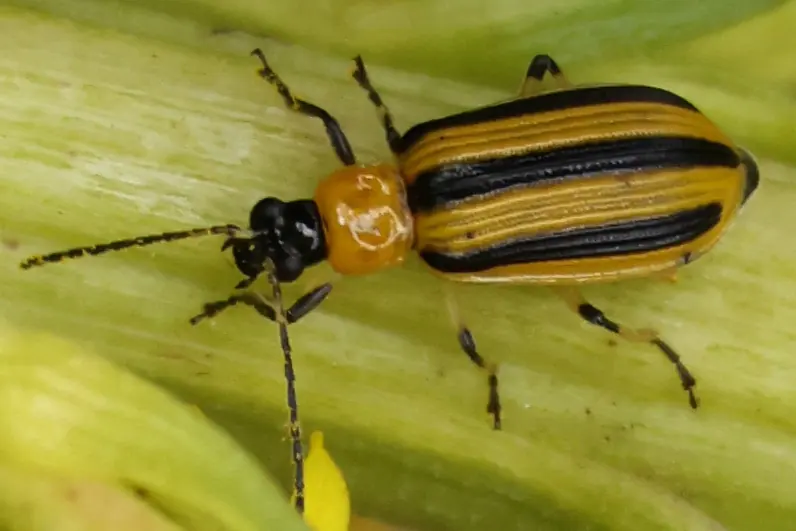
- The striped cucumber beetle has three black stripes down yellow wing covers, a black head and an orange area behind the head.
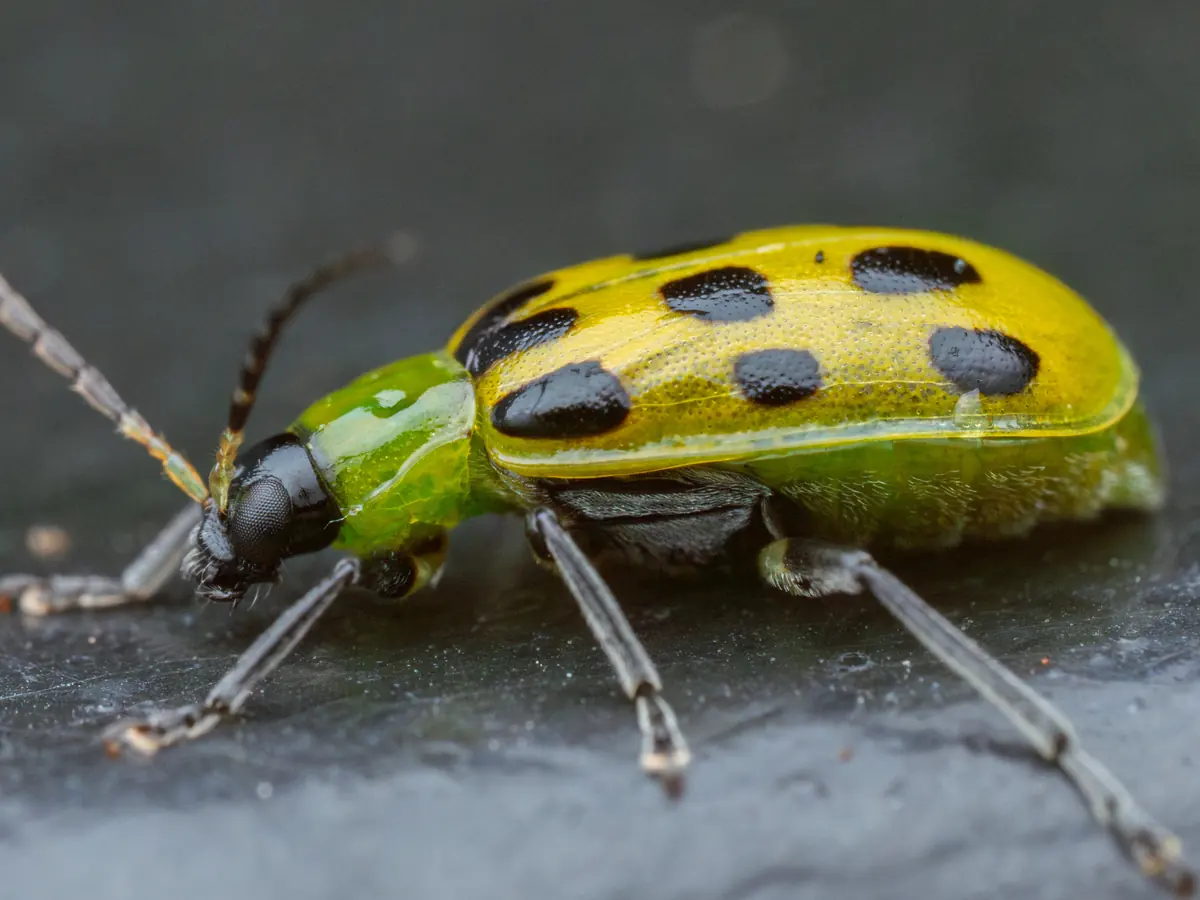
- The spotted cucumber beetle is yellow green with twelve black spots; its larva is the southern corn rootworm.
- Later in the season you may see scarred, scraped patches on the rinds of cucumbers, melons and pumpkins.
- A cucumber or cantaloupe vine that wilts suddenly and does not recover overnight, even with moist soil, may have bacterial wilt spread by the beetles.
What it is often confused with
Squash vine borer
A squash vine borer also makes a vine wilt, but you will find a hole near the base of the stem packed with wet, sawdust-like frass. Bacterial wilt leaves the stem intact.
Mexican bean beetle
The spotted cucumber beetle is sometimes mistaken for a lady beetle, but it is longer and narrower with a black head. Mexican bean beetles are rounded, copper colored and feed on beans, not cucurbits.
When and where it is worst
Striped cucumber beetles are found east of the Rocky Mountains, with the related western striped cucumber beetle in the West. They spend the winter as adults in leaf litter and field edges and fly into gardens as soon as cucurbits come up, from April in the South to early June in Minnesota. The larvae feed on roots and a new crop of adults appears in midsummer.
Spotted cucumber beetles overwinter in the South and migrate north each summer, reaching the upper Midwest in late June or July. In the Southeast and Texas, Clemson notes beetles are present all season and can even feed on seedlings below the soil surface. Cucumbers and cantaloupes stay at risk from bacterial wilt all season, while squash, pumpkins and watermelon tolerate more feeding once they have a few true leaves.
Plants it attacks
These plants in our library list it as a problem to watch for.
How to prevent it
- Cover newly planted cucumbers, melons and squash with floating row cover right away and seal the edges, then remove it when female flowers open so bees can pollinate.
- Choose cucumber and melon varieties listed as resistant or tolerant to bacterial wilt where you can.
- Set out sturdy transplants instead of direct seeding in gardens with a history of beetles, because plants past the third true leaf stand feeding much better.
- Plant a few Blue Hubbard squash a week or two before your main crop as a trap crop, and remove the beetles that gather there.
- Lay a thick straw mulch around established plants to make it harder for females to lay eggs in the soil.
- Clean up weeds and old vines in fall so fewer adults find shelter for the winter.
Organic control, step by step
- Check seedlings every day or two and knock beetles into a bucket of soapy water, which is practical for a few plants.
- Pull out any cucumber or melon plant that shows bacterial wilt straight away so beetles cannot spread the bacteria from it.
- Coat young plants with kaolin clay before beetles arrive to discourage feeding, and reapply after rain.
- Spray spinosad or pyrethrins on seedlings if beetles are numerous, applying late in the day when bees are not working the flowers.
Conventional control
- Treat seedlings if you find two or more beetles per plant on a quarter of your plants, or if a quarter of a young plant's leaf area is gone, which is the threshold University of Minnesota Extension uses.
- Carbaryl, permethrin, bifenthrin and cyfluthrin are sold in home garden products labeled for cucumber beetles on cucurbits, and Clemson lists them for this pest.
- These insecticides are toxic to bees, so never spray open flowers, and spray in the evening after blooms close.
- Read the label every time, check that the crop you are treating is listed, and keep to the pre-harvest interval before you pick.
Frequently asked questions
Why do my cucumbers wilt and die even though I water them?
Sudden wilting of cucumber and cantaloupe vines is often bacterial wilt, carried by cucumber beetles. A simple field check is to cut a wilted stem, touch the cut ends together and pull them slowly apart; sticky strings often point to bacterial wilt, though a lab test is needed to be sure. There is no cure, so remove infected plants.
Do I need to worry about beetles in late summer?
Usually not. Late season beetles mostly feed on pollen and flowers and scar a little fruit, which is largely cosmetic. Melons and cucumbers can still pick up bacterial wilt, so keep watching them.
Will row covers stop my plants from setting fruit?
Only if you leave them on too long. Cucurbits need bees to move pollen between flowers, so lift the covers as soon as female flowers, the ones with a tiny fruit behind them, begin to open.
Related problems
Sources: University of Minnesota Extension, Cucumber beetles; Clemson Cooperative Extension HGIC, Cucumber, squash, melon and other cucurbit insect pests. Identification and control follow these sources. Always read and follow the product label.