
Spider mites: identify, prevent, control
Updated October 2026
Worst in hot, dry midsummer from June to September across most of the country, and in spring and fall in the Southwest deserts and Florida.
Spider mites are tiny relatives of spiders that suck the contents out of leaf cells. In hot, dusty weather a colony can go through a generation in less than a week, turning leaves of cucumbers, blackberries, boysenberries, zinnias, marigolds and herbs pale, bronzed and webbed. They are often a problem caused by water stress or by sprays that killed their predators.
Tetranychidae (mainly Tetranychus urticae, the twospotted spider mite)
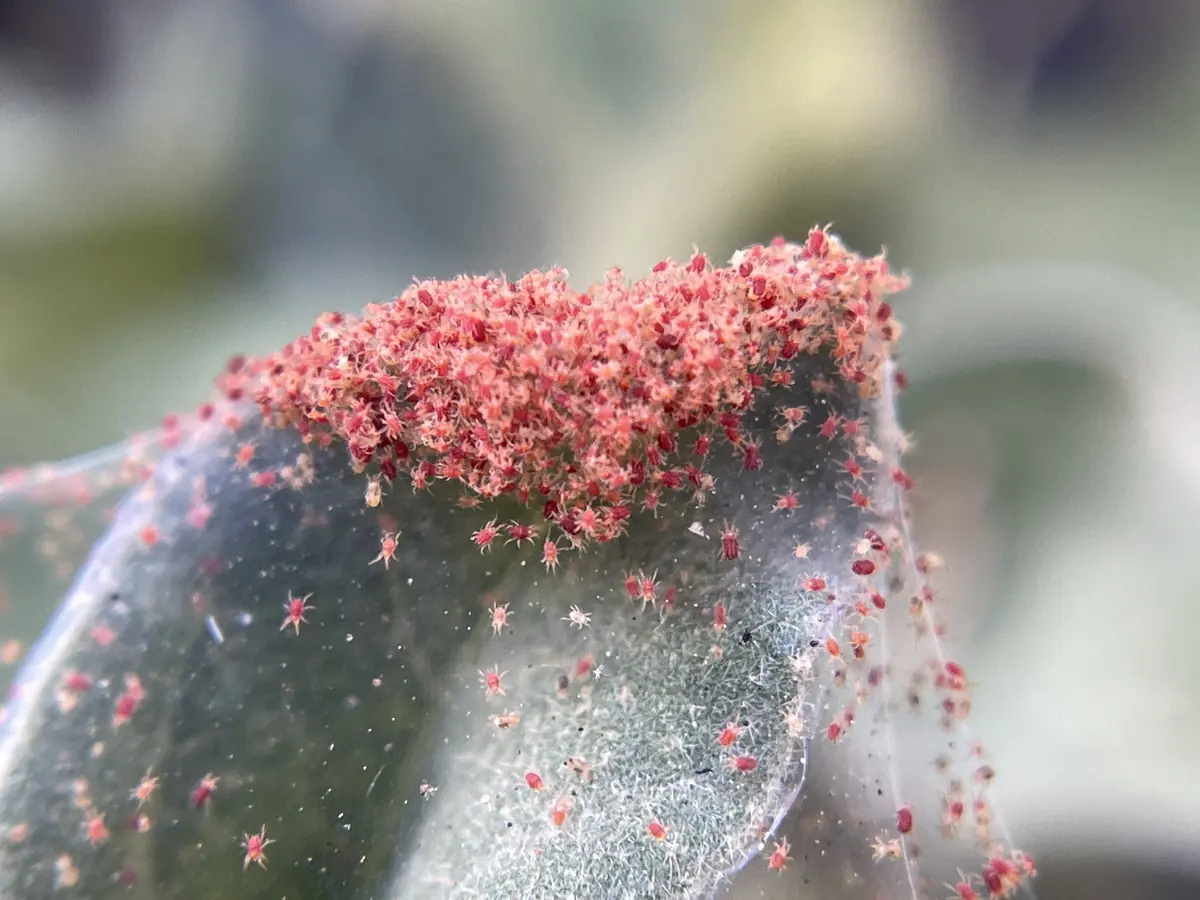
How to identify it
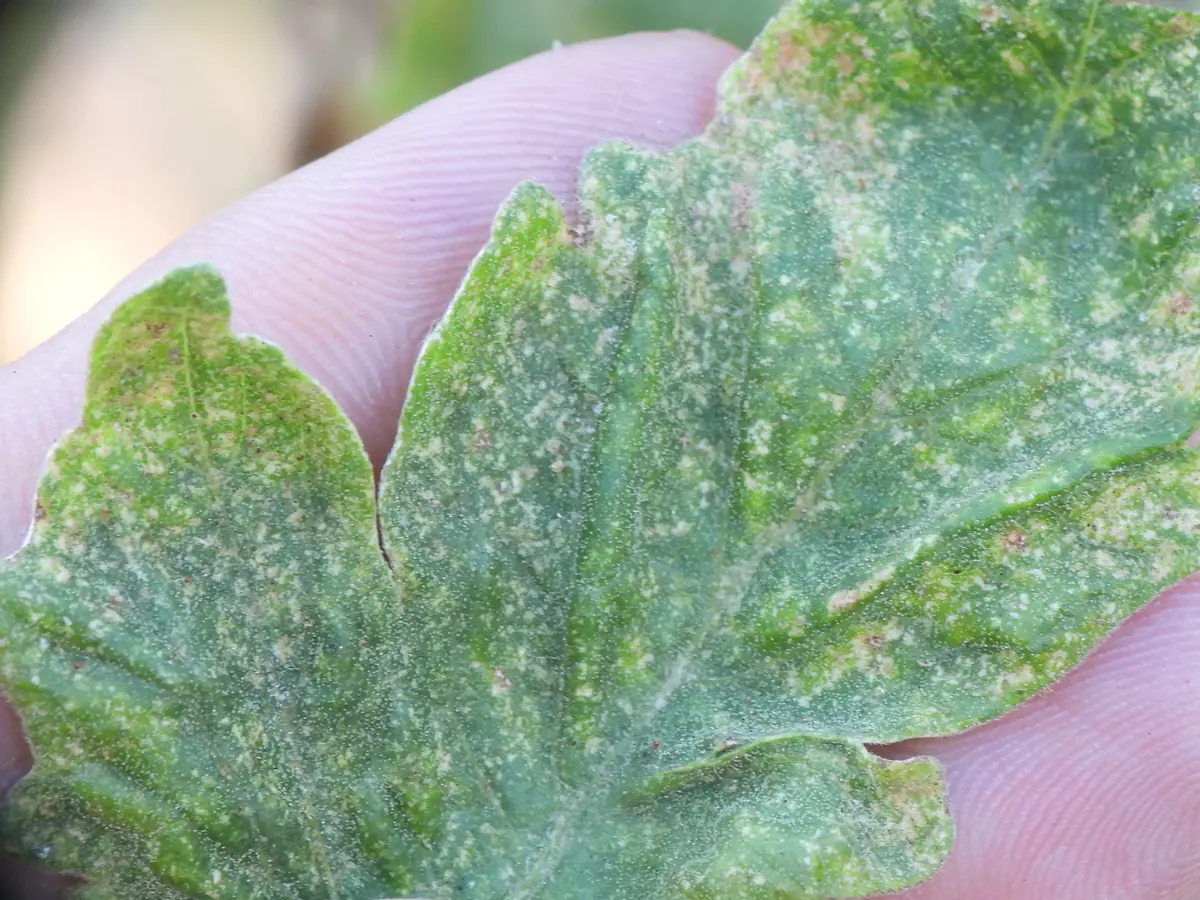
- You usually notice leaves that look dull, peppered with tiny pale yellow or white dots, often starting on lower or inner leaves.
- As numbers grow, leaves turn bronze or yellow, dry out and drop, and you may see fine silk webbing over leaves, shoot tips and flowers.
- Turn a leaf over and look with a hand lens to find tiny moving specks under 1/50 inch long, often greenish or yellow with two dark spots, or red in fall.
- Hold a sheet of white paper under a branch and tap it, and mites will show as moving dots that leave a streak when smeared.
- Heavily infested plants of cucumber, sage, marjoram and lemon verbena look dusty and grayish and stop growing.
What it is often confused with
Thrips
Thrips leave silvery streaks with tiny black droppings and no webbing, and they are slender insects rather than round mites.
Leaf spot
Fungal leaf spots are larger, distinct spots with edges, often with a dark border, while mite damage is fine, even speckling across the leaf.
When and where it is worst
Spider mites occur everywhere in the US. They are worst in hot, dry summers in the Great Plains, Texas, the Southwest deserts, California and the Mountain West, and during dry spells in the Midwest, Southeast and Northeast. In Florida and low desert gardens they often peak in the dry spring months.
Temperatures above about 70°F speed up breeding, and hot weather, dusty plants, drought stress and sprays of carbaryl, pyrethroids or other broad-spectrum insecticides that kill predatory mites all trigger outbreaks. Cool, humid or rainy weather usually slows them down.
Plants it attacks
These plants in our library list it as a problem to watch for.
How to prevent it
- Water deeply and regularly in hot weather, because drought-stressed plants are much more prone to mites.
- Hose dust off plants and wet down dusty paths near the garden.
- Avoid broad-spectrum insecticides such as carbaryl and pyrethroids, which kill the predatory mites that normally keep spider mites in check.
- Check the undersides of cucumber, berry and herb leaves weekly in summer with a hand lens.
- Remove and bag heavily infested leaves or whole plants at the end of the season.
Organic control, step by step
- Spray the undersides of leaves with a strong jet of water every few days, which knocks mites off and breaks up their webbing.
- Encourage predatory mites, minute pirate bugs, lacewings and the tiny black spider mite destroyer lady beetle; predatory mites can also be bought and released, and the western predatory mite works best in hot, dry areas.
- Spray insecticidal soap or horticultural or neem oil, wetting the leaf undersides thoroughly, and repeat every 5 to 7 days because these sprays do not kill eggs.
- Sulfur can be used on many plants but never above about 90°F, within about 30 days of an oil spray, or on sulfur-sensitive plants such as some cucumbers and melons.
Conventional control
- Horticultural (petroleum) oil, insecticidal soap and sulfur are the main miticides available for home vegetable and fruit gardens; few synthetic miticides are sold for home use.
- General insecticides such as pyrethroids, carbaryl and imidacloprid do not control mites and often make them worse, so do not use them for this problem.
- Read the label, check that your crop and mites are listed, follow the rate exactly and keep to the pre-harvest interval stated on it.
Frequently asked questions
How do I know if I have spider mites?
Look for fine pale stippling on the leaves, then hold white paper under the plant and tap. Tiny moving specks that streak when smeared are mites. Fine webbing on leaves and shoot tips confirms a heavy infestation.
Why did my spider mites get worse after I sprayed?
Many common insecticides kill the predatory mites and insects that eat spider mites, and some even speed up mite breeding. UC IPM notes that outbreaks can follow within days of carbaryl or pyrethroid sprays. Switch to water sprays, soap or oil and give predators time to return.
Will spider mites go away on their own?
Numbers often crash when the weather turns cooler and more humid or when predators build up. Keeping plants watered and hosing them off helps you get through the hot spell without heavy losses.
Related problems
Sources: UC IPM Pest Notes: Spider Mites; UC IPM Pest Notes: Thrips. Identification and control follow these sources. Always read and follow the product label.