
Sooty mold: how to identify it and get rid of it
Updated November 2026
Follows sap-sucking insect activity, so worst from late spring to fall, and year-round in Florida, the Gulf Coast, Hawaii and greenhouses.
Sooty mold is a black fungus that grows on the sticky honeydew dropped by aphids, soft scales, whiteflies, mealybugs, psyllids and leafhoppers. It does not infect the plant, but a thick coat blocks light and can stunt growth and cause early leaf drop. The mold is a symptom, and the lasting fix is to control the insects above it.
Capnodium, Fumago, Scorias and related fungi

How to identify it
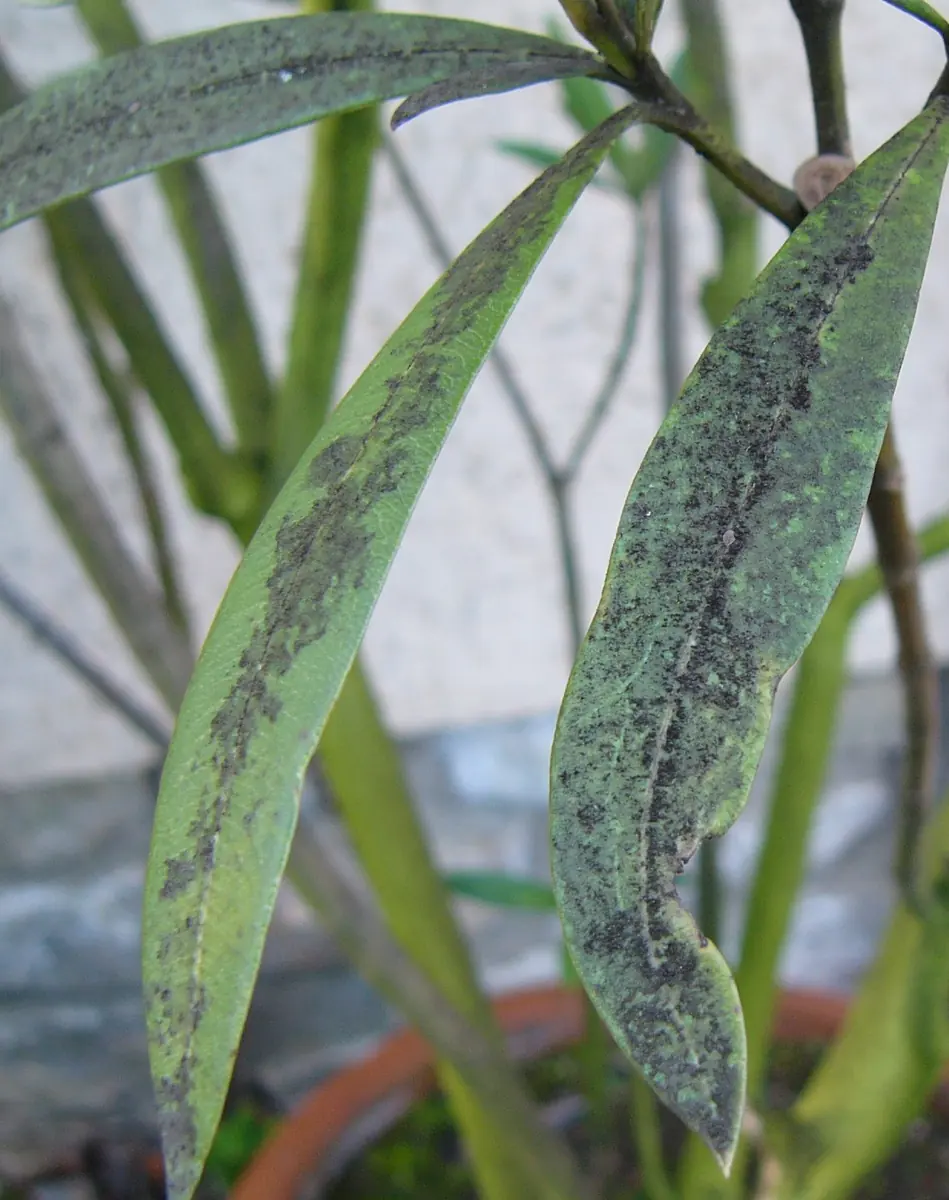
- A dull black film coats leaves, twigs and sometimes fruit, often in patches that follow where honeydew has dripped.
- The coating can be rubbed or washed off to reveal green leaf underneath, which is the quickest way to tell it from a leaf spot disease.
- Fresh honeydew feels sticky, and ants, wasps or bees may be visiting the plant for it.
- Look above the mold for the culprits: aphids on shoot tips, soft scale on twigs, whiteflies under leaves, white fluffy mealybugs or leafhoppers.
- Heavy coatings turn whole plants dark, and leaves can yellow and drop early.
- Plants and patio furniture under a honeydew-producing tree such as crape myrtle, citrus, maple or magnolia are often coated from above.
What it is often confused with
Leaf spot and black spot
Fungal leaf spots mark the leaf itself with distinct spots that do not wipe off. Sooty mold sits on top of a healthy leaf and washes away.
Citrus scab and melanose
Scab makes raised, corky bumps on citrus leaves and fruit that cannot be wiped off. Sooty mold is a smooth black film.
Dust and soot
City grime is gray and gritty rather than jet black, and it is not sticky.
When and where it is worst
Sooty mold appears a few weeks after honeydew starts to fall. In most of the country that means late spring to fall, and in Florida, the Gulf Coast, Hawaii, southern California and greenhouses it can persist through the whole year. Citrus, gardenia, camellia, crape myrtle, magnolia, oleander and tomatoes under cover are common hosts, because aphids, soft scale, whiteflies and mealybugs feed on them.
UC IPM explains that sooty mold does not infect plants, but the coating blocks sunlight, which reduces photosynthesis and can cause leaves to age and drop early. Fruit and vegetables coated in it are still edible after washing with mild soap and warm water.
Once the honeydew producers are controlled, honeydew falls off and the mold gradually weathers away. A strong water stream or soap and water speeds up cleaning, though removing every trace can be difficult.
Sooty mold action ladder
- Hand removal. Find the insects behind the honeydew, pick off or prune scale-covered twigs and wash aphids and whiteflies off with a firm jet of water.
- Barriers. Block the ants that farm honeydew with a sticky band on the trunk or a barrier around the pot, so natural enemies can reach the pests.
- Beneficials. Ladybugs, lacewings, hoverflies and parasitic wasps clear most honeydew producers once ants and broad-spectrum sprays are out of the way.
- A registered product, following the label. If a plant is still being overrun, use an EPA-registered insecticidal soap or horticultural oil product aimed at the insects, not the mold, and wipe or wash the leaves afterward.
How to prevent it
- Check citrus, gardenias, camellias and crape myrtle every couple of weeks for aphids, scale, whiteflies and mealybugs.
- Avoid heavy nitrogen fertilizer and overwatering, because soft new growth attracts sap-sucking insects.
- Put a sticky barrier on tree trunks to keep ants from tending honeydew producers.
- Prune for light and airflow so natural enemies can find the pests.
- Skip broad-spectrum insecticides, which kill the lady beetles and lacewings that normally keep sap suckers in check.
Organic control, step by step
- Control the honeydew producers first, because washing mold off while honeydew keeps falling just brings it back.
- Hose off or wipe the leaves with a soft damp cloth once the pests are under control.
- Prune out heavily coated, shaded or scale-covered growth and bag it.
- Use an EPA-registered insecticidal soap or horticultural oil product, following the label, on soft scale, aphids and whiteflies.
- Be patient, because the mold flakes off and weathers away over several weeks once the honeydew stops.
Conventional control
- You do not need a fungicide, because sooty mold does not infect the plant.
- If you need a product for the insects, choose one labeled for them on your plant, follow the label, and keep to the pre-harvest interval on edible crops.
- Systemic and broad-spectrum products also kill natural enemies and pollinators, so keep them for serious infestations on woody plants and read the label for flowering plants.
Frequently asked questions
Is sooty mold harmful to plants?
Not directly. It does not infect the plant, but a heavy coating blocks light and can stunt growth and cause leaves to drop early. The insects producing honeydew do the real harm.
How do I get rid of black sooty mold on my plants?
Control the aphids, scale, whiteflies or mealybugs above it, block ants, and then wash the leaves with a strong stream of water or mild soap and water. Without new honeydew, the mold weathers away.
Is it safe to eat vegetables and fruit with sooty mold?
Yes. The mold is only on the surface, and UC IPM notes that coated fruits and vegetables are still edible after washing with mild soap and warm water.
Why does my crape myrtle turn black every summer?
Crape myrtle bark scale and aphids drip honeydew on the leaves and bark, and sooty mold grows on it. Controlling the insects and ants is the way to stop it.
Related problems
Not sure this is the problem? Try our plant problem finder, which starts from what you can see.
Sources: UC IPM, Sooty mold (Pest Notes). Identification and control follow these sources. Always read and follow the product label.