
When to Plant Cabbage in Zone 6
USDA zone 6 covers zones 6a and 6b, with winter lows of -10 to 0°F (-23 to -18°C).
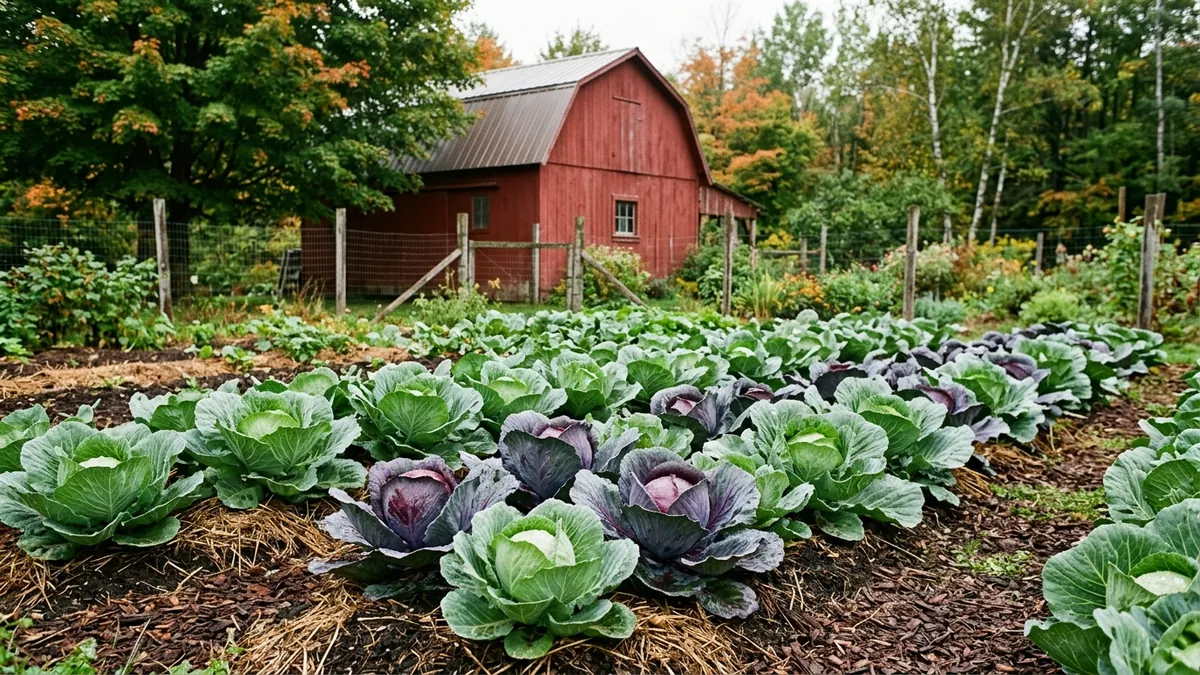
Zone 6 is cabbage country, with a cool spring and a long, cool fall. Midwest and Mountain West gardeners sow or transplant in April and May and again from July to September. The Northeast begins earlier, from March to May, and Missouri and Kansas earlier still, from February to April, with a second run that reaches from July to October.
Zone 6 cabbage planting months by region
| Planting region | Share of zone 6 | Sow or transplant cabbage | Last frost, zone 6 ZIP codes | First frost, zone 6 ZIP codes |
|---|---|---|---|---|
| Midwest & Great Lakes Continental, cold winters and warm summers | 38 percent | April and May, then July to September | April 23 | October 21 |
| Northeast & New England Cold winters, warm humid summers | 30 percent | March to May, then July to September | April 30 | October 17 |
| Southern Plains Hot summers, two planting seasons | 15 percent | February to April, then July to October | April 16 | October 21 |
| Mountain West High-elevation, dry, big day-night swings | 7 percent | April and May, then July to September | May 10 | October 5 |
Other regions (9 percent of the zone): Mid-Atlantic, Mid-South, Pacific Northwest.
How we built this table: we placed all 10,458 zone 6 ZIP codes (2023 USDA map) in our planting regions; the months are each region's own calendar and the frost dates are NOAA 1991 to 2020 medians for the zone's ZIP codes there.
Heads that finish in cool weather keep the longest
Pennsylvania, Ohio and the lower Great Lakes have a long cabbage tradition, and the reason is in the weather: heads finish well when days stay between about 55°F and 75°F. Spring plantings that turn hot while the head is still forming go loose and bitter, so start with transplants, not seed, and set them out as soon as the soil is workable. A typical last frost of April 23 in the Midwest and April 30 in the Northeast does little harm to cabbage that has been hardened off.
For storage, grow the late crop. Danish Ballhead is a dense, long-keeping variety that holds in a cold cellar for months and is a classic choice for sauerkraut. Set the transplants out early in the second run so that the roughly 90 days to harvest, our figure, end around the first frost, near October 21 in the Midwest. Mature heads can stand through a few frosts. Cut the head and leave the stump and roots, and it may send up small secondary heads.
Missouri and Kansas have the longest season in the zone, about 186 frost-free days, and also the hardest summers for cabbage. Heat sets in quickly, and cabbage looper and harlequin bug numbers climb through the season. Use row cover from planting, pick off the bugs by hand and set out the spring crop early. Mountain West gardeners, with about 146 frost-free days, should favor early varieties such as Early Jersey Wakefield and Golden Acre.
Zone 6 cabbage questions
Why did my cabbage head crack open?
A heavy rain or watering after a dry spell makes the inner leaves grow faster than the outer ones, and the head splits. Water evenly and harvest as soon as the head feels solid, or twist the plant a quarter turn to cut a few roots and slow the growth.
How long can I leave cabbage in the garden in zone 6?
Mature heads handle frosts down to about 20°F, and many gardeners cut them after the first few hard frosts, then store them cold and damp. Heads left too long after a hard freeze, or through a wet spell, start to split and rot.
Growing advice follows published guidance from Ohio State University Extension and Penn State Extension, cabbage guidance.
Keep planning
- How to grow cabbage: the full guide
- Cabbage planting calendar for every region
- Zone 6a planting calendar and zone 6b planting calendar
- All USDA zones and the Frost Lookup by ZIP code
- When to plant cabbage in zone 7
- When to plant beans in zone 6
- When to plant beets in zone 6
- When to plant broccoli in zone 6
- When to plant carrots in zone 6
- When to plant cucumbers in zone 6
- When to plant lettuce in zone 6
- When to plant onions in zone 6