
When to Plant Beets in Zone 8
USDA zone 8 covers zones 8a and 8b, with winter lows of 10 to 20°F (-12 to -7°C).
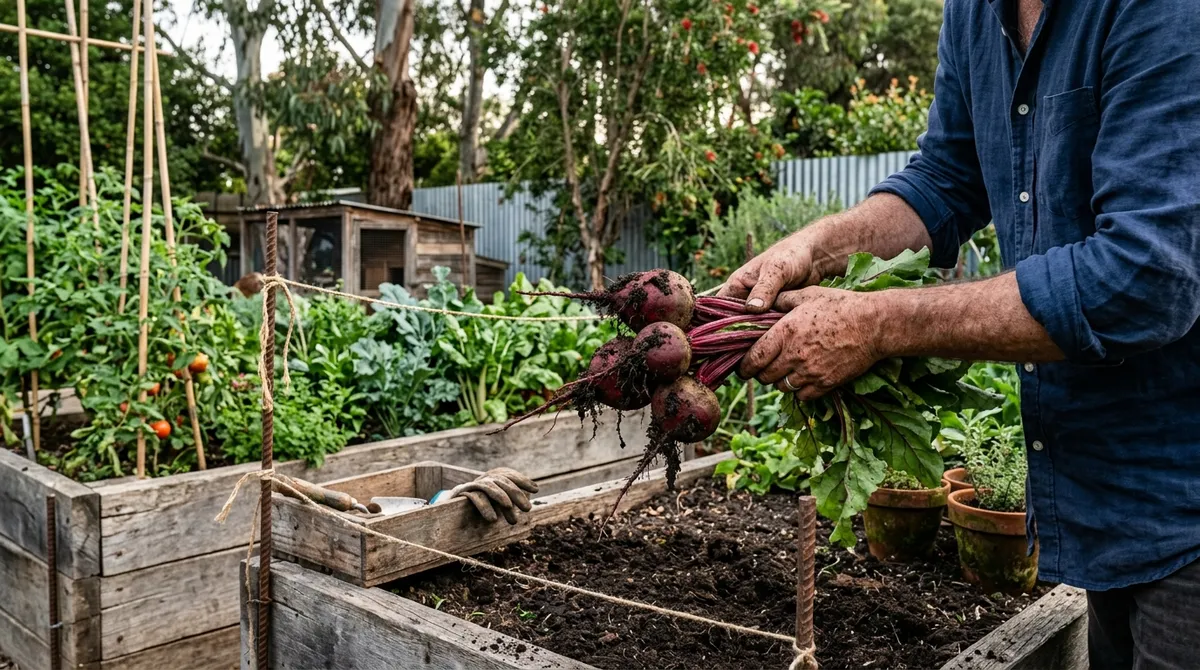
In the Gulf South gardeners sow beets from September to February, most of the cool season, while the rest of zone 8 gets two shorter windows. Texas sows in February and in September and October, the Mid-South in February and March and in August and September, the Mid-Atlantic from February to April and from July to October, and the Pacific Northwest from February to April and from July to September.
Zone 8 beets planting months by region
| Planting region | Share of zone 8 | Sow beets | Last frost, zone 8 ZIP codes | First frost, zone 8 ZIP codes |
|---|---|---|---|---|
| Mid-South Warm temperate | 36 percent | February and March, then August and September | March 27 | November 7 |
| Gulf South Humid subtropical | 21 percent | September to February | March 19 | November 11 |
| Texas Hot summers, spring and fall seasons | 19 percent | February, then September and October | March 16 | November 14 |
| Mid-Atlantic Humid subtropical, four seasons | 9 percent | February to April, then July to October | March 30 | November 12 |
| Pacific Northwest Maritime, mild wet winters and cool summers | 8 percent | February to April, then July to September | April 7 | November 3 |
Other regions (7 percent of the zone): Southern Plains, Northern California & Central Valley, Desert Southwest, Mountain West, Southern California.
How we built this table: we placed all 6,809 zone 8 ZIP codes (2023 USDA map) in our planting regions; the months are each region's own calendar and the frost dates are NOAA 1991 to 2020 medians for the zone's ZIP codes there.
Beets prefer the cool end of a warm zone
Beets take a light frost in stride and germinate in cool soil, but they dislike heat, because roots grown in warm weather turn woody and show pale rings. That sets the calendar. In Texas and the Gulf South, where the typical last frost comes near March 16 and March 19, a fall sowing grows into cool weather and gives the sweetest roots, while a spring sowing has to finish within about 65 days, our figure, before the days warm. The typical first frost is November 14 in Texas, so a fall row has a long runway.
Sandy, acid southern soils bring a problem the north rarely sees, which is boron deficiency. Beets show it first, as dark, corky spots inside the root or cracked skin. A soil test tells you whether boron is short, and a very light dusting of borax, measured exactly because too much harms plants, corrects it. Cercospora leaf spot is the other southern complaint, so water at the base and leave 4 inches (10 cm) between plants, our spacing, so air moves through the leaves. Detroit Dark Red and Ruby Queen are dependable across the South, and Chioggia adds candy stripes.
The Mid-South has a typical last frost near March 27 and about 226 frost-free days, room for both a spring and a fall run, and fall roots can stay in the ground well into winter under straw. Western Washington and Oregon are slow starters, with a typical last frost near April 7 and seed that sits in cold, wet soil, so warm the bed under clear plastic first. Leaf miners and slugs attack seedlings there, and a floating cover keeps both off. Trim the tops to an inch when you lift the roots, and the beets will store in damp sand.
Zone 8 beets questions
Do beets grow through winter in zone 8?
On the Gulf and in Texas they can. Sown in the fall run, they keep sizing slowly in mild weather and stand light freezes, and you pull them as you need them. In the Mid-South and the Northwest a thick straw mulch holds the roots a few weeks longer, but a hard freeze eventually ends them.
Why do my beet seedlings come up in clumps?
Each wrinkled beet seed is a cluster that holds several seeds, so one seed gives a tuft of seedlings. Thin to 4 inches (10 cm), our spacing, when the tops are a few inches tall, snipping the extras with scissors rather than pulling, which disturbs the roots left behind.
Growing advice follows published guidance from Texas A&M AgriLife Extension, University of Georgia Extension and Oregon State University Extension, beet guidance.
Keep planning
- How to grow beets: the full guide
- Beets planting calendar for every region
- Zone 8a planting calendar and zone 8b planting calendar
- All USDA zones and the Frost Lookup by ZIP code
- When to plant beets in zone 7
- When to plant broccoli in zone 8
- When to plant cabbage in zone 8
- When to plant carrots in zone 8
- When to plant sweet corn in zone 8
- When to plant cucumbers in zone 8
- When to plant lettuce in zone 8
- When to plant onions in zone 8