
When to Harvest Garlic
Updated November 2026
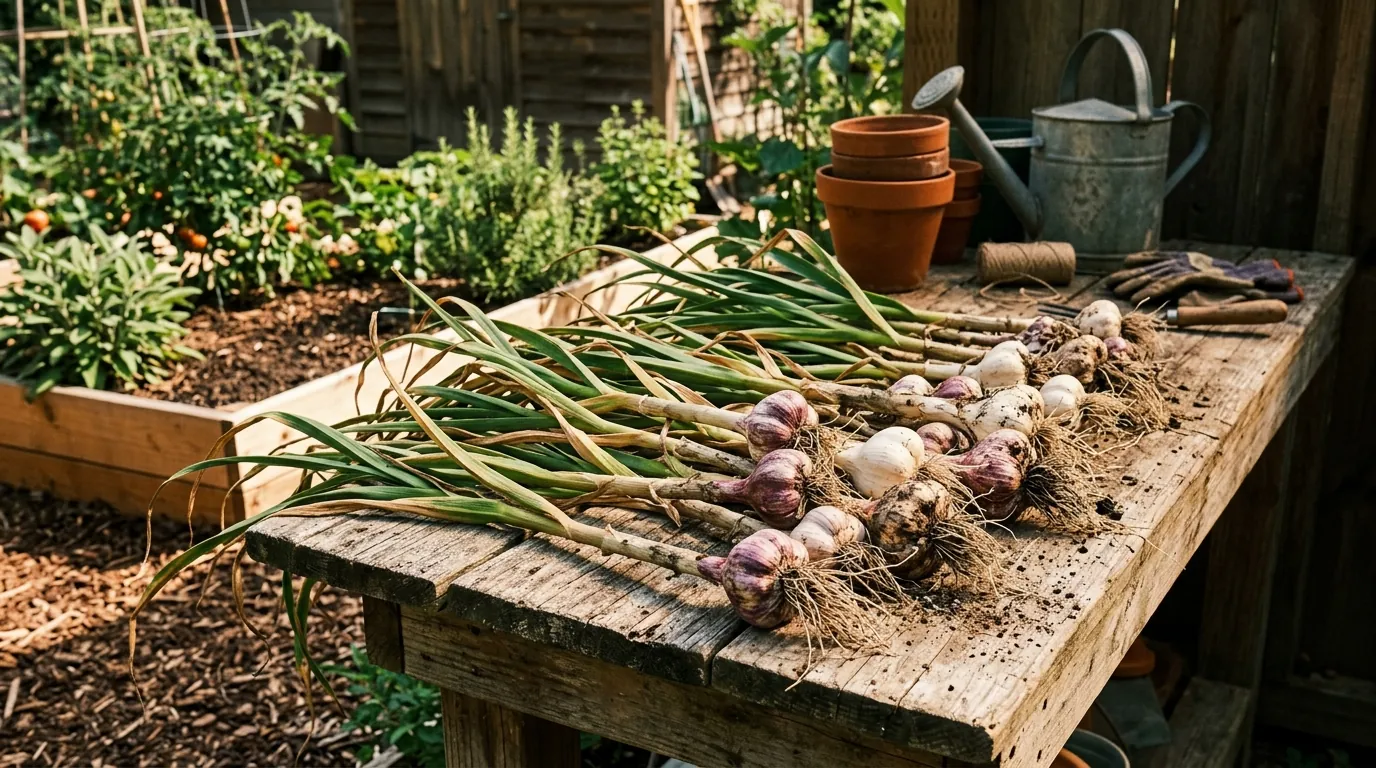
Garlic planted in fall is ready the following summer, usually late June to late July in cold-winter regions and earlier in the South. The plant gives the real signal. Lift the bulbs when the lower leaves have turned brown and half, or a little more than half, of the leaves are still green. University of Minnesota Extension and University of Illinois Extension give that same leaf rule. Each leaf is one wrapper around the bulb, so waiting until the whole plant is dead costs you storage life.
This page covers how to read the plant, when to start checking in each region, what to do if you lift early or late, and how to cure and store the bulbs week by week. If you have not planted yet, start with how to plant and grow garlic.
How to tell when garlic is ready
Harvest by the leaves, not the calendar. A cool spring pushes the date back and a hot one pulls it forward. Work through these checks in order.
| Check | What you see | What to do |
|---|---|---|
| Leaf count | The lower leaves are brown and dry, and half or slightly more than half of the leaves are still green (University of Minnesota Extension) | Start digging test bulbs. |
| Test bulb | Dig one or two bulbs. The bulb is plump, the cloves fill the skin and the wrappers are tight and papery | Lift the bed within a week or two. |
| Scapes (hardneck) | If you left a few scapes on, they straighten and point up when it is time to harvest (South Dakota State University Extension) | Lift soon. |
| Too early | Small bulb, thin wrappers and loose cloves | Wait a week or two and test again. |
| Too late | Every leaf is brown, the wrappers are splitting and the cloves are separating | Lift today. Late bulbs rarely keep. |
Stop watering about two weeks before harvest, which is the advice from the Minnesota, South Dakota State and Illinois extension services, so the bulbs firm up and the soil is dry enough to fork out cleanly. Leaf rust can brown the leaves early in a humid spring, which makes the leaf count unreliable, so rely on a test bulb in a rusty year.
When to start checking, by region
The planting months below are the app data months for each region. The start-checking window is the planting date plus about seven months, which is the 210 days of growth in our plant data. That is the earliest you should look, not a deadline. Winter slows garlic, so in cold regions the real harvest comes later: Minnesota gives late June to late July, South Dakota State gives mid-June through the end of July, and UConn gives mid to late July for Connecticut.
| Region | Plant cloves | Start checking from |
|---|---|---|
| North Florida | September to February | April onward, depending on planting date |
| Central Florida | September to February | April onward, depending on planting date |
| South Florida | October to January | May onward, depending on planting date |
| Gulf South | September to February | April onward, depending on planting date |
| Desert Southwest | October to November | May to June |
| Texas | January and October to November | May to June for fall planting, about August for January planting |
| Southern California | January to February and September to November | April to June for fall planting, about August for winter planting |
| Mid-South | October to November | May to June |
| Pacific Northwest | October to November | May to June |
| Northeast & New England | October | May, with most lifting in July |
| Mid-Atlantic | October to November | May to June |
| Midwest & Great Lakes | October | May, with most lifting in late June to July |
| Upper Midwest & Northern Plains | September to October | April to May, with most lifting in late June to July |
| Mountain West | September to October | April to May, with most lifting in July |
| Southern Plains | October to November | May to June |
| Northern California & Central Valley | October to November | May to June |
| Hawaii | October to November | May to June |
| Alaska | September | April onward, though growth is slow, so expect a late summer harvest |
In Florida and the Gulf South, the University of Florida says to harvest when about half of the leaves have dried and bent toward the ground, so the leaf signs apply in the South as well.
How to lift garlic
- Choose a dry spell, so the soil falls away from the bulbs.
- Loosen the soil with a garden fork a few inches out from the row. Do not pull a bulb up by its stem, because the neck can snap or bruise.
- Keep the stems, leaves and roots attached.
- Brush off loose soil. Do not wash the bulbs.
- Move the plants into the shade straight away, because strong sun on fresh bulbs can scald them.
Curing garlic, week by week
Curing dries the wrappers and seals the neck so the bulbs can keep. Extension services give two to four weeks.
| When | What to do | How you know it is working |
|---|---|---|
| Day 1 | Tie the plants in loose bundles and hang them, or lay them in a single layer on a screen, in a dry, airy, shaded place such as a porch, barn or garage. | The leaves begin to wilt. |
| Week 1 to 2 | Keep the bulbs out of rain and direct sun, with air moving on all sides. | The outer wrappers dry and turn papery. |
| Week 3 to 4 | Cut a stem and check the neck. | The neck is completely dry and tight and the roots are brittle. If it is still soft, wait another week. |
| When cured | Brush off dry soil, trim the roots to a fraction of an inch and cut the stems to about an inch, or leave softneck stems long to braid. | The bulb is firm and the cloves do not squeeze under your thumb. |
Humid weather slows curing in the Southeast, so allow extra time and use a fan in a closed space.
Storing garlic
Keep cured bulbs in a cool, dry, airy place in a mesh bag, basket or braid, out of direct light. Do not store garlic in the refrigerator or in a plastic bag. University of Illinois Extension gives about six to eight months for properly cured softneck garlic and about three to four months for hardneck, so use the hardneck first. Our plant page gives a cautious up to three months for a bag in a warm kitchen, so check the bulbs every few weeks and use any that soften.
Keep your biggest, healthiest bulbs as seed for fall planting, and freeze any peeled surplus. Our guide to freezing the harvest has the method.
Hardneck scapes
Hardneck garlic sends up a curling flower stalk, called a scape, in late spring. Snap it off once it makes a loop or two so the plant puts its energy into the bulb, and use it in a stir-fry or pesto. Softneck garlic does not reliably make scapes. If you leave a couple on, they straighten when the bulbs are close to ready.
Related pages
- How to plant and grow garlic
- Garlic plant page with regional planting dates
- Garlic in containers
- What to plant with garlic
- White rot
- Rust
Questions
When do you harvest garlic?
In cold-winter regions, garlic planted in fall is usually ready from late June to late July. Minnesota gives late June to late July, South Dakota State gives mid-June through July and Connecticut mid to late July. In the South it is ready earlier, in spring or early summer.
How do you know when garlic is ready to harvest?
Lift when the lower leaves are brown and half, or slightly more than half, of the leaves are still green. Confirm by digging one bulb, which should be plump with cloves that fill the skin.
What happens if you harvest garlic too early or too late?
Garlic lifted too early gives small bulbs with thin wrappers that do not keep. Garlic left too long loses its wrappers, the cloves begin to separate and the bulb stores poorly.
How long does garlic take to cure?
Plan on two to four weeks in a dry, airy, shaded place. The garlic is cured when the neck is completely dry and tight and the wrappers are papery.
How long does garlic keep?
According to University of Illinois Extension, properly cured softneck garlic keeps about six to eight months and hardneck about three to four months. Keep it cool, dry and airy, not in the refrigerator.
Should I cut the scapes off garlic?
Yes, on hardneck types, once the scape has made a loop or two. Removing it sends energy to the bulb, and you can eat the scape.
Can I leave garlic in the ground?
Not for long. Once the leaves die back, the wrappers begin to break down and the cloves can split or sprout. Lift on time and cure the bulbs out of the ground.
Sources
- University of Minnesota Extension, Growing garlic in home gardens
- South Dakota State University Extension, Garlic: How to grow it
- UConn Extension, Garlic cultivation in Connecticut
- University of Illinois Extension, Garlic
- UF/IFAS Gardening Solutions, Garlic
See also: How long garlic takes to grow.